The best 60-gallon air compressor for a pro shop is a two-stage, cast-iron, 175 PSI machine that makes about 14 to 15 CFM at 90 PSI. That is enough air for two technicians using impact wrenches and ratchets all day. It is not enough for a body shop that sands for hours. Knowing which shop you are is the whole game.
This guide is written for people who earn money with air. You will learn how to add up your shop’s real air demand, why two-stage pumps suit paid work, which current 60-gallon models are worth a look, and how to set up power, piping and dry air so the compressor is never the reason a job runs late.
Every figure comes from a current Amazon listing, a federal rule or simple arithmetic that we show. We have not tested these compressors ourselves.
60-gallon shop compressors at a glance
One tank size, very different machines
Specs come from each model’s current Amazon listing, checked in October 2026. Delivered air at 90 PSI ranges from under 8 CFM to over 14 CFM in the same 60-gallon size.
Quick answer
For a one or two-bay repair shop, buy a 5 HP two-stage 60-gallon compressor that delivers about 14 CFM at 90 PSI, such as the Ingersoll Rand 2340L5-V or the DEWALT DXCMV5076055. If someone sands, grinds or paints for long stretches, 60 gallons and 5 HP will fall behind, so step up to a 7.5 HP, 80-gallon machine. If noise or oil-free air matters more than volume, look at the California Air Tools 60-gallon models. Always size by delivered CFM at 90 PSI, never by horsepower or tank size.
How we put this guide together
We have not tested these compressors. Specifications come from each product’s current Amazon listing, written by the maker or seller. Tool air use comes from the typical figures in our own CFM guide. Safety rules are quoted from OSHA standards. The tank arithmetic is ours and we show the working. We do not show prices or star ratings because they change daily.
In this guide
- What Makes a 60-Gallon Compressor “Pro Shop” Grade?
- Step 1: Add Up Your Shop’s Air Demand
- Step 2: Understand What the Tank Really Does
- Six 60-Gallon Compressors Compared
- The Four Best 60-Gallon Picks for Pro Shops
- Power: What Your Shop Needs to Run One
- Shop Air Layout: Piping, Drops and Dry Air
- Installing a 60-Gallon Compressor in a Working Shop
- Maintenance in a Working Shop
- Common Mistakes Pro Shops Make (and the Fix)
- Pro Tips From the Spec Sheets
- Real-Life Scenarios: Which Shop Are You?
- 60-Gallon Air Compressors for Pro Shops: FAQ
- Your Pro-Shop Compressor Checklist
What Makes a 60-Gallon Compressor “Pro Shop” Grade?
Two compressors can share a 60-gallon tank and still be very different tools. One is built for a home garage that runs an impact wrench on Saturdays. The other is built to run all day, five or six days a week, with a customer waiting.
Here is what separates them.
| Feature | Typical home-garage unit | Pro-shop unit | Why it matters in paid work |
|---|---|---|---|
| Pump design | Single-stage | Two-stage with an intercooler | Cooler running and more air per horsepower |
| Maximum pressure | 125 to 155 PSI | 175 PSI | The same tank stores far more usable air |
| Duty cycle | Often 50 to 75 percent | Often rated for continuous duty | The pump can keep running when the shop is busy |
| Pump material | Cast iron or aluminum | Cast iron, oil-lubricated | Longer life and easier rebuilds |
| Tank | ASME on better models | ASME-certified | Required for a pressure vessel in a workplace |
| Service parts | Sometimes hard to find | Valve, gasket and filter kits sold for years | A rebuild beats a replacement |
Duty cycle is the one buyers skip most. A pump with a 50 percent duty cycle needs as much rest as work. In a busy shop that rest never comes, so the pump overheats and wears out early. A pump rated for 100 percent continuous duty can run for as long as the shop needs air.
Two-stage does not mean two cylinders. Many single-stage pumps have two cylinders doing the same job side by side. A two-stage pump squeezes the air once, cools it, then squeezes it again. Our single-stage vs two-stage comparison explains the difference in detail.
Key insight: in a pro shop the compressor is not a tool. It is a utility, like electricity. You notice it only when it fails, so buy the one that is built to keep running.
Step 1: Add Up Your Shop’s Air Demand
Do this before you look at a single model. It takes ten minutes and it stops you from buying the wrong machine.
Every air tool has an air use figure in CFM at 90 PSI. CFM means cubic feet per minute. You will find it in the tool’s manual or on its label. If you cannot find it, use the typical figures below.
| Tool | Typical CFM at 90 PSI | How it is used |
|---|---|---|
| Blow gun | 2.5 to 3 | Short bursts |
| Air ratchet, 3/8 inch | 3 to 5 | Bursts |
| Impact wrench, 1/2 inch | 4 to 5 | Bursts |
| Die grinder | 4 to 6 | Often continuous |
| Cut-off tool | 4 to 8 | Often continuous |
| Impact wrench, 3/4 inch | 7 to 9 | Bursts |
| Dual-action sander | 11 to 13 | Continuous |
| HVLP spray gun | 10 to 14 | Continuous |
| Abrasive blaster | 10 to 20 or more | Continuous |
Now follow these steps.
- Count the people, not the tools. A technician can only hold one tool at a time. Two technicians means two tools running at most.
- Pick the hungriest tool each person is likely to use. For a mechanic that is usually an impact wrench or a die grinder. For a body technician it is a sander or a spray gun.
- Add those figures together. This is the air your shop can ask for at one moment.
- Add 30 percent for headroom. It covers leaks, worn tools and the day you hire one more person.
- Compare the total with delivered CFM at 90 PSI on the compressor listing. Ignore horsepower and tank size at this stage.
Three worked examples
These are examples to show the method. Your own tools may differ.
| Shop | Tools running together | Sum | Plus 30 percent | Does a 5 HP, 60-gallon two-stage fit? |
|---|---|---|---|---|
| Two-bay repair shop | 1/2 inch impact (5) and air ratchet (5) | 10 CFM | 13 CFM | Yes. About 14 CFM covers it |
| Three-bay repair shop | Impact (5), ratchet (5) and die grinder (6) | 16 CFM | 21 CFM | No. Look at 7.5 HP and 80 gallons |
| Small body shop | Dual-action sander (13) and impact (5) | 18 CFM | 23 CFM | No. Look at 7.5 HP and 80 gallons |
The pattern is honest and useful. A 5 HP, 60-gallon compressor is a two-technician machine for mechanical work. Add a third person or a sander that runs all morning, and you have outgrown it.
Want to check your own numbers? Use our free Compressor Output Calculator, or read air compressor CFM explained for the full method.
Tip: size for the worst ten minutes
Think about the busiest ten minutes of your week, such as two cars on lifts with wheels coming off at the same time. If the compressor keeps up then, it will keep up always.
Step 2: Understand What the Tank Really Does
The pump makes the air. The tank only stores it. A big tank helps with short bursts, but it cannot fix a pump that is too small.
Pressure matters more than most people think. A tank at 175 PSI holds much more *usable* air than the same tank at 135 PSI. Usable air is what you can take out before the pressure drops to the 90 PSI your tools need.
Here is the arithmetic. A 60-gallon tank has a volume of about 8 cubic feet. The usable free air is that volume, multiplied by the pressure drop, divided by normal air pressure of 14.7 PSI.
| Tank full pressure | Pressure you can use above 90 PSI | Usable free air | What it means |
|---|---|---|---|
| 125 PSI | 35 PSI | About 19 cubic feet | Typical oil-free 60-gallon unit |
| 135 PSI | 45 PSI | About 25 cubic feet | Typical single-stage unit |
| 175 PSI | 85 PSI | About 46 cubic feet | Two-stage unit |
So a 175 PSI tank gives you almost twice the reserve of a 135 PSI tank of the same size.
A real-world example. Say your shop suddenly asks for 20 CFM and your pump makes 14 CFM. You are short by 6 CFM. With 46 cubic feet in reserve, a 175 PSI tank covers that gap for about seven and a half minutes. A 135 PSI tank covers it for about four minutes. That extra time is often the difference between finishing the job and standing around waiting.
Why this matters for burst tools
Impact wrenches and ratchets use air in short bursts. A high-pressure tank soaks up those bursts, so the pump can catch up in the gaps. Sanders and spray guns never give the pump a gap. For them, only delivered CFM counts.
Six 60-Gallon Compressors Compared
These six models all had an active listing and an Add to Cart button on Amazon when we checked in October 2026. The air figures are the ones each listing gives.
| Model | Pump type | Delivered air, as listed | Max pressure | Motor | Stand-out feature |
|---|---|---|---|---|---|
| Ingersoll Rand 2340L5-V | Two-stage, cast iron | 14.3 CFM at 90 PSI | 175 PSI | 5 HP, 230 V single phase | Listed for 100% continuous duty |
| DEWALT DXCMV5076055 | Two-stage, belt drive, oil-lubed | 15.3 SCFM at 100 PSI, 13.5 at 175 PSI | 175 PSI | 5 HP, 230 V | Thermal overload protection |
| DEWALT DXCM603 | Single-stage, belt drive, oil-lubed | 14.6 CFM at 90 PSI | 175 PSI | 5 HP, 208 to 230 V | 2-year pump warranty |
| Campbell Hausfeld XC602100 | Two-stage, cast iron | 7.6 SCFM at 90 PSI | 175 PSI | 3.7 running HP, 230 V | 3-year limited warranty |
| California Air Tools 60040CAD | Oil-free, twin motors | 10.6 CFM at 90 PSI | 125 PSI | 4.0 HP, 220 V | 75 dB and an automatic drain |
| California Air Tools 60050SCR | Oil-free scroll | 13.0 CFM at 90 PSI | Not clear on the listing | 5.0 HP, 230 V | 77 dB, continuous running |
Three things stand out.
- “Two-stage” alone does not mean high output. The Campbell Hausfeld is a two-stage machine with a 175 PSI tank, yet it lists 7.6 SCFM at 90 PSI. That is about half of what the 5 HP units make.
- The two 5 HP two-stage models are close. The Ingersoll Rand lists 14.3 CFM at 90 PSI. The DEWALT lists 15.3 SCFM at 100 PSI. Either one fits the two-bay shop in our example.
- Quiet has a cost. The oil-free California Air Tools units are far quieter on paper, but they give less air or less pressure than the cast-iron machines.
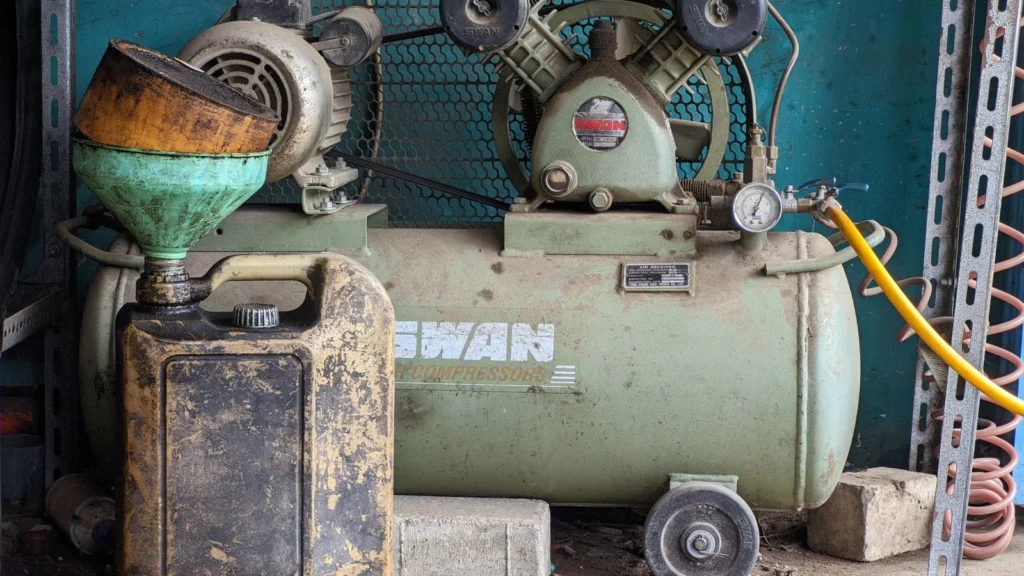
The Four Best 60-Gallon Picks for Pro Shops
Each pick below suits a different kind of shop. “Best” here is our judgment from the published specs, not from testing.
Best overall for a repair shop
Ingersoll Rand 2340L5-V 5 HP Type 30 Two-Stage Air Compressor (60 Gallon)
A classic shop compressor with a cast-iron two-stage pump. The listing says it is built for 100% continuous duty, which is exactly what paid work needs.
- Delivered airUp to 14.3 CFM at 90 PSI
- Max pressure175 PSI
- Motor5 HP, 230 V single phase
- Tank60 gallon, vertical
- Weight430 lb
- Warranty on listing1 year
- Why it works: two-stage compression with a cast-iron pump runs cooler, so it can keep going through a full shift.
- Who it is best for: one and two-bay auto, truck and fleet shops that live on impact wrenches, ratchets and grinders.
- What it solves: downtime. Individually cast cylinders, an overhung crankshaft and a one-piece connecting rod are there to make service simpler.
- Handy to know: Ingersoll Rand’s own description names auto service, body shops, fleet maintenance and machine shops as its intended users.
- Keep in mind: it weighs 430 pounds and the listing showed a wait of one to two weeks. The Amazon listing gives a noise level of 85 dB, so plan where it will sit.
As an Amazon Associate we earn from qualifying purchases. Specs come from the Amazon listing, checked October 2026.
Best value two-stage
DEWALT 60-Gallon Two-Stage Stationary Air Compressor (DXCMV5076055)
A 5 HP two-stage, belt-driven, oil-lubricated compressor with a 175 PSI tank. On paper it matches the output of the big-name shop machines.
- Delivered air15.3 SCFM at 100 PSI
- Air at full pressure13.5 SCFM at 175 PSI
- Max pressure175 PSI
- Motor5 HP, 230 V
- PumpTwo-stage, belt drive, oil-lubed
- Stock when checkedIn stock
- Why it works: it still lists 13.5 SCFM at 175 PSI, so it keeps filling the tank quickly even near full pressure.
- Who it is best for: new shops and serious home shops that want two-stage performance without waiting for a freight order.
- What it solves: recovery time. More air at high pressure means the tank refills faster after a hard pull.
- Handy to know: the motor has thermal overload protection, which shuts it down before heat can damage it.
- Keep in mind: the listing does not state a duty cycle or a pump life in hours. Ask the seller if you plan to run it for hours without a break. We would not rely on the 65 dB noise figure on the listing, since it is far below what belt-driven piston compressors normally make.
As an Amazon Associate we earn from qualifying purchases. Specs come from the Amazon listing, checked October 2026.
Best for a one-person shop
Campbell Hausfeld 60-Gallon 2-Stage Air Compressor, 175 PSI (XC602100)
A lighter two-stage machine with a cast-iron pump and a 175 PSI ASME tank. It gives less air than the 5 HP units but carries a longer warranty.
- Delivered air7.6 SCFM at 90 PSI
- Air at full pressure6.9 SCFM at 175 PSI
- Max pressure175 PSI
- Motor3.7 running HP, 230 V
- Footprint23 x 23 inches
- Warranty on listing3-year limited
- Why it works: the 175 PSI tank holds a big reserve, so one technician using burst tools rarely waits for air.
- Who it is best for: a solo mechanic, a tire and brake bay, or a mobile repairer’s home base.
- What it solves: floor space and weight. It needs a 23 by 23 inch footprint and weighs 255 pounds, far less than the 5 HP machines.
- Handy to know: the maker rates the pump for up to 10,000 hours, based on the bearing life rating.
- Keep in mind: 7.6 SCFM will not feed a dual-action sander or two busy technicians. Buy it for one person and burst tools only.
As an Amazon Associate we earn from qualifying purchases. Specs come from the Amazon listing, checked October 2026.
Best quiet and oil-free
California Air Tools CAT-60040CAD 4.0 HP Ultra Quiet Oil-Free Air Compressor (60 Gallon)
An oil-free compressor with twin slow-running motors and a factory-fitted automatic drain. It trades top-end output for low noise and clean air.
- Delivered air10.6 CFM at 90 PSI
- Air at 40 PSI12.8 CFM
- Max pressure125 PSI
- Noise75 dB
- MotorsTwin 2.0 HP at 1,680 RPM, 220 V
- Weight213 lb
- Why it works: two motors turning at only 1,680 RPM make less noise and wear than one fast pump.
- Who it is best for: detail shops, small woodworking shops and service counters where the compressor shares the room with customers.
- What it solves: two daily chores. There is no pump oil to change, and the EZ-1 automatic drain valve empties the tank on a timer.
- Handy to know: the tank is a 60-gallon ASME steel tank, and the listing gives a current draw of 14 amps.
- Keep in mind: 125 PSI stores less usable air than a 175 PSI tank, and the pump life is listed at over 3,000 hours, well below the cast-iron machines. Only three were in stock when we checked.
As an Amazon Associate we earn from qualifying purchases. Specs come from the Amazon listing, checked October 2026.
Two more 60-gallon models worth a look: the DEWALT DXCM603, a single-stage 5 HP unit that lists 14.6 CFM at 90 PSI, and the California Air Tools 60050SCR, an oil-free scroll compressor that lists 13.0 CFM at 90 PSI at 77 dB and is described as able to run continuously.
When 60 gallons is not enough
If your sum in Step 1 came out above 15 CFM, do not stretch a 60-gallon machine. Step up.
- Same pump, bigger tank: the Ingersoll Rand 2340N5-V puts the 5 HP, 14.3 CFM pump on an 80-gallon tank for a larger reserve.
- More air: the Ingersoll Rand 2475N7.5 is a 7.5 HP, 80-gallon two-stage machine that lists up to 24.3 CFM at 90 PSI.
- Three-phase power: the Campbell Hausfeld CE7051 is a 5 HP, 80-gallon three-phase unit that lists 17.2 CFM at 90 PSI. Ingersoll Rand also sells a three-phase version of the 2340L5-V.
Power: What Your Shop Needs to Run One
Every compressor in this guide needs a 220 to 240-volt supply. None of them plugs into a normal wall outlet.
| Question | What to check | Why it matters |
|---|---|---|
| Single phase or three phase? | Your building’s service | Most small shops have single phase. A three-phase motor will not run on it |
| What does the motor draw? | The nameplate, in amps | The listings give 14 A for the California Air Tools 60040CAD and 22 A at 230 V for the 60050SCR |
| Is there a dedicated circuit? | A breaker that feeds only the compressor | A shared circuit trips when a lift or welder starts |
| Plug or hard-wired? | The manual | Many stationary units are wired straight to a disconnect switch |
| Who does the work? | A licensed electrician | The wire and breaker must be sized from the nameplate and local code |
Do not guess the breaker size from horsepower. Two “5 HP” motors can draw different currents. The number that counts is the full-load amps on the motor nameplate. Give that to your electrician.
If your building has three-phase power, ask your electrician whether a three-phase compressor makes sense. If you only have single phase, buy a single-phase model and move on. A three-phase motor will not run on a single-phase supply without extra equipment.
A stationary compressor is a wiring job
Have a licensed electrician install the circuit and disconnect. A motor fed through wire that is too thin runs hot and starts poorly. Get it right once.
Shop Air Layout: Piping, Drops and Dry Air
A good compressor feeding bad piping gives bad air. Water, pressure drop and leaks all begin after the tank.
Lay the pipe out the right way
- Use a flexible connection at the tank. A short hose between the tank and the hard pipe keeps vibration away from the fittings.
- Run a main line around the shop. A loop that feeds each drop from two directions keeps pressure more even than a single dead-end run.
- Slope the main line slightly toward a drain point, so water runs to one place instead of sitting in the pipe.
- Take each drop off the top of the main line. Water stays in the bottom of the pipe and does not run down to your tool.
- Put a drain leg at the bottom of each drop, below the outlet, to catch any water that gets that far.
- Fit a filter and regulator at each work point, so every technician sets their own pressure.
Do not use ordinary PVC water pipe for compressed air. Use pipe or tubing that is sold and rated for compressed air.
Get the water out
Compressing air squeezes water out of it. That water rusts tanks, washes the oil out of tools and ruins paint. Deal with it in stages.
| Part | What it does | Example | Listing details |
|---|---|---|---|
| Automatic tank drain | Empties tank water on a timer | Ingersoll Rand EDV200 Electronic Drain Valve | 1/4 inch NPT, 110/120 V, adjustable timer |
| Filter and regulator | Removes water and dirt, sets tool pressure | DEWALT 3/4 inch Filter and Regulator | 5-micron filter, regulates up to 150 PSI |
| Refrigerated dryer | Chills the air so water drops out | Schulz 35 CFM Refrigerated Air Dryer | 115 V, 41 °F dew point at 100 PSI, needs a pre-filter |
| Piping kit | Carries air to each bay | Maxline M7500 3/4 inch x 100 ft Kit | Rated 200 PSI at 73 °F and 160 PSI at 140 °F |
| Hose reel | Keeps hose off the floor | Milton 2760-50D Hose Reel | 3/8 inch x 50 ft rubber hose, 300 PSI max |
Here are the links for those five examples: Ingersoll Rand EDV200 Electronic Drain Valve, DEWALT 3/4 inch Filter and Regulator, Schulz 35 CFM Refrigerated Air Dryer, Maxline M7500 3/4 inch x 100 ft Kit, Milton 2760-50D Hose Reel.
A mechanical shop can usually manage with an automatic drain and good filters. If you paint or blast, add a refrigerated dryer. It takes out far more water than a filter can.
One caution on the piping kit. Its 200 PSI rating is at 73 °F, and it falls to 160 PSI at 140 °F. A two-stage compressor fills its tank to 175 PSI, so fit a regulator before the tubing and keep the tubing away from the hot discharge pipe. Check the maker’s instructions for your layout.
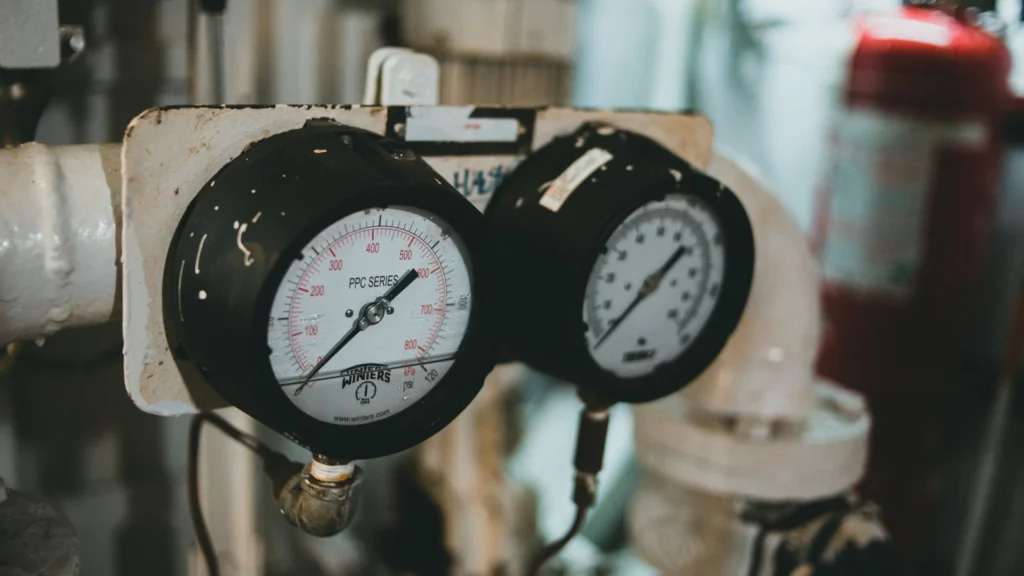
Installing a 60-Gallon Compressor in a Working Shop
These machines weigh between about 210 and 430 pounds. Plan the move before the truck arrives.
- Choose the spot. Pick a cool, dry, level place with space around the pump for cooling air. Keep it away from sanding dust, because the pump breathes whatever is in the room.
- Plan the delivery. Ask how it ships and whether the truck has a lift gate. Have a pallet jack or enough helpers ready.
- Mount it as the manual says. Most makers want the tank on a level concrete floor with vibration pads under the feet. Follow the manual for bolting it down.
- Have the electrician connect it to its own circuit with a disconnect you can reach.
- Check the oil before the first start. Do not assume an oil-lubricated pump arrives filled. The manual tells you the type and the level.
- Follow the break-in steps in the manual, then pump the tank up and check every joint with soapy water.
Two federal safety rules every shop should know
If you have employees, OSHA rules apply to your air system. Two are worth knowing by heart.
- Air receivers. OSHA standard 29 CFR 1910.169 requires a drain valve at the lowest point of the tank, a pressure gauge, and one or more spring-loaded safety valves. It also says safety valves must be tested at regular intervals.
- Cleaning with air. OSHA standard 29 CFR 1910.242(b) says compressed air must not be used for cleaning unless it is reduced to less than 30 PSI, with chip guarding and protective equipment. Fit safety blow guns and say so in your shop rules.
Never weld, drill or patch a tank. A tank with rust pits inside is finished. Our equipment safety guide covers the basics for the rest of the shop.
Maintenance in a Working Shop
A shop compressor runs many more hours than a home unit, so its upkeep must be a routine and not a memory.
| When | Task | Why |
|---|---|---|
| Every day | Drain the tank, or check that the automatic drain is working | Water rusts the tank from the inside |
| Every week | Check the pump oil level and look for leaks | Low oil destroys a pump quickly |
| Every month | Clean the intake filter, check belt tension, pull the safety valve ring | Dust and a slipping belt both cost you air |
| At the manual’s interval | Change the pump oil | Hot oil breaks down |
| Every year | Inspect the tank, check valve and wiring | Small faults are cheap to fix early |
Oil life depends on the oil. Ingersoll Rand’s listing for its 7.5 HP shop compressor says its All Season Select synthetic lubricant gives 2,000 hours of service between changes, which it describes as four times longer than petroleum-based lubricants. Use the oil your maker names, and keep a log on the wall beside the compressor.
Our air compressor maintenance guide has the full schedule, and the free Maintenance Interval Generator will build a checklist for you.
Common Mistakes Pro Shops Make (and the Fix)
Pro Tips From the Spec Sheets
- Read the duty cycle before the price. A pump listed for continuous duty is built for shop hours.
- Look for a pump life in hours. The listings in this guide range from over 3,000 hours to more than 15,000 hours.
- Check what “CFM” was measured at. Some listings quote 90 PSI, others 100 PSI or 175 PSI.
- Set regulators at the drop, not the tank. Keep the tank at full pressure for reserve and give each tool only what it needs.
- Fix leaks every month. A compressor that starts by itself overnight is paying to fill a leak.
- Buy the service kit with the compressor. A spare belt, filter and oil on the shelf turn a lost day into a short pause.
- Keep an hour log. It makes oil changes automatic and gives you a record if you ever need one.
Real-Life Scenarios: Which Shop Are You?
These are typical situations that shop owners describe in forums and reviews. They are examples to help you choose, not quotes from real people.
🚗 The two-bay repair shop
Two technicians do brakes, suspension and tires all day with impact wrenches and ratchets.
You need about 13 CFM with headroom and a pump that can run all shift.
Best fit: Ingersoll Rand 2340L5-V or DEWALT DXCMV5076055
🧽 The detail and tint studio
Customers wait in the same room. Air is used for blow-off and light tools.
You need low noise and clean, oil-free air more than high volume.
Best fit: California Air Tools 60040CAD
🎨 The small body shop
One person sands for an hour at a time while another removes panels.
You need over 20 CFM, which no 5 HP, 60-gallon machine makes.
Best fit: a 7.5 HP, 80-gallon two-stage and a refrigerated dryer
60-Gallon Air Compressors for Pro Shops: FAQ
Is a 60-gallon air compressor big enough for a professional shop?
It is big enough for a one or two-technician mechanical shop if the pump is a 5 HP two-stage that delivers about 14 CFM at 90 PSI. It is too small for continuous sanding, blasting or three busy technicians.
How many CFM does a 60-gallon compressor make?
It depends on the pump, not the tank. The current 60-gallon listings we checked range from 7.6 SCFM to 14.6 CFM at 90 PSI.
Do I need a two-stage compressor for an auto repair shop?
For daily paid work, a two-stage pump is the usual choice. It runs cooler, is often rated for continuous duty and fills the tank to 175 PSI, which stores almost twice the usable air of a 135 PSI tank.
Can a 60-gallon compressor run on single-phase power?
Yes. All six 60-gallon models in this guide run on a 220 to 240-volt supply, and the two-stage Ingersoll Rand 2340L5-V is listed as single phase. Three-phase versions exist for shops that have that service.
Should a pro shop buy a 60-gallon or an 80-gallon compressor?
Choose by air demand. If your tools need under about 14 CFM with headroom, 60 gallons works. Above that, an 80-gallon tank with a 7.5 HP pump is the better match.
Do I need an air dryer in my shop?
A mechanical repair shop can often manage with an automatic tank drain and filters. A shop that paints or blasts should add a refrigerated dryer, because water in the air line ruins finishes.
Your Pro-Shop Compressor Checklist
- Count how many people use air at the same time.
- Add up their tools in CFM at 90 PSI and add 30 percent.
- Confirm whether your building has single-phase or three-phase power.
- Choose a two-stage, cast-iron pump for daily paid work.
- Compare delivered CFM at the same pressure.
- Check the duty cycle, pump life and warranty on the listing.
- Plan the delivery, the floor space and the cooling air.
- Book a licensed electrician for a dedicated circuit.
- Plan the piping with drops taken off the top of the main line.
- Add an automatic drain, filters and a dryer if you paint.
- Fit safety blow guns and test the safety valve on a schedule.
- Start a maintenance log on day one.
The bottom line
For most one and two-bay repair shops, a 5 HP two-stage 60-gallon compressor that delivers about 14 CFM at 90 PSI is the right machine. The Ingersoll Rand 2340L5-V is listed for 100% continuous duty and is our top pick on published specs. If your numbers come out above 15 CFM, skip the 60-gallon class and buy an 80-gallon, 7.5 HP unit.
As an Amazon Associate we earn from qualifying purchases.
Sources: Current Amazon listings for the Ingersoll Rand, DEWALT, Campbell Hausfeld, California Air Tools, Schulz, Maxline and Milton products named in this guide; OSHA standards 29 CFR 1910.169 (air receivers) and 29 CFR 1910.242(b) (compressed air used for cleaning); typical tool air-use figures from our own CFM guide. All checked October 2026.