A Generac portable generator can keep the important parts of your home running through an outage, and you do not need the biggest one to do it. The hard part is choosing. Generac sells small quiet inverters, mid-size open-frame models and big tri-fuel machines, and the names all look alike.
Here is the short version. For most homes, a 5,500 to 6,500 running watt Generac covers the essentials: fridge, freezer, furnace fan, sump pump, lights and internet. If you want a well pump, a second air conditioner or the option to run on natural gas, step up to the 9,500-watt tri-fuel model. If quiet and clean power matter most, look at the dual-fuel inverter.
In this guide you will learn how to size a Generac portable for your house, what really changes when you switch from gasoline to propane or natural gas, how to connect it safely, and which four current models are worth your money. Every spec comes from a live product listing, not from memory.
Generac portables for home backup
Four sizes cover almost every house
Figures come from current Amazon listings for each model, checked in October 2026.
Quick answer
The best Generac portable generator for most homes is a 5,500 to 6,500 running watt model such as the GP6500E, which is listed at 6,500 running and 8,125 starting watts with electric start and CO shutdown. Choose the GP5500E EFI if you want fuel injection and less carburetor trouble, the GP9500E TF if you want natural gas or propane and more power, and the iQ5200 DF inverter if quiet operation and clean power for electronics matter most.
How we put this guide together
We have not tested these generators ourselves. The specs come from each model’s current Amazon listing and from Generac retailer spec sheets, checked in October 2026. Typical appliance wattages come from the same data that powers our Generator Size Calculator. We do not show prices or star ratings, because both change constantly.
In this guide
- Why Look at Generac for Home Backup?
- The Current Generac Portable Lineup at a Glance
- What Size Generac Portable Do You Need?
- Gasoline, Propane or Natural Gas?
- The Best Generac Portable Generators for Home Use
- How to Connect a Generac Portable to Your House
- Running It Safely at Home
- Fuel, Run Time and Storage
- Portable or Standby: Which Generac Is Right for You?
- Common Mistakes With Portable Generators at Home (and the Fix)
- Pro Tips for Home Backup With a Portable
- Real-Life Scenarios: Which One Fits You?
- Generac Portable Generators for Home Use: FAQ
- Your Home Backup Checklist
Why Look at Generac for Home Backup?
Generac is best known for the permanent standby generators you see bolted down beside houses. Its portable line is the same idea at a smaller scale: power you wheel out when the grid goes down.
Three features show up again and again in the current portable listings, and all three matter at home:
- COsense carbon monoxide protection. A built-in sensor watches for dangerous CO levels. On most models the listing says it shuts the generator down automatically.
- Electric start. A rocker switch or button and an included battery, so anyone in the family can start it.
- PowerRush starting boost. The GP listings describe 40% more starting capacity, which helps with motors such as well pumps and refrigerators.
Newer models add two more things worth knowing about: electronic fuel injection (EFI), which removes the carburetor, and multi-fuel operation, which lets one machine run on gasoline, propane or even your home’s natural gas.
Key insight: the right generator is not the biggest one. It is the smallest one that starts your largest motor and still carries everything else on your list.
The Current Generac Portable Lineup at a Glance
These are the four models this guide focuses on. Between them they cover nearly every home backup plan.
| Feature | GP5500E EFI | GP6500E | GP9500E TF | iQ5200 DF |
|---|---|---|---|---|
| Type | Open frame | Open frame | Open frame, tri-fuel | Enclosed inverter, dual fuel |
| Running watts (gasoline) | 5,500 | 6,500 | 9,500 | 3,900 |
| Starting watts (gasoline) | 6,875 | 8,125 | 12,500 | 5,200 |
| Fuels | Gasoline | Gasoline | Gasoline, propane, natural gas | Gasoline, propane |
| Fuel system | Fuel injection | Not listed | Fuel injection | Not listed |
| Starting | Electric | Electric | Electric with recoil backup | Push-button electric |
| 240-volt outlet | Yes, 30 A (L14-30R) | Not stated on listing | Yes, 30 A and 50 A | No, 120 V only |
| CO protection | COsense | COsense, auto shutdown | COsense, auto shutdown | COsense, auto shutdown |
| Run time at half load | About 10 to 11 hours | Up to 10.5 hours | Up to 10.5 hours | Up to 9 hours |
| Listed weight | 163 lb | 182 lb | 227 lb | 107 lb |
| Emissions note on listing | 50-state | 49-state | 50-state | 50-state |
Generac also lists smaller inverter models at 2,500 and 3,300 watts, a 3,800-watt dual-fuel inverter, and larger gasoline and dual-fuel open-frame models. They follow the same pattern, so once you understand these four you can judge the rest.
What Size Generac Portable Do You Need?
Sizing is simple math. You do it once, on paper, on a calm day. Then you never have to guess in the dark.
- List what must run at the same time. Be honest. Outage life is fridge, freezer, heat, water, lights and internet, not the whole house.
- Add up the running watts. Use the label on each appliance, or the typical figures in the table below.
- Find the biggest motor. Note its starting watts. Motors need a short burst of extra power to get going.
- Add them together. Running watts for everything, plus the extra starting watts for the biggest motor, is the number your generator must cover.
- Leave some headroom. Aim to run at about three quarters of the running rating, not flat out.
| Appliance | Running watts | Starting watts |
|---|---|---|
| Refrigerator or freezer | 700 | 2,200 |
| Chest freezer | 500 | 1,500 |
| Sump pump, 1/3 hp | 800 | 1,300 |
| Well pump, 1/2 hp | 1,000 | 2,100 |
| Gas furnace blower, 1/2 hp | 800 | 2,350 |
| Lights, several rooms | 300 | 300 |
| TV, router and chargers | 300 | 300 |
| Window air conditioner, 10,000 BTU | 1,200 | 3,600 |
Try a typical list: refrigerator, chest freezer, furnace blower, sump pump, lights and the TV and router. That adds up to 3,400 running watts. The biggest starting demand is the furnace blower, which needs about 1,550 watts more than it uses while running. So the generator must cover roughly 4,950 watts for a moment.
A 5,500-watt model handles that with room to spare. Add a well pump and a window air conditioner and you are at 5,600 running watts, which is where the GP6500E earns its place. Want exact numbers for your own home? Use our free Generator Size Calculator or read What Size Generator Do I Need?
Tip: start big loads one at a time
Start the generator with nothing connected. Switch on the biggest motor first, let the engine settle, then add the next load. Staggering your loads like this lets a smaller generator do the work of a bigger one.
Gasoline, Propane or Natural Gas?
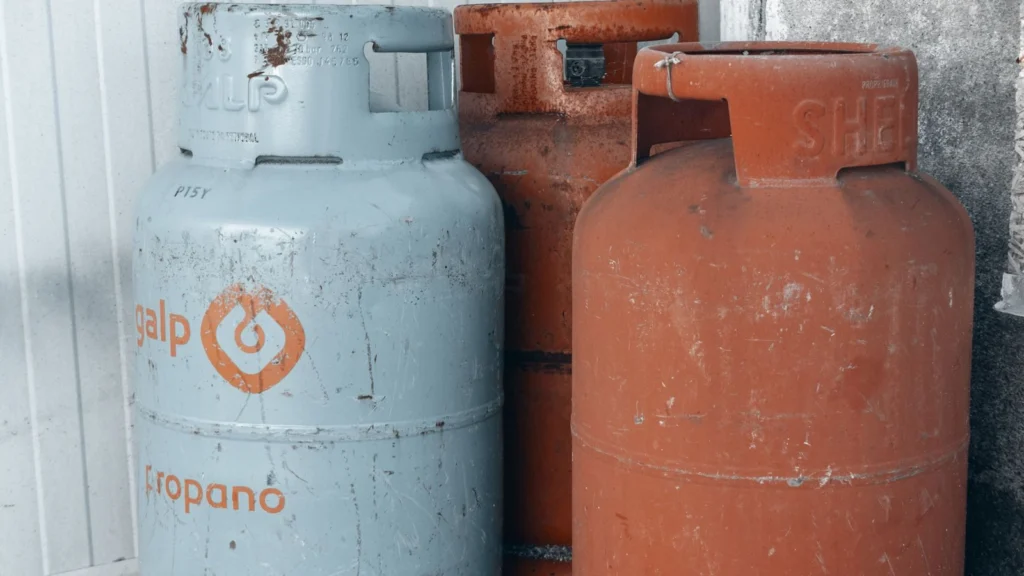
A lot of people search for a Generac propane portable generator, and for good reason. Fuel is the part of an outage plan that fails most often. Here is what each fuel really means.
Gasoline
Gasoline gives you the most power from the same engine. It is also the fussiest fuel. It goes stale in storage, it gums up carburetors, and gas stations cannot pump when their own power is out. If you rely on gasoline, rotate your cans and treat the fuel. Our guide on how long gasoline lasts explains the details.
Propane
Propane does not go stale. A tank you filled years ago works like one you filled yesterday, and that is its superpower for emergency use. The trade-off is power. On the GP9500E TF, the listing shows 9,500 running watts on gasoline but 8,550 running watts on propane. The same listing says a standard 20-pound tank runs the generator for up to 6 hours at a quarter load, so plan on larger tanks or several small ones.
Natural gas
Natural gas is the “never refuel” option. The generator connects to your home’s gas supply, so there are no cans and no tanks to swap. Output drops further: the GP9500E TF is listed at 7,000 running watts on natural gas. You will also need a gas connection point installed by a qualified professional.
| Fuel | Running watts | Best thing about it | Watch out for |
|---|---|---|---|
| Gasoline | 9,500 | Most power | Goes stale, hard to buy in a wide outage |
| Propane | 8,550 | Stores for years | Less power, tanks empty quickly at high load |
| Natural gas | 7,000 | No refueling | Lowest power, needs a gas connection |
The iQ5200 DF inverter is the exception to the rule. Its listing gives the same 3,900 running and 5,200 starting watts on gasoline or propane. For a deeper look at multi-fuel machines, read our guide to dual-fuel generators.
The Best Generac Portable Generators for Home Use
Here are our four picks, each matched to a different kind of household.
Best all-rounder for most homes
Generac GP6500E Portable Generator (6,500 Running Watts)
This is the sweet spot for home backup. It has enough running power for the essentials plus a well pump or a window air conditioner, and a strong starting surge for stubborn motors.
- Running watts6,500 W
- Starting watts8,125 W
- StartElectric, battery included
- Run timeUp to 10.5 hours at 50% load
- SafetyCOsense with automatic shutdown
- Weight182 lb
- Why it works: PowerRush is listed as giving 40% more starting capacity, so motors that stall smaller generators get the push they need.
- Who it is best for: households that want to cover the fridge, freezer, heat, sump pump and lights, with room for one or two extras.
- What it solves: fewer juggling acts. You can leave more things plugged in and stop worrying about which appliance may start next.
- Easy ownership: an hour meter for maintenance, low-oil shutdown and automatic idle control are all on the listing.
- Keep in mind: the listing marks it as 49-state compliant, so check the rules if you live in California. It is an open-frame generator, so it is not quiet.
As an Amazon Associate we earn from qualifying purchases. Specs come from the Amazon listing, checked October 2026.
Easiest to own
Generac GP5500E EFI Portable Generator (5,500 Running Watts)
Fuel injection is the headline here. There is no carburetor to gum up after months of storage, and that is the number one reason backup generators fail to start.
- Running watts5,500 W
- Starting watts6,875 W
- Engine298 cc OHV with EFI
- StartElectric, battery included
- 240-volt outlet120/240 V, 30 A (L14-30R)
- Run timeAbout 10 to 11 hours at 50% load
- Why it works: Generac says EFI improves fuel efficiency and cuts maintenance. For a machine that sits most of the year, that matters more than raw power.
- Who it is best for: people who want a generator that simply starts when the lights go out, without a yearly carburetor ritual.
- What it solves: hard starting after storage, plus it is listed as 50-state compliant.
- Keep in mind: 5,500 running watts covers the essentials but leaves less headroom than the GP6500E.
As an Amazon Associate we earn from qualifying purchases. Specs come from the Amazon listing and Generac retailer spec sheets, checked October 2026.
Best for big homes and natural gas
Generac GP9500E TF Tri-Fuel Generator (12,500 Starting Watts)
One machine, three fuels. It runs on gasoline, propane or natural gas, and the listing says a single dial switches fuel without shutting the generator down.
- Running watts9,500 W on gasoline
- On propane8,550 W running
- On natural gas7,000 W running
- Fuel systemFuel injection (EFI)
- Outlets120/240 V 50 A, 120/240 V 30 A, 120 V 20 A GFCI duplex
- Run timeUp to 10.5 hours at 50% load on gasoline
- Why it works: if gasoline runs short, you switch to propane or natural gas and keep going. That is real security in a long outage.
- Who it is best for: larger homes, homes with well pumps and central systems, and anyone with natural gas service.
- What it solves: the 50-amp outlet can feed a larger transfer switch, and electric start comes with a recoil backup in case the battery is flat.
- Keep in mind: at 227 pounds it is heavy, and it produces less power on propane and natural gas than on gasoline.
As an Amazon Associate we earn from qualifying purchases. Specs come from the Amazon listing, checked October 2026.
Quiet, clean-power pick
Generac iQ5200 DF Dual-Fuel Inverter Generator (3,900 Running Watts)
An enclosed inverter generator that runs on gasoline or propane. It makes less power than the open-frame models, but the power is cleaner and the machine is far easier to live next to.
- Running watts3,900 W
- Starting watts5,200 W
- FuelGasoline or propane
- Power qualityUnder 3% THD
- Run time on gasUp to 9 hours at 50% load
- Weight107 lb
- Why it works: inverter power with under 3% harmonic distortion is safe for laptops, TVs and medical devices, according to the listing.
- Who it is best for: smaller homes, apartments with a yard, and anyone with close neighbors.
- What it solves: noise and fuel worries. Economy mode stretches run time to as much as 15 hours at a quarter load, and propane never goes stale.
- Room to grow: it is parallel-ready. Two units with the optional kit are listed at up to 7,800 running watts.
- Keep in mind: it is 120 volts only. If you need 240 volts for a well pump or a transfer switch, choose one of the open-frame models.
As an Amazon Associate we earn from qualifying purchases. Specs come from the Amazon listing, checked October 2026.
Not sure whether you want an inverter or an open-frame model? Our comparison of inverter vs conventional generators walks through the trade-offs.
How to Connect a Generac Portable to Your House
There are two safe ways to use a portable generator at home, and one dangerous shortcut you must never take.
Option 1: extension cords
Run heavy-duty outdoor cords from the generator to each appliance. It is simple and needs no installation. It is also clumsy, and it cannot power hard-wired things such as a furnace or a well pump.
Option 2: a transfer switch or interlock
An electrician installs a power inlet box outside and a transfer switch or interlock kit at your panel. During an outage you plug one cord into the inlet, flip the switch, and your chosen circuits come alive. This is the right way to run a furnace, a well pump or anything hard-wired.
Match the plug to the generator. The 30-amp L14-30 outlet on the GP5500E EFI is the standard for mid-size setups. The GP9500E TF adds a 50-amp outlet for larger switches. The iQ5200 DF is 120 volts only, so it suits cords or a small 120-volt setup.
Never backfeed your house
Never plug a generator into a wall outlet or a dryer outlet to power your home. This is called backfeeding. It can send power back out to the utility lines and injure or kill the people working on them, and it can destroy your generator when grid power returns. Use a transfer switch or interlock installed by a qualified electrician. Our guide to connecting a generator to your house safely explains each option.
Running It Safely at Home
A built-in CO sensor is a backup, not a permission slip. Treat every portable generator the same way, no matter how smart it is.
- Outdoors only. Never in a garage, basement, shed or porch, even with the door open.
- Keep your distance. Safety agencies advise at least 20 feet from the house, with the exhaust pointing away from doors, windows and vents.
- Fit CO alarms indoors. Battery-powered alarms near bedrooms are cheap insurance.
- Keep it dry. Do not run it in rain or snow without a proper generator tent or cover made for the job.
- Refuel cold. Shut the engine off and let it cool before you add gasoline.
- Use outdoor-rated cords that are heavy enough for the load.
Our generator safety guide covers carbon monoxide, fuel, cords and placement in more depth.

Fuel, Run Time and Storage
Run time numbers on a listing are measured at a set load, usually half. Your real run time depends on what you plug in.
- GP6500E: up to 10.5 hours at 50% load.
- GP5500E EFI: about 10 to 11 hours at 50% load.
- GP9500E TF: up to 10.5 hours at 50% load, or 14 hours at 25% load, on its 7.5-gallon gasoline tank.
- iQ5200 DF: up to 9 hours at 50% load, or 15 hours at 25% load, on its 3.2-gallon tank.
For a three-day outage, plan your fuel before you need it. Our guide on how much gas a generator uses shows the math.
Storage is where most backup generators are ruined. Stale gasoline left in a carburetor is the classic reason a generator will not start when you need it. Treat stored fuel with a stabilizer such as STA-BIL Storage, run the generator for a few minutes every month, and follow the storage steps in your owner’s manual. Our guide on how to store a generator has a full checklist.
Portable or Standby: Which Generac Is Right for You?
Generac also makes permanent home standby generators. They start by themselves, run on your home’s natural gas or propane, and cost far more to buy and install. Here is the honest comparison.
| Question | Generac portable | Generac home standby |
|---|---|---|
| How does it start? | You wheel it out and start it | Starts automatically when the power fails |
| Typical size | 3,900 to 9,500 running watts in this guide | 10 kW to 28 kW |
| Fuel | Gasoline, with propane or natural gas on some models | Natural gas or propane |
| Installation | None, or an inlet box and transfer switch | Permanent, by a professional, with permits |
| Warranty on listing | 3-year limited | 5-year limited |
| Best for | Occasional outages and tighter budgets | Frequent or long outages, or anyone who cannot go outside to start a generator |
If outages are rare where you live, a portable is the sensible choice. If they are frequent, long, or dangerous for someone in your home, read our guides to portable vs standby generators and whole-house generators before you decide.
Common Mistakes With Portable Generators at Home (and the Fix)
Pro Tips for Home Backup With a Portable
These come from manufacturer guidance and from everyday generator practice.
- Do a rehearsal. Once a year, roll it out, start it and run your real essentials for an hour. You will find the missing cord on a sunny day instead of a stormy night.
- Label your circuits. If you use a transfer switch, mark which breakers the generator feeds.
- Keep the battery charged. Electric start is only convenient if the battery has power. Put it on a maintainer in storage.
- Store spare oil and a spark plug with the generator, along with the manual.
- Track hours. Use the hour meter and follow the maintenance schedule in the manual. Our generator maintenance checklist helps.
- Think about noise. Point the exhaust away from bedrooms and neighbors, and consider the inverter model if houses are close together.
- Plan your fuel. Decide in advance how many gallons or tanks you will keep, and where.
Real-Life Scenarios: Which One Fits You?
These are typical situations that homeowners describe in forums and reviews. They are examples to help you choose, not quotes from real people.
🏡 The suburban family
Outages are rare but can last a day or two. The list is fridge, freezer, furnace, sump pump, lights and Wi-Fi.
A mid-size open-frame model covers it all with room for a window air conditioner.
Best fit: GP6500E
🌾 The rural home on a well
A deep well pump, long outages and a natural gas line or big propane tank.
You need a strong starting surge and a fuel that will not run out or go stale.
Best fit: GP9500E TF
🏘️ The close-neighbors house
A small lot, light sleepers next door, and a home office full of electronics.
Quiet running and clean power matter more than raw watts.
Best fit: iQ5200 DF
Generac Portable Generators for Home Use: FAQ
What size Generac portable generator do I need to run my house?
Most homes can run the essentials, such as a refrigerator, freezer, furnace blower, sump pump, lights and internet, on 5,500 to 6,500 running watts. Add up your own running watts, then add the extra starting watts of your biggest motor. Larger homes with a well pump and several air conditioners usually need more, which is where a 9,500 running watt model fits.
Can a Generac portable generator run on propane?
Yes, some can. The Generac iQ5200 DF runs on gasoline or propane, and the GP9500E TF runs on gasoline, propane or natural gas. Expect less power on propane with the tri-fuel model: its listing shows 9,500 running watts on gasoline and 8,550 on propane.
Do Generac portable generators shut off for carbon monoxide?
The current models in this guide all list Generac's COsense technology. On the GP6500E, GP9500E TF and iQ5200 DF, the listings say it shuts the generator down automatically when CO reaches a dangerous level. You must still run any generator outdoors, far from the house.
Can I plug a Generac portable generator into my house?
Not into a wall outlet. The safe way is a power inlet box with a transfer switch or interlock kit, installed by a qualified electrician. The generator then connects with one cord, usually a 30-amp L14-30 or a 50-amp plug.
How long will a Generac portable generator run on a tank of gas?
It depends on the load. At half load, the listings give up to 10.5 hours for the GP6500E, about 10 to 11 hours for the GP5500E EFI, up to 10.5 hours for the GP9500E TF and up to 9 hours for the iQ5200 DF.
Is a portable generator enough, or do I need a standby generator?
A portable is enough for occasional outages if someone can set it up and refuel it. A standby generator makes more sense if outages are frequent or long, or if someone in the home depends on powered medical equipment and cannot wait for a manual start.
Your Home Backup Checklist
- Write down the appliances you must run in an outage.
- Add up the running watts and note your biggest motor’s starting watts.
- Pick the smallest Generac that covers that total with some headroom.
- Decide on your fuel: gasoline, propane or natural gas.
- Have an electrician fit an inlet box and transfer switch if you need hard-wired circuits.
- Choose a spot at least 20 feet from the house, and fit CO alarms indoors.
- Store treated fuel, spare oil and a spark plug with the generator.
- Do a practice run once a year with your real loads.
The bottom line
For most homes, the Generac GP6500E has the right mix of power, starting surge and safety features. Start there, then move up or down based on your own list of essentials.
As an Amazon Associate we earn from qualifying purchases.
Sources: Amazon product listings for the Generac GP5500E EFI (model 8150), GP6500E, GP9500E TF (model 8061) and iQ5200 DF (model 8947), plus Generac retailer spec sheets, all checked October 2026. Typical appliance wattages are from this site’s Generator Size Calculator.