Portable propane generators are almost always dual fuel generators: machines that run on gasoline or propane at the turn of a dial. Propane is the fuel that makes them shine in an emergency, because it can sit in a cylinder for years and still work on the day the power fails.
This guide is about the propane side. You will learn how long a cylinder really lasts, how much power you give up on propane, why cold weather matters, how to store and connect cylinders safely, and which current models are worth a look.
Every figure comes from a manufacturer’s website or a current Amazon listing. We have not tested these generators ourselves.
Portable propane generators at a glance
A fuel that never goes stale, with a little less power
Run times and wattages come from manufacturer websites and current Amazon listings, checked in October 2026.
Quick answer
A portable propane generator is usually a dual fuel model that also burns gasoline. On propane it makes roughly 10% less power, and a standard 20-pound cylinder runs a 3,500-watt class generator for about 10 hours at half load. Propane does not go stale, so it suits generators that sit for months between uses. Store cylinders outdoors and upright, use a larger cylinder for big generators or cold weather, and always run the generator outside.
How we put this guide together
We have not tested these generators. Wattages and run times on propane come from the makers’ own websites and from current Amazon listings for Champion, Generac, Westinghouse, WEN and Pulsar models. Cylinder capacities and gallons-per-hour figures are our own arithmetic, using conversion factors printed on a Kohler generator spec sheet. We do not show prices or star ratings.
In this guide
- What Is a Portable Propane Generator?
- Why Run a Generator on Propane?
- How Much Power Do You Lose on Propane?
- Cylinder Sizes and How Much They Hold
- How Long Will a Propane Cylinder Last?
- Why a Gallon of Propane Does Not Go as Far
- Propane in Cold Weather
- Connecting Propane Safely
- Four Portable Propane Generators to Look At
- Looking After Cylinders and the Generator
- Common Mistakes With Propane Generators (and the Fix)
- Pro Tips for Propane Users
- Real-Life Scenarios: Is Propane Right for You?
- Portable Propane Generators: FAQ
- Your Portable Propane Generator Checklist
What Is a Portable Propane Generator?
Portable generators that burn propane only are rare. In practice, “portable propane generator” means one of two things.
- A dual fuel generator, which runs on gasoline or propane.
- A tri fuel generator, which adds natural gas as a third choice.
Both use the same engine for every fuel. A selector dial or switch changes the fuel, and a hose with a regulator connects the propane cylinder. Many models let you start on propane straight out of the box, because the hose is included.
If you want the basics of how the two fuels share one engine, our guide to dual-fuel generators explains it. This article goes deeper into propane itself.
Why Run a Generator on Propane?
| Point | Propane | Gasoline |
|---|---|---|
| Shelf life | Does not go stale | Months, with stabilizer |
| Storage | Sealed steel cylinders, outdoors | Cans that vent fumes |
| Carburetor trouble after storage | Rare, propane leaves no gummy residue | Common with old fuel |
| Power from the same engine | About 10% lower | Full rated output |
| Run time per container | Shorter per cylinder on large generators | Longer per tank |
| Cold weather | Vaporizes more slowly as it gets colder | Unaffected in normal winter cold |
| Refueling | Swap a cylinder, with nothing to pour | Pour from a can, with the engine off and cool |
Key insight: propane is the fuel for a generator that waits. If yours sits in the garage for eleven months of the year, propane is what makes it start in month twelve.
That is the heart of the case. Gasoline gives more power and is sold everywhere, but it goes bad in storage. Propane gives a little less power and never goes bad.
How Much Power Do You Lose on Propane?
Every dual fuel generator has two sets of ratings. The listings below show the pattern.
| Model | Running watts on gasoline | Running watts on propane | Drop |
|---|---|---|---|
| WEN DF360iX inverter | 2,900 | 2,600 | 10% |
| Champion 4500-Watt Dual Fuel inverter | 3,500 | 3,150 | 10% |
| Westinghouse 4650 Dual Fuel | 3,600 | 3,240 | 10% |
| Westinghouse 6500 Dual Fuel | 5,300 | 4,800 | 9% |
| Champion 9375-Watt Dual Fuel | 7,500 | 6,750 | 10% |
| Champion 11,500-Watt Dual Fuel | 9,200 | 8,280 | 10% |
| Pulsar G12KBN | 9,500 | 8,550 | 10% |
| Generac iQ5200 Dual Fuel inverter | 3,900 | 3,900 | None |
Most models lose about a tenth of their running power. A few, such as the Generac iQ5200, list the same running watts on both fuels.
The rule that follows is simple. If propane is your emergency fuel, size the generator on its propane rating.
Cylinder Sizes and How Much They Hold
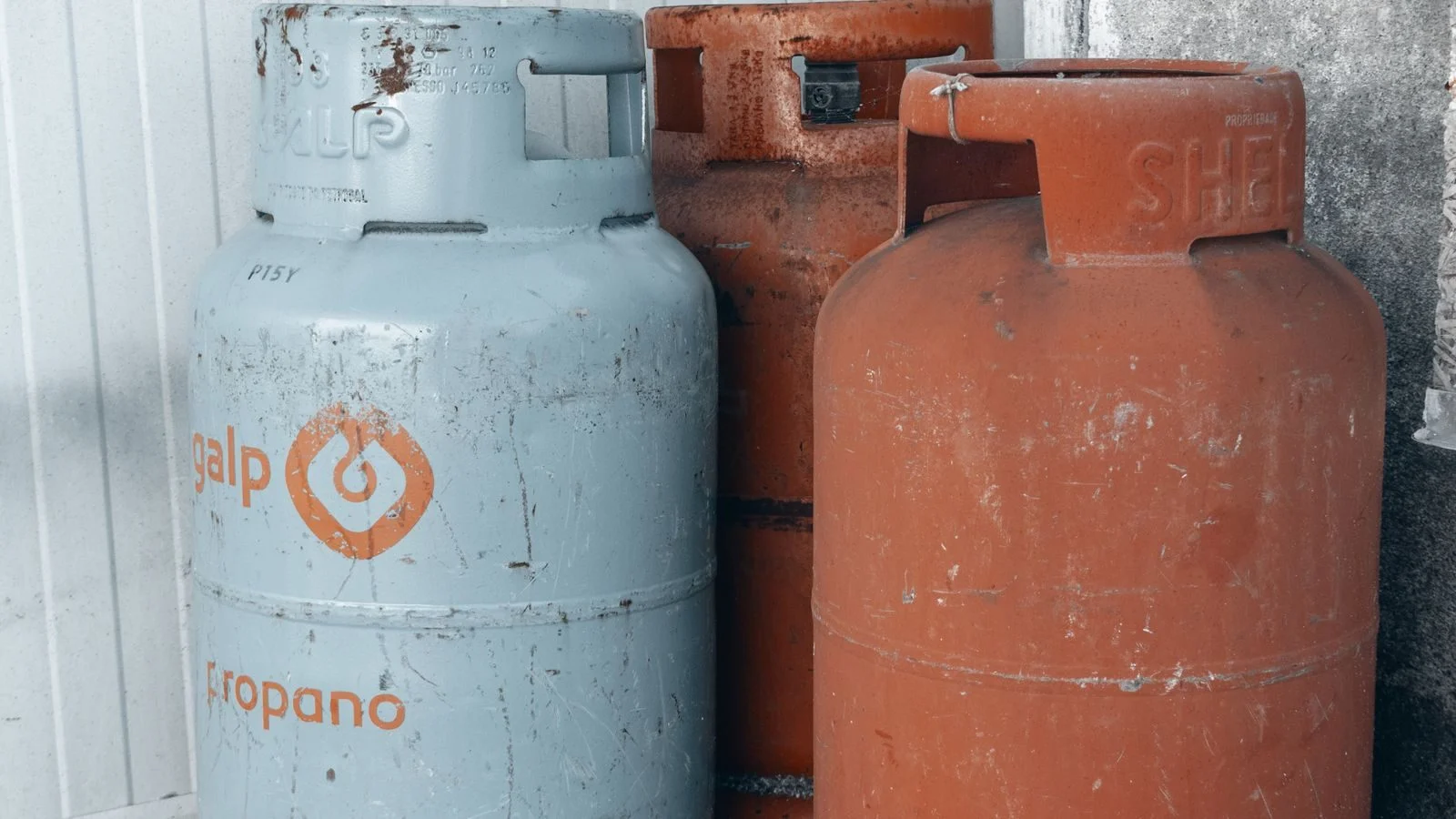
Propane cylinders are sold by the weight of fuel they hold. The conversion factors on a Kohler generator spec sheet work out to about 4.24 pounds for each gallon of liquid propane.
| Cylinder | Propane inside | Typical use |
|---|---|---|
| 20 lb | About 4.7 gallons | The standard barbecue cylinder |
| 30 lb | About 7.1 gallons | Common on RVs |
| 40 lb | About 9.4 gallons | Longer run times, still portable |
| 100 lb | About 23.6 gallons | A semi-permanent supply for home backup |
A 20-pound cylinder is easy to carry and easy to exchange, which is why most run-time claims use it.
How Long Will a Propane Cylinder Last?
Manufacturers publish run times on a 20-pound cylinder. Read the load carefully, because it changes everything.
| Model | Running watts on propane | Run time on a 20 lb cylinder | Load |
|---|---|---|---|
| Champion 4500-Watt Dual Fuel Open Frame Inverter | 3,285 | 21 hours | 25% |
| Champion 5500W Dual Fuel Inverter | 3,600 | 15 hours | 25% |
| Champion 4375-Watt Wireless Start Dual Fuel | 3,150 | 10.5 hours | 50% |
| Generac iQ5200 Dual Fuel inverter | 3,900 | 11 hours | 50% |
| Generac GP9500E Tri Fuel | 8,550 | 6 hours | 25% |
| Westinghouse 14500 Tri-Fuel | 10,500 | Up to 7 hours | Not stated |
Two lessons stand out.
- A quarter-load figure flatters the generator. Twenty-one hours at 25% load is nowhere near 21 hours with the air conditioner running.
- Big generators empty small cylinders fast. A 9,500-watt class machine can drain a barbecue cylinder in an afternoon.
A rough way to estimate your own
Take a 3,500-watt class generator that lists 10.5 hours on a 20-pound cylinder at half load.
- Divide the fuel by the hours. 4.7 gallons over 10.5 hours is about 0.45 gallons an hour.
- Multiply by the hours you plan to run each day. Eight hours a day is about 3.6 gallons.
- Convert to cylinders. That is roughly three quarters of a 20-pound cylinder a day.
- Plan for the outage you expect. Three days needs two to three cylinders, or one 40-pound cylinder and a spare.
This is our arithmetic and only a guide. Your real use depends on the load.
Why a Gallon of Propane Does Not Go as Far
People are often surprised that a generator runs for less time on a gallon of propane than on a gallon of gasoline. The reason is energy.
The conversion factors on Kohler’s spec sheet put a gallon of liquid propane at about 91,000 Btu. A gallon of gasoline holds roughly a quarter to a third more than that. So the engine has to burn more propane to do the same work.
That has two practical effects.
- Run time per gallon is shorter on propane. A 4.7-gallon gasoline tank outlasts a 4.7-gallon propane cylinder on the same generator.
- Cost per hour depends on local prices. Compare the price of a gallon of each fuel where you live, and remember that propane needs more gallons for the same job.
None of this cancels propane’s big advantage. A fuel that is slightly less efficient but always ready is worth more in an emergency than a stronger fuel that has gone stale.
Propane in Cold Weather
Propane is stored as a liquid and burned as a gas. It has to boil off inside the cylinder to feed the engine, and that happens more slowly as the cylinder gets colder.
Two things make the problem worse.
- A big generator on a small cylinder. The faster you draw gas, the faster the cylinder chills itself. You may see frost on the outside.
- A nearly empty cylinder. There is less liquid surface to boil from.
The signs are an engine that surges, loses power or stalls even though the cylinder still has fuel in it.
Tip: go bigger in winter
In cold weather, use the largest cylinder you can and keep it well filled. A 40-pound or 100-pound cylinder copes far better than a barbecue cylinder. Never warm a cylinder with a heater, a torch or hot water. If you need full power in deep cold, start and run on gasoline.
This is one of the best arguments for dual fuel. You are not forced to rely on propane on the one night it struggles.
Connecting Propane Safely
Most dual fuel generators ship with a propane hose and regulator. The steps are simple, and each one matters.
- Place the generator outdoors on level ground, at least 20 feet from the house.
- Stand the cylinder upright beside the generator, not on top of it and not in the exhaust path.
- Connect the hose to the generator’s propane inlet and to the cylinder. Tighten the fittings as your manual describes.
- Check for leaks. Brush soapy water on the connections and open the cylinder valve. Bubbles mean a leak.
- Set the fuel selector to propane and start the generator as the manual describes.
- To stop, follow the shutdown steps in your manual, and make sure the cylinder valve is closed when you finish.
Propane safety basics
Propane is heavier than air and collects in low places. Store and use cylinders outdoors only, upright, away from doors, windows, drains and anything that sparks. Never store a cylinder in a house, a basement or an attached garage. If you smell gas, shut the cylinder valve, move away and do not operate switches or flames nearby.
Four Portable Propane Generators to Look At
All four are dual fuel models with an active Amazon listing when we checked in October 2026. The propane figures are the ones that matter here.
Lightest pick
WEN DF360iX 3600-Watt Dual Fuel RV-Ready Portable Inverter Generator
A small, light dual fuel inverter. It suits camping and short outages, and it connects to propane with a tool-free quick-connector.
- On propane2,600 rated, 3,500 surge
- On gasoline2,900 rated, 3,600 surge
- TypeInverter
- RV outletTT-30R, 30 amps
- Weight49 lb
- Warranty3-year
- Why it works: at 49 pounds one person can carry it, and it makes clean power for phones, tablets and laptops.
- Who it is best for: campers and RV owners who already carry propane for cooking.
- What it solves: fuel hassle on the road. One fuel can serve the stove, the grill and the generator.
- Handy extras: a carbon monoxide shutdown sensor, a fuel shut-off, two USB ports and a 12-volt outlet.
- Keep in mind: 2,600 rated watts on propane limits what it can start. Check your air conditioner’s starting watts before you rely on it.
As an Amazon Associate we earn from qualifying purchases. Specs come from the Amazon listing, checked October 2026.
Best for RVs
Champion 4500-Watt Electric Start Dual Fuel Portable Inverter Generator
A quiet mid-size inverter with electric start. Its listing gives one of the longest propane run times of any model in this guide.
- On propane3,150 running watts
- On gasoline3,500 running, 4,500 starting
- Run time on propaneUp to 21 hours
- Noise61 dBA
- Weight99.2 lb
- Warranty3-year limited
- Why it works: an inverter engine slows down when demand is light, which stretches a 20-pound cylinder. Champion quotes inverter run times at 25% load.
- Who it is best for: RV owners who want to run one air conditioner and a few small loads.
- What it solves: noise at the campsite. At 61 dBA it is far quieter than an open-frame generator.
- Handy extras: CO Shield shutoff, a parallel-ready design and a meter for voltage, frequency and hours.
- Keep in mind: the long run time is at light load. Expect much less with an air conditioner running.
As an Amazon Associate we earn from qualifying purchases. Specs come from the Amazon listing, checked October 2026.
Home essentials
Westinghouse 6500 Watt Dual Fuel Home Backup Portable Generator
An open-frame dual fuel generator with a 120/240-volt selector switch and a 30-amp twist-lock outlet for a transfer switch.
- On propane4,800 running, 5,800 peak
- On gasoline5,300 running, 6,500 peak
- Engine274 cc OHV
- Fuel tank4.7 gallons
- Weight135.6 lb
- Warranty3-year limited
- Why it works: 4,800 running watts on propane covers a refrigerator, a freezer, a furnace blower and lights together.
- Who it is best for: homeowners who want to back up the essentials and keep propane as the long-life fuel.
- What it solves: 240-volt loads. The L14-30R outlet can feed a transfer switch.
- Handy extras: a propane hose and wheel kit in the box, plus low-oil and carbon monoxide shutdown.
- Keep in mind: at this size a 20-pound cylinder will not last long under load. Plan on a 40-pound cylinder or several spares.
As an Amazon Associate we earn from qualifying purchases. Specs come from the Amazon listing, checked October 2026.
Most power on propane
Champion 11,500-Watt Electric Start Dual Fuel Portable Generator
A large open-frame generator that keeps 8,280 running watts on propane. It is built for whole-home backup through a transfer switch.
- On propane8,280 running, 10,350 starting
- On gasoline9,200 running, 11,500 starting
- Engine459 cc
- StartElectric, battery included
- Weight209 lb
- Warranty3-year limited
- Why it works: it has enough propane output to run many household loads at once.
- Who it is best for: homeowners with a large propane cylinder or a home tank who want serious backup power.
- What it solves: stale fuel in a generator that may sit for a year between storms.
- Handy extras: CO Shield, Volt Guard and a meter for voltage, hertz and run-time hours.
- Keep in mind: a generator this size needs a large propane supply. A barbecue cylinder is only a stopgap, especially in cold weather.
As an Amazon Associate we earn from qualifying purchases. Specs come from the Amazon listing, checked October 2026.
Two more worth a look: the Generac iQ3800 Dual Fuel inverter, which lists 2,700 running watts on propane, and the Pulsar G12KBN, which lists 8,550.
Looking After Cylinders and the Generator
Propane is forgiving, but a few habits keep the whole system ready.
- Know how full a cylinder is. Weigh it. The empty weight is stamped on the collar as “TW”. The difference is your fuel.
- Check the date. Cylinders carry a manufacture date and must be requalified from time to time. A filling station will refuse one that is out of date.
- Refill or exchange. Refilling usually gives you a full cylinder. Exchange cages are quick and convenient. Either way, check the valve cap is fitted.
- Close the valve when you finish, and disconnect the hose for storage.
- Run the generator on propane now and then. A short monthly run keeps the regulator, hose and engine working.
- Do not forget the gasoline side. If you never use gasoline, keep the tank and carburetor empty so nothing goes stale. See how to store a generator.
The engine still needs normal care on either fuel: oil changes, a clean air filter and a good spark plug. Our generator maintenance checklist lists the routine.
Common Mistakes With Propane Generators (and the Fix)
Pro Tips for Propane Users
- Keep two cylinders, not one. When the first runs out at night, you swap and carry on.
- Buy a cylinder gauge or use a scale. Guessing by lifting is how people run out.
- Start on propane after long storage. It avoids any doubt about old gasoline.
- Use the propane you already have. An RV, a grill or a home tank may already give you a supply.
- Carry the hose with the generator. A propane generator without its hose is a gasoline generator.
- Think about a home tank. If you have a large propane tank for heating, ask your supplier about a connection point for a generator.
Real-Life Scenarios: Is Propane Right for You?
These are typical situations that buyers describe in forums and reviews. They are examples to help you choose, not quotes from real people.
⛈️ The once-a-year user
Your generator comes out for one or two storms a year and then sits.
You need a fuel that is still good after twelve months in storage.
Best fit: dual fuel, run mainly on propane
🚐 The RV traveler
Your rig already carries two propane cylinders for the stove and furnace.
You need a quiet inverter that can share that fuel.
Best fit: a dual fuel inverter such as the Champion 4500-Watt
❄️ The cold-climate homeowner
Winter outages are your main worry, and temperatures drop well below freezing.
You need propane for storage and gasoline as a fallback in deep cold.
Best fit: a dual fuel model with a large cylinder and fresh gasoline on hand
Portable Propane Generators: FAQ
How long will a generator run on a 20 lb propane tank?
It depends on the size and the load. Champion lists 10.5 hours at half load for its 3,500-watt class dual fuel generator. Generac lists 11 hours at half load for the iQ5200 inverter. A large 9,500-watt model may run only about 6 hours at a quarter load.
Do generators make less power on propane?
Usually, yes. Most dual fuel models in this guide list about 10% fewer running watts on propane than on gasoline. A few inverters list the same output on both fuels.
Is propane better than gasoline for a generator?
Propane is better for storage, because it does not go stale and leaves the carburetor clean. Gasoline gives more power and works in deep cold. A dual fuel generator lets you use whichever suits the day.
Can I run a portable generator from my home's propane tank?
Often, yes, with the right connection. Ask your propane supplier to fit a suitable outlet and regulator for a generator. Do not improvise your own connection to a home tank.
Does cold weather affect a propane generator?
Yes. Propane turns to gas more slowly as the cylinder gets colder, and a heavy load makes it worse. Use a larger, fuller cylinder in winter, and switch to gasoline if the engine starves.
Is it safe to store propane cylinders in a garage?
No. Propane cylinders should be stored outdoors, upright and away from ignition sources. Propane is heavier than air and can collect in low, enclosed spaces.
Your Portable Propane Generator Checklist
- Add up your loads and size the generator on its propane rating.
- Check the run time and the load it was measured at.
- Choose the cylinder size: 20, 30, 40 or 100 pounds.
- Keep at least one spare cylinder.
- Store cylinders outdoors and upright.
- Check the hose and fittings for leaks with soapy water.
- Plan for cold weather with a larger cylinder or gasoline.
- Keep the gasoline side empty or fresh.
- Run the generator outdoors, at least 20 feet from the house.
- Fit carbon monoxide alarms indoors.
The bottom line
Propane is the best fuel for a generator that waits. Buy a dual fuel model, size it on the propane rating, and keep enough cylinders outdoors for the outage you expect. For RVs and home essentials, the Champion 4500-Watt Dual Fuel inverter is a strong place to start.
As an Amazon Associate we earn from qualifying purchases.
Sources: Champion Power Equipment’s official website and Amazon listings; Generac’s official website and Amazon listings; Amazon listings for the Westinghouse, WEN and Pulsar models named in this guide; propane conversion factors from Kohler specification sheet G4-272. All checked October 2026.