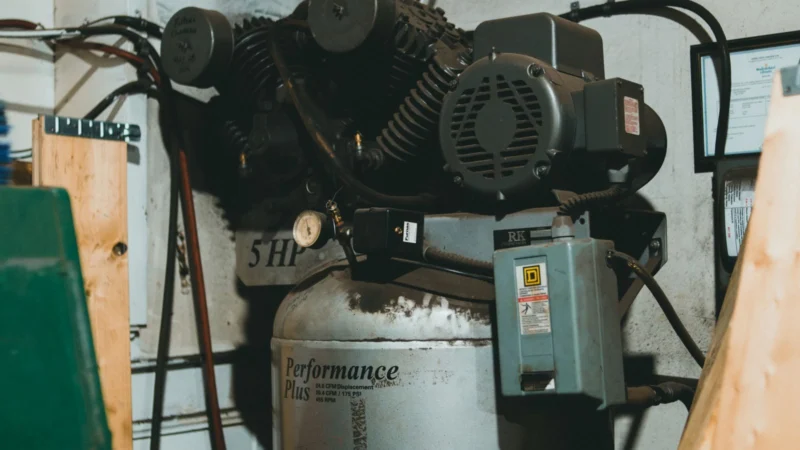
A 60-gallon vertical compressor is the point where air stops being a limitation. With a 240 V motor and a proper cast-iron pump, this class runs impact wrenches without a pause, keeps up with a grinder, and in two-stage form supports a sander or spray gun. It is also a permanent, heavy, wired-in piece of equipment, so it pays to choose carefully once.
Quick answer
For a serious home garage or light commercial use, a 60-gallon single-stage compressor delivering 10 to 13 CFM at 90 PSI on a 240 V circuit covers nearly everything except continuous sanding and blasting. For a professional shop, choose a 60- or 80-gallon two-stage model delivering 14 CFM or more at 90 PSI with a 175 PSI tank. Judge by delivered CFM at 90 PSI and the pump construction, not by horsepower.
In this guide
What a 60-gallon compressor gives you
- Air delivery of roughly 10 to 18 CFM at 90 PSI, depending on the pump, which is two to three times what a wheeled 20-gallon unit makes.
- Storage that lets burst tools run for long stretches between pump cycles.
- A vertical footprint of roughly two feet square, which fits in a corner.
- A real motor, typically 3 to 5 running horsepower on 240 V, with a belt-driven pump that runs slower, cooler and quieter than a direct-drive unit.
Single-stage or two-stage at 60 gallons
Both designs are sold at this size, and the difference matters more here than anywhere else. Our single-stage vs two-stage comparison explains the mechanics; in short:
60-gallon single-stage compressor
Best for: Impact wrenches, ratchets, grinders, occasional sanding and painting
- Delivered air
- Roughly 10 to 13 CFM at 90 PSI
- Maximum pressure
- About 135 to 155 PSI
- Motor
- 3 to 4 running HP, 240 V
- Pump
- Cast-iron, oil-lubricated, belt drive on better models
What we like
- Costs considerably less than a two-stage unit
- Runs every common mechanic's tool
- Big tank buffers burst tools well
What to consider
- Falls behind a dual-action sander or spray gun used continuously
- Lower duty cycle: pump runs hot if worked non-stop
Our take: The sensible choice for a home mechanic or small shop that does not sand or blast all day.
60- to 80-gallon two-stage compressor
Best for: Continuous tools: sanders, grinders, spray guns, blasting cabinets, several users
- Delivered air
- Roughly 14 to 18 CFM at 90 PSI for 5 HP class
- Maximum pressure
- 175 PSI
- Motor
- 5 running HP class, 240 V single-phase; larger units three-phase
- Pump
- Two-stage cast-iron with intercooler, belt drive
What we like
- Runs continuous tools without falling behind
- Cooler running and rated for long duty cycles
- 175 PSI tank stores more usable air
- Longer service life
What to consider
- Higher price
- Heavier; needs a dedicated 30 A or larger 240 V circuit
- More than most home garages need
Our take: If anyone sands, paints or blasts regularly, this is the class to buy once.
Specifications to check
Delivered CFM at 90 PSI
The only airflow figure that matters. Ignore CFM at 40 PSI and displacement figures. See air compressor CFM explained for sizing your tools against it.
Real motor size
Look at the nameplate amperage rather than the horsepower on the box. A genuine 5 HP motor on 240 V draws in the region of 20 to 25 amps. A “5 HP” compressor that plugs into an ordinary outlet is a 2 HP compressor with optimistic marketing.
Pump construction
Cast-iron cylinders, oil lubrication, a belt drive and a slow pump speed (under about 1,000 rpm for two-stage pumps) point to a long-lived unit. Direct-drive, oil-free pumps at this size are louder and wear faster.
Duty cycle
Stated as a percentage. A 100 percent duty cycle pump can run continuously; a 50 percent pump needs as much rest as it gets work. For continuous tools, this matters as much as CFM.
Noise
Belt-driven cast-iron pumps at low rpm typically run in the mid-70s to low-80s of decibels; direct-drive units are louder. If the compressor will live in an attached garage, consider a quiet-rated model or a small enclosure with ventilation.
Tank and drain
Look for an ASME-certified tank, a drain valve you can reach easily (or add an automatic drain), and a pressure relief valve. A tank that is awkward to drain does not get drained, and that is how tanks rust.
Installation
- Electrical. Nearly all 60-gallon compressors need a dedicated 240 V circuit; many are hard-wired rather than plugged in. Have an electrician size the circuit from the nameplate.
- Location. A cool, dry, ventilated spot on a level concrete floor, with clearance around the pump for cooling air and access to the drain and belt guard. Keep it out of the dustiest corner; the pump breathes that dust.
- Mounting. Bolt it down with vibration pads between the feet and the floor. A 60-gallon tank full of air that walks across the shop is dangerous.
- Air line. A flexible hose or loop between the tank and rigid piping absorbs vibration. Fit a filter and regulator, and a water separator or dryer if you paint.
- Delivery. These units weigh 200 to 400 pounds. Plan how it will get from the truck to its corner before it arrives.
Worth adding
- A filter-regulator-lubricator unit at the outlet.
- An automatic tank drain.
- A 3/8-inch hose reel and high-flow couplers.
- An hour meter if the compressor does not have one, so oil changes happen on time. Our compressor maintenance guide gives the schedule.
Alternatives
If you do not have 240 V available, a 30-gallon single-stage compressor on 120 V is the largest practical option and will run most intermittent tools. If you need more air than a 5 HP two-stage unit provides, the next step is a 7.5 or 10 HP unit on an 80- or 120-gallon tank, usually on three-phase power.
Frequently asked questions
Is a 60-gallon air compressor enough for a home garage?
It is more than enough for a home garage, and for most home mechanics it is the last compressor they buy. A 60-gallon single-stage unit runs impact wrenches, ratchets, grinders and blow guns without a pause and copes with occasional sanding or painting.
Do I need 240 V for a 60-gallon compressor?
In practice, yes. The motors in this class draw more than a 120 V circuit can supply. Expect to have a dedicated 240 V circuit installed, sized from the compressor's nameplate.
How loud is a 60-gallon compressor?
Belt-driven cast-iron units typically run around 75 to 85 decibels when the pump is cycling, similar to a lawn mower at a distance. Direct-drive oil-free units are louder. Placement in a separate room or an enclosure with ventilation makes a big difference.