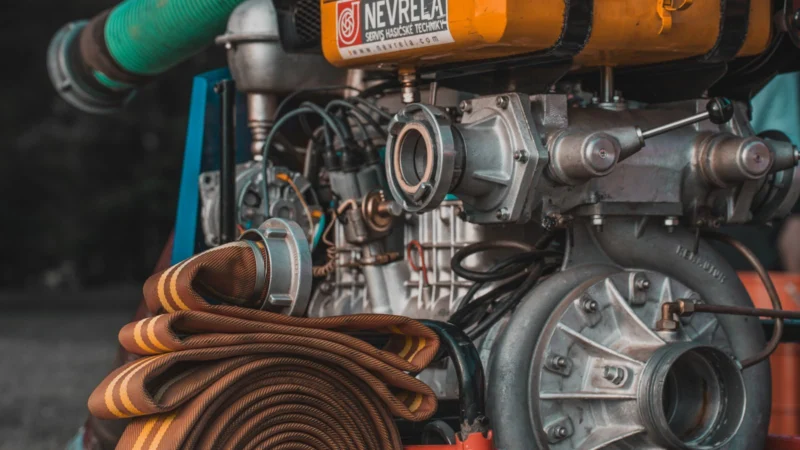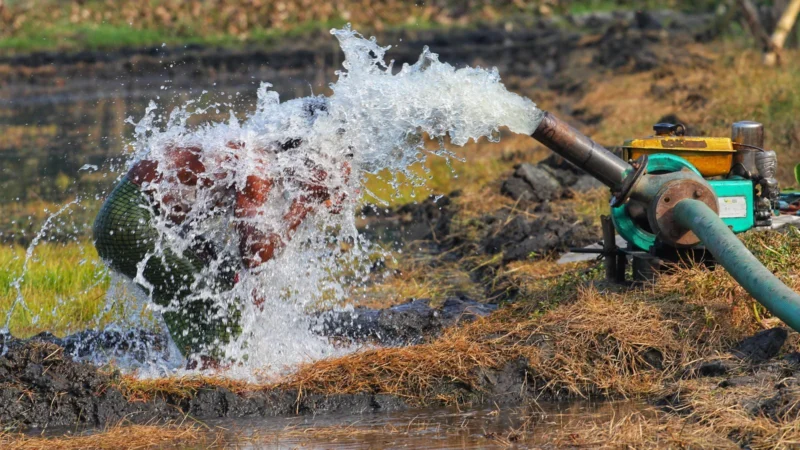
From the outside a 2-inch trash pump and a 2-inch transfer pump look much alike: the same small engine, the same hose fittings, a similar price tag. Inside the pump housing they are built for opposite priorities. One is designed to squeeze every bit of pressure out of clean water; the other is designed to let a handful of gravel pass straight through.
Quick answer
Choose a transfer pump when the water is clean or only slightly dirty and you want the most flow and pressure for the money. Choose a trash pump when the water contains leaves, sticks, sand, gravel or mud, as flood water, ponds and excavations nearly always do. A semi-trash pump sits between the two and handles silt and small debris.
| Factor | Transfer (clear-water) pump | Trash pump |
|---|---|---|
| Water it handles | Clean to lightly dirty, no solids | Dirty water with solids up to its rating |
| Impeller | Closed or tight-clearance, often aluminum or plastic | Open, heavy, usually cast iron |
| Solids rating | Practically none | About 3/4 inch (2 in), 1 to 1.5 inch (3 in), 2 inch (4 in) |
| Flow | High | Higher for the same port size |
| Pressure and head | Higher | Lower |
| Clean-out port | Rarely | Usually, to clear blockages without tools |
| Wear in dirty water | Fast | Designed for it |
| Weight | Lighter | Heavier |
| Price | Lower | Higher |
| Typical jobs | Pools, tanks, irrigation supply, creek water | Flooded basements and excavations, ponds, construction sites |
In this guide
What makes a trash pump different
A trash pump uses an open impeller with wide vanes and a large gap between the impeller and the housing. Together with wide internal passages, this lets solids pass through instead of jamming. Most have a clean-out port on the front of the housing so that when a rock does get stuck, you unscrew a cover and remove it in a minute. The impeller and housing are made of hardened or cast iron because sand and grit would eat softer metals.
The price of all that clearance is pressure. The same engine on a trash pump produces less head than on a transfer pump, so a trash pump is the wrong choice for sprinklers or for pushing water far uphill.
What makes a transfer pump different
A transfer pump, sometimes called a clear-water or de-watering pump, uses a closed or close-clearance impeller that converts engine power into pressure efficiently. It will move clean water a long way and up a good height, and it costs less. It also wears out quickly if it is fed sand, and it will jam on the first twig. If you have ever used one to drain a muddy ditch, you will remember the sound of gravel inside it and the leak that followed.
Semi-trash pumps
Semi-trash pumps have a sturdier impeller and larger passages than a transfer pump, but not the open impeller and clean-out of a true trash pump. They pass small solids, typically up to about 5/8 of an inch, and tolerate sandy or silty water. For a homeowner who occasionally drains a muddy area but mostly moves clean water, a semi-trash pump is a good single-pump compromise.
Choosing by job
| Job | Best choice | Why |
|---|---|---|
| Draining a swimming pool or hot tub | Transfer or submersible utility pump | Clean water, high flow |
| Filling stock tanks from a creek | Transfer pump with a strainer | Clean water; pressure helps on long runs |
| Flooded basement after a storm | Trash or semi-trash pump | Silt and debris in the water |
| Dewatering a footing excavation | Trash pump | Mud, gravel and the odd rock |
| Draining a pond or ditch | Trash pump | Leaves, weeds and sludge |
| Irrigation sprinklers | High-pressure pump | Needs pressure, not solids handling |
| Occasional mixed use | Semi-trash pump | Handles silt without giving up too much pressure |
Using either pump well
- Always fit the strainer and keep it off the bottom, suspended in a bucket or on a block, so it does not suck up the mud layer.
- Use a rigid suction hose the same size as the inlet. A collapsed hose is the most common reason a pump will not prime.
- Fill the pump housing with water before starting. Self-priming pumps still need a primed casing. See why a pump will not prime.
- Flush the pump with clean water after pumping dirty water, and drain it before storage or freezing weather.
See trash pumps on Amazon
See transfer pumps on Amazon
Frequently asked questions
Can a trash pump be used for clean water?
Yes. It will move clean water perfectly well, just with less pressure than a transfer pump of the same size. If you only own one pump and the water is sometimes dirty, a trash pump is the safer choice.
What size solids can a 2-inch trash pump handle?
Most 2-inch trash pumps pass solids up to about 3/4 of an inch. Three-inch pumps typically handle 1 to 1.5 inches and 4-inch pumps around 2 inches. Check the specification for the model you are considering.
Why is my transfer pump leaking after pumping muddy water?
Sand and grit have damaged the mechanical seal between the engine and the pump housing, or worn the impeller. Transfer pumps are not built for abrasive water. The seal can usually be replaced, but the next muddy job will do the same thing.