The Kohler 20RESAL is a 20 kW home standby generator that needs very little from its owner, but the little it needs really matters. A standby generator spends almost its whole life waiting. Small problems go unnoticed for months, and they show up on the one night the power fails.
This is an owner’s guide, not a buyer’s guide. It takes the maintenance schedule, the oil change procedure, the exercise settings, the fault messages and the storage steps from Kohler’s own operation manual and puts them into plain English.
You will learn what to check every week, what to service every year, how to change the oil safely, what the messages on the DC2 controller mean, and which jobs belong to a Kohler dealer. If you want the full specifications and replacement options instead, see our separate guide to the Kohler 20RESAL generator.
Kohler 20RESAL care at a glance
Twenty minutes a week, one service a year
Intervals and settings are from Kohler operation manual TP-6804 for the 14/20RESA and 14/20RESAL.
Quick answer
Leave the Kohler 20RESAL in AUTO and let it exercise for 20 minutes once a week. Check the oil before use and every 8 hours of running. Change the oil and filter every year or every 150 hours, whichever comes first, using 5W-30 or 10W-30 synthetic oil. Service the air cleaner and spark plugs on the manual’s schedule, keep the battery connections clean and tight, and write down any fault message before you reset it. Leave the alternator brushes, electrical faults and gas work to a Kohler dealer.
How we put this guide together
We have not serviced or tested this generator ourselves. Everything here comes from Kohler’s operation manual TP-6804 (June 2015 edition), which covers the 14RESA, 14RESAL, 20RESA and 20RESAL with RDC2 and DC2 controllers, and from Kohler specification sheet G4-210. We checked both in October 2026. Your own manual and the labels on your generator take priority. If anything here differs from them, follow them.
In this guide
- Safety First: Disable the Generator Before Any Work
- Know Your Controller: DC2 on the RESAL
- The Weekly Exercise
- The Quick Visual Check
- The 20 kW Service Schedule
- Engine Oil: Type, Level and Change
- Air Cleaner and Spark Plugs
- The Battery: The Part That Fails Most Often
- Fault Messages: Warnings and Shutdowns
- Running Through a Long Outage
- Cold Weather
- Storing the Generator
- What You Can Do and What a Dealer Should Do
- Parts and Tools Worth Having
- Common 20RESAL Maintenance Mistakes (and the Fix)
- Pro Tips From the Manual
- Real-Life Scenarios: What Would You Do?
- Kohler 20RESAL Owner’s FAQ
- Your Kohler 20RESAL Maintenance Checklist
Safety First: Disable the Generator Before Any Work
A standby generator can start by itself at any moment. That is its job. Before you put a hand inside the enclosure, you must make sure it cannot.
Kohler’s manual gives a set order for disabling the generator.
- Press the OFF button on the controller to shut the generator down.
- Disconnect the utility power to the generator. This removes power from the battery charger.
- Remove the battery cables, negative lead first. When you reconnect, fit the negative lead last.
- Let the engine cool. The manual warns that the engine and exhaust parts become extremely hot in use.
Jobs that are not for owners
The manual marks some tasks as “authorized distributor/dealer only”. These include the alternator brushes and collector ring, the stepper motor coupling and insulation resistance tests. The transfer switch is connected to utility power and must be left to a dealer or a licensed electrician. Gas piping and pressure checks belong to a licensed gas fitter. Never run the generator with guards or electrical covers removed, and keep working carbon monoxide alarms in your home.
Know Your Controller: DC2 on the RESAL
The 20RESAL has Kohler’s DC2 controller. Its sister model, the 20RESA, has the RDC2. They look alike, but a few steps differ, so make sure you follow the DC2 instructions.
The DC2 has a two-line display and four buttons: OFF, AUTO, RUN and EXERCISE.
- AUTO is where the generator lives. In AUTO, it starts when utility power fails and stops when it returns.
- OFF stops the generator and also clears a fault message on the DC2.
- RUN starts the generator by hand. Use it after a service to check your work.
- EXERCISE sets the weekly exercise time.
One difference catches people out. The RDC2 on the RESA model asks you to set the date, the time and the exerciser whenever the battery is connected. The DC2 does not prompt you. After you disconnect and reconnect the battery on a 20RESAL, check that an exercise is still scheduled. If it is not, the controller shows a warning that no exercise is scheduled.
The Weekly Exercise
Kohler’s manual says to run the generator without load once each week for 20 minutes. The controller does this automatically once you set it.
Kohler describes three exercise modes. Two of them can be set from the DC2’s own buttons.
| Mode | What happens | When to use it |
|---|---|---|
| Unloaded cycle with complete system diagnostics | Runs 20 minutes: about 10 minutes at reduced speed, 3 minutes at full speed for diagnostics and 5 minutes of cooldown | The default. Kohler recommends it |
| Unloaded full-speed exercise | Runs at full speed with no load | Rarely needed. On the DC2 this mode is set with Kohler’s dealer software |
| Loaded full-speed exercise | Transfers the house to generator power and runs at full speed | To prove the whole system. Needs the RXT transfer switch |
The default mode is the one Kohler recommends. It is also the quietest. Kohler’s spec sheet lists the 20RESAL at 64 dB(A) during the weekly exercise and 69 dB(A) at full speed, measured at 7 meters.
To set the exercise time on the DC2
The manual’s procedure is short. Press AUTO and check that the AUTO light is on and utility power is present. Then press the EXERCISE button to start an unloaded exercise. For a loaded exercise, press EXERCISE again within 5 seconds. The generator cranks, runs the cycle and stops by itself after 20 minutes.
The time you press the button becomes the schedule. The same exercise then runs at that time every seven days. To change the day or time, simply repeat the steps at the new time. Choose a time when you are usually home, so you hear it run.
What if the power fails during an exercise?
The manual covers this. If utility power is lost during an unloaded exercise, the transfer switch moves the house to the generator, the exercise ends and the controller stays in AUTO. The generator keeps running for as long as the outage lasts.
Key insight: the weekly exercise is the cheapest insurance you own. It circulates the oil, tests the battery and the starter, and runs a full set of diagnostics. Never switch it off to save noise or gas.
The Quick Visual Check
The manual lists a short prestart checklist. For a generator in AUTO, do it once a week, at about the time it exercises.
- Air cleaner: fitted and clean, so no unfiltered air enters the engine.
- Air inlets: clean and not blocked by leaves, snow or stored items.
- Battery: connections tight and free of corrosion.
- Exhaust: no leaks, cracks or corrosion, and the outlet is clear.
- Oil level: at or near the full mark on the dipstick, and not above it.
- Operating area: nothing left on or near the generator that could block cooling air.
- Controller: in AUTO, with no fault message on the display.
The manual adds a note that is easy to miss. Do not block the cooling air inlets or mount other equipment above them. Overheating can cause severe damage.
The 20 kW Service Schedule
Kohler publishes separate schedules for the 14 kW and 20 kW models. This table is the 20 kW schedule that applies to the 20RESAL. Intervals are in running hours or calendar time, whichever comes first.
| Item | Interval | Who does it |
|---|---|---|
| Check the oil level | Every 8 hours of running, or before each use | Owner |
| Exercise the generator | Weekly | Automatic |
| Check for exhaust leaks and anything combustible near the outlet | Weekly | Owner |
| Check the propane tank level, if you use propane | Weekly | Owner |
| Check battery charger operation | Monthly | Owner |
| Inspect flexible fuel lines and connections | Quarterly | Owner. Repairs by a gas fitter |
| Change the engine oil and oil filter | Yearly or every 150 hours | Owner or dealer |
| Clean the oil cooler | Yearly or every 150 hours | Owner or dealer |
| Service the air cleaner | At 150 hours and 300 hours | Owner or dealer |
| Service the spark plugs | At 150 hours and 300 hours | Owner or dealer |
| Clean and tighten the battery terminals | Yearly | Owner |
| Tighten control and power wiring connections | Yearly | Dealer or electrician |
| Check fuel regulator vent tubes, if fitted | Yearly | Owner |
| Check the crankcase breather hose | Yearly or every 500 hours | Owner or dealer |
| Brushes and collector ring | Yearly or every 300 hours | Dealer only |
| Stepper motor coupling and bushing | Every 500 hours | Dealer only |
For most homes, the generator runs well under 150 hours a year. Twenty minutes a week is about 17 hours. Add a few outages and you are still far below the hour limits. That means the calendar sets your schedule: one full service a year.
A long outage changes the picture. A generator that runs around the clock for six days passes 150 hours. After a major storm, an oil and filter change may be due long before the year is up.
Engine Oil: Type, Level and Change
Which oil
The manual specifies 5W-30 or 10W-30 synthetic oil of API service class SG, SH or SJ. Later classes replace these, so a current synthetic of the right grade meets the requirement. Kohler explains the choice: synthetic oil oxidizes and thickens less than other oils and leaves the intake valves and pistons cleaner.
How much
Here the paperwork disagrees. Kohler’s operation manual lists the 20 kW engine’s oil capacity as 1.9 liters, or 2.0 quarts. The earlier specification sheet lists 3.0 quarts with filter. The manual also says that some oil stays in the engine when you drain it, so a refill can take less than the listed capacity.
The safe answer is the same either way. Fill by the dipstick, not by the bottle. Add oil in stages and stop at the F mark.
How to check the level
Check the oil with the generator stopped. Never check it while the engine is running. Wait a few minutes after shutdown, so the oil drains back. Keep the level at or near the full mark, and never above it.
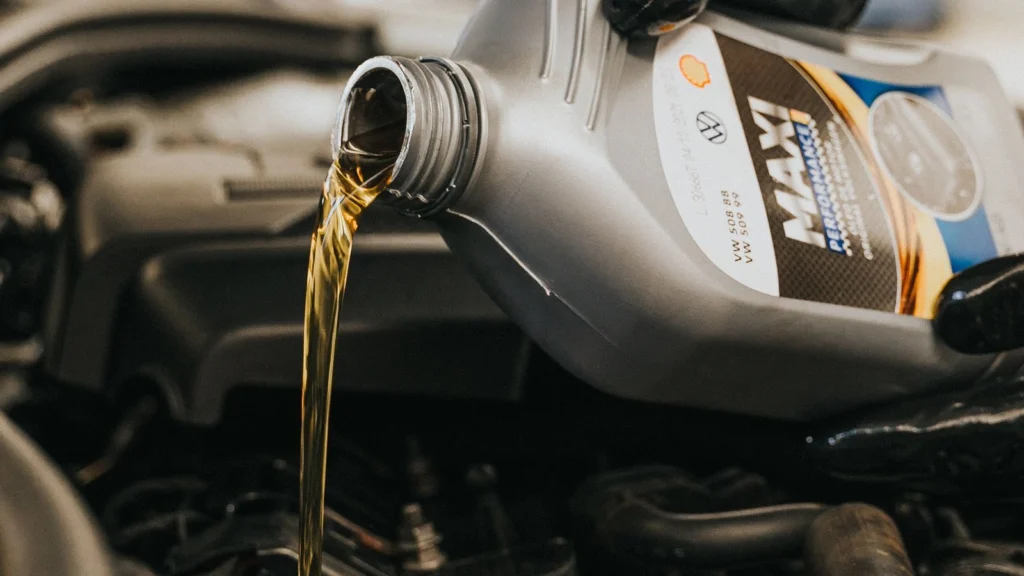
How to change the oil and filter
These steps follow the manual. Drain the oil while it is still warm, because warm oil flows better and carries more dirt out with it.
- Run the generator for a few minutes, then press OFF on the controller.
- Disconnect the utility power to the generator and remove the battery cables, negative lead first.
- Remove the housing side panel and clean around the dipstick and oil fill cap.
- Lower the oil drain hose into a container. Take the hose from its clip and remove its cap.
- Open the oil drain valve on the engine. Remove the dipstick and fill cap and let the oil drain fully.
- Close the valve, refit the cap on the hose and clip the hose back in place.
- Replace the oil filter. Turn the old one counterclockwise with a filter wrench. Clean the sealing surface, wipe clean oil on the new filter’s rubber seal and fit it as its instructions say.
- Fill with fresh oil to the F mark. Check the dipstick before you add the last of it.
- Reconnect the battery, negative lead last, and restore utility power to the generator.
- Press RUN and let the engine run for about a minute. Stop it, wait one minute and check the level again. Top up to the F mark.
- Check for leaks, refit the side panel and return the controller to AUTO.
- Reset the maintenance timer. On the DC2, press and hold OFF and AUTO together until the display shows that the maintenance timer has been reset.
Take the old oil and filter to a recycling point. Most auto parts stores accept them.
The oil cooler
The 20 kW models have an oil cooler, which the 14 kW models do not. The manual says to inspect and clean it at the scheduled interval and to keep it free of debris. It sits under the shroud of the number 2 cylinder.
Air Cleaner and Spark Plugs
Air cleaner
The engine breathes through a replaceable air cleaner element. The manual says to replace it at the scheduled intervals and more often in very dusty or dirty conditions. Check for dirt and debris around the air cleaner, and replace any bent or damaged parts.
The manual warns against running the engine with the air cleaner removed. A backfire through an open intake can cause serious injury, and unfiltered air wears an engine quickly.
Spark plugs
The manual gives a spark plug gap of 0.76 mm, or 0.030 inch, for both the 14 kW and 20 kW models. Check the gap with a wire feeler gauge and adjust it by carefully bending the ground electrode. Tighten the plug to 18 to 22 foot-pounds.
Clean around the base of each plug before you remove it, so dirt does not fall into the cylinder. Replace any plug that is worn or doubtful. Plugs are cheap, and the engine has only two.
The Battery: The Part That Fails Most Often
A standby generator cannot start without its battery. Kohler’s spec sheet calls for a 12-volt, group 51 battery with at least 500 cold cranking amps. The battery was sold separately, so check what is fitted.
The controller has a built-in 2.5-amp charger that keeps the battery topped up from utility power. It also watches the voltage and warns you when something is wrong.
| Message | What triggers it | What to do |
|---|---|---|
| Battery voltage low | Below 12.5 volts for more than 90 seconds while the engine is not running | Check the battery’s rating and condition and the charger. Charge or replace the battery |
| Battery cranking low | Below 11 volts for more than 10 seconds | Check the battery and the charger. Charge or replace the battery |
| Battery high | Above 16 volts for more than 10 seconds | Check the battery and the charger operation |
Each of these is a warning, not a shutdown. The message clears by itself when the voltage returns to normal. Do not ignore it, though. A battery that reads low at rest will not crank a cold engine.
Battery care
- Once a month, confirm that the charger is working. The battery voltage on the display should be steady.
- Once a year, clean and tighten the terminals and check the protective boots.
- Replace on age. Starting batteries rarely give warning. Many owners replace theirs every few years as routine.
- Mind the order. Negative lead off first, negative lead on last.
The manual’s battery warnings are serious. Battery acid can cause blindness and burns, and battery gases can explode. Wear splash-proof goggles and gloves, keep sparks and flames away, and remove jewelry before you work on it.
Fault Messages: Warnings and Shutdowns
The DC2 displays a message when something is wrong. There are two kinds, and they behave differently.
A warning shows a message, but the generator keeps running. It resets by itself once the problem is fixed.
A shutdown stops the generator. The OFF light flashes and a fault message appears. The generator cannot be restarted until the cause is corrected and the controller is reset.
How to reset the DC2 after a shutdown
The manual is clear about the order. Find and fix the cause first. Then press the OFF button to clear the fault message, and press AUTO to return the generator to automatic mode.
Write the message down before you press anything. A technician can do far more with “Eng Speed Low” than with “it stopped”.
| Message | Type | What it means | First step |
|---|---|---|---|
| Battery voltage low | Warning | Battery below 12.5 volts at rest | Check the battery and the charger |
| Exercise not scheduled | Warning | No exercise is set on the controller | Set the exerciser |
| ATS communication error | Warning | The link to the RXT transfer switch interface board is lost | Have the communication wiring checked |
| Engine speed low | Shutdown | Speed fell below 85% of normal for more than 3 seconds | Reduce the load. Call a dealer if it returns |
| Frequency low | Shutdown | Frequency fell below 90% of the setting for more than 10 seconds | Reduce the load and restart |
| Engine speed high | Shutdown | Speed went above 115% of normal | Call a dealer |
| AC sensing loss | Warning, then shutdown | The controller cannot sense generator output | Call a dealer |
Two of these, engine speed low and frequency low, usually point to overload. The generator is being asked for more than it can give. That is more likely on natural gas, where the 20RESAL is rated at 18 kW instead of 20. Switch off some large loads and try again. If it keeps happening, ask a dealer about load control.
Before you call for service
The manual’s troubleshooting section starts with simple causes. Check these first.
- A dead or weak battery.
- Loose connections, above all at the battery.
- An open circuit breaker on the generator.
- The gas supply. Is the valve open? Is the propane tank low?
- The controller mode. Is it in AUTO?
For general starting problems on any generator, our generator won’t start checklist is a useful companion.
Running Through a Long Outage
A multi-day outage is when a standby generator earns its keep, and when it most needs attention.
- Check the oil every 8 hours of running, as the schedule says. Shut the generator down first and let it cool for a few minutes.
- Keep a service kit on the shelf. In a wide outage, oil and filters sell out fast.
- Watch the propane gauge. Kohler’s spec sheet lists propane use at 82 cubic feet per hour at half load, which is about 2.3 gallons an hour.
- Count the hours. At 150 hours, about six days of constant running, the oil and filter are due.
- Reduce the load overnight. Lower demand means lower fuel use.
- Keep the area clear of snow, leaves and storm debris so cooling air can flow.
Our emergency power outage checklist covers the rest of the house.
Cold Weather
Kohler listed three cold weather accessories for this generator on its spec sheet.
- A carburetor heater, which runs on 120 volts. Kohler recommends it for reliable starting below 32°F.
- A fuel regulator heater pad, recommended for the 20 kW model below 0°F.
- A battery heater.
If your winters are hard and your generator has none of these, ask a Kohler dealer about fitting them. Keep snow away from the air inlets and the exhaust outlet, and check the enclosure after every heavy snowfall.
Storing the Generator
If the generator will be out of service for three months or longer, the manual gives a storage procedure. It also notes that it is better to run the generator monthly whenever possible.
- Run the generator for about 15 minutes until it reaches operating temperature, then stop it.
- Drain the oil while it is warm and refill with fresh oil. Run it for a few minutes to spread the clean oil, then stop it.
- Start the generator and shut off the gas supply. Let it run until the engine stops, then press OFF.
- Protect the cylinders. Remove the spark plugs, pour one tablespoon of engine oil into each plug hole, refit the plugs and crank the engine two or three turns. Follow the manual’s instructions for the plug leads.
- Clean the outside and spread a light film of oil over unpainted metal.
- Store the battery last. Disconnect it, negative lead first. Clean it, keep it somewhere warm and dry, and connect it to a float charger or charge it monthly.
What You Can Do and What a Dealer Should Do
| Task | Owner | Dealer or licensed professional |
|---|---|---|
| Weekly visual check | Yes | Not needed |
| Checking and topping up oil | Yes | Not needed |
| Oil and filter change | Yes, if you are comfortable | Yes |
| Air cleaner and spark plugs | Yes, if you are comfortable | Yes |
| Battery cleaning and replacement | Yes, with care | Yes |
| Setting the exerciser | Yes | Not needed |
| Brushes and collector ring | No | Yes |
| Stepper motor coupling | No | Yes |
| Wiring connections and transfer switch | No | Yes |
| Gas pressure, regulator and piping | No | Yes |
| Repeated fault shutdowns | No | Yes |
A yearly dealer visit is still worth having, even if you do the oil yourself. A technician checks the things you cannot, including the brushes and the transfer switch.
Parts and Tools Worth Having
We have not tested these items. Details are from the sellers’ listings. Check the part numbers against your own manual and nameplate before you order.
Service kit
Kohler Maintenance Kit for CH1000 Generators (17, 18 and 20 kW)
A genuine Kohler kit for generators with the CH1000 engine. Kohler’s listing says it includes the recommended air and oil filters and the correct amount of oil.
- FitsKohler CH1000 engine
- Generator sizes17, 18 and 20 kW
- IncludesAir filter, oil filter, oil
- BrandKohler
- UseRoutine yearly service
- Stock on listingIn stock when checked
- Why it works: one box holds what a yearly service needs, in the right amounts for this engine.
- Who it is best for: 20RESAL owners who do their own oil changes, and anyone who wants a spare kit for a long outage.
- What it solves: a mid-outage service when stores are closed or sold out.
- Keep in mind: confirm the engine model on your nameplate before you order. Retailers also list Kohler kit GM62347 for the 20RESAL, so check the part number with the seller.
As an Amazon Associate we earn from qualifying purchases. Details come from the Amazon listing, checked October 2026.
Battery check
Klein Tools MM325 Digital Multimeter
A manual-ranging multimeter that measures AC and DC voltage up to 600 volts. It lets you confirm the battery voltage that the controller reports.
- VoltageAC and DC to 600 V
- Current10 A DC
- RangingManual
- TestsContinuity, diode, battery
- BrandKlein Tools
- UseBattery and basic checks
- Why it works: a resting voltage reading tells you in seconds whether the battery is healthy.
- Who it is best for: owners who want to check the battery before storm season.
- What it solves: guessing whether a low battery warning is the battery or the charger.
- Keep in mind: use it on the 12-volt battery only. Do not probe the generator output or the transfer switch. Those carry dangerous voltage and are a job for a professional.
As an Amazon Associate we earn from qualifying purchases. Details come from the Amazon listing, checked October 2026.
Home safety
Kidde Carbon Monoxide Alarm with 10-Year Sealed Battery and Digital Display
A battery-powered carbon monoxide alarm with a display. Kohler’s manual warns that the exhaust system must be leak-free, and any engine near a home is a reason to have CO alarms inside.
- Power10-year sealed lithium battery
- DisplayDigital, updates every 15 seconds
- Alarm85 dB
- SensorElectrochemical
- MemoryPeak level
- BrandKidde
- Why it works: it needs no wiring and keeps working through a power failure.
- Who it is best for: every home with a generator, a gas furnace or an attached garage.
- What it solves: exhaust gas drifting indoors without anyone noticing.
- Keep in mind: an alarm is a backup, not a fix. If it sounds, get everyone into fresh air and call for help.
As an Amazon Associate we earn from qualifying purchases. Details come from the Amazon listing, checked October 2026.
Common 20RESAL Maintenance Mistakes (and the Fix)
Pro Tips From the Manual
- Use the drain hose. The engine has an oil drain valve and hose, so you do not need to reach under it.
- Reset the maintenance timer after each service, so the reminders stay accurate.
- Keep a logbook. Note the date, the hours and what you did. It helps a technician and a future buyer.
- Check the regulator vent tubes once a year, if your unit has them. Insects like to nest in them.
- Photograph the nameplate. You will need the model and serial numbers for every parts order.
- Test before the season. Press RUN before winter and before storm season, and listen to it for a few minutes.
- Clean the oil cooler when you change the oil. A blocked cooler shortens the life of the oil and the engine.
Real-Life Scenarios: What Would You Do?
These are typical situations. They are examples, not reports from real customers.
🔋 The low battery message
The display shows a battery voltage low warning on a cold morning.
Check that utility power reaches the generator and that the connections are tight. If the battery is several years old, replace it with a group 51, 500 CCA battery.
Action: check, then replace
🌀 Day five of an outage
The generator has run almost non-stop since the storm.
It is close to 150 hours. Shut it down in daylight, let it cool, and change the oil and filter with the kit on your shelf.
Action: service now
📉 The shutdown under load
The generator stops with an engine speed low message when the air conditioner and the oven run together.
Note the message, switch off some large loads and reset. If it returns, ask a dealer about load control.
Action: reduce load, call dealer
Kohler 20RESAL Owner’s FAQ
How often should I change the oil in a Kohler 20RESAL?
Kohler's service schedule for 20 kW models says to change the oil and oil filter every year or every 150 hours of running, whichever comes first. Check the oil level every 8 hours of running or before each use.
What oil does a Kohler 20RESAL take?
The operation manual specifies 5W-30 or 10W-30 synthetic oil. Fill to the F mark on the dipstick. The manual lists 2.0 quarts for 20 kW models, and an earlier spec sheet lists 3.0, so go by the dipstick.
How long does the Kohler 20RESAL exercise each week?
Twenty minutes. In the default mode it runs about 10 minutes at reduced speed, 3 minutes at full speed for diagnostics and 5 minutes of cooldown, with no load on the generator.
How do I reset a fault on the Kohler DC2 controller?
Find and fix the cause first. Then press the OFF button to clear the fault message, and press AUTO to return to automatic mode. Write down the message before you clear it.
What is the spark plug gap on a Kohler 20RESAL?
The manual gives 0.76 mm, or 0.030 inch, for the 14 kW and 20 kW models. Tighten the plugs to 18 to 22 foot-pounds.
What battery does the Kohler 20RESAL use?
A 12-volt, group 51 battery with at least 500 cold cranking amps, according to Kohler's spec sheet. The controller's built-in 2.5-amp charger keeps it charged.
Your Kohler 20RESAL Maintenance Checklist
- Controller in AUTO, with no fault message.
- Weekly exercise scheduled and running.
- Weekly visual check: oil, air inlets, exhaust, battery, area clear.
- Propane tank level checked weekly, if you use propane.
- Battery charger checked monthly.
- Fuel lines inspected quarterly.
- Oil and filter changed yearly or at 150 hours.
- Oil cooler cleaned at each oil change.
- Air cleaner and spark plugs serviced on schedule.
- Battery terminals cleaned and tightened yearly.
- Maintenance timer reset after each service.
- Dealer visit booked for brushes, wiring and the transfer switch.
The bottom line
The Kohler 20RESAL asks for a weekly glance, a yearly service and a healthy battery. Give it those three things, write down any fault before you clear it, and it will be ready when the lights go out.
As an Amazon Associate we earn from qualifying purchases.
Sources: Kohler operation manual TP-6804 (6/15) for the 14/20RESA, 14/20RESAL and 20RESC/RESCL with RDC2 and DC2 controllers; Kohler specification sheet G4-210 for the 14RESAL and 20RESAL; Amazon listings for the Kohler CH1000 maintenance kit, Klein Tools MM325 and Kidde carbon monoxide alarm. All checked October 2026.