A propane powered generator burns fuel from a tank or cylinder that never goes stale, which makes it one of the most dependable ways to keep a home running when the grid fails. For homes without natural gas service, propane is the standard fuel for automatic standby power.
This guide looks at the whole propane picture. You will see how a propane generator works, the difference between a propane standby system and a propane portable, how much fuel the popular sizes burn, and how to work out the tank size you need for the outage you fear.
Every figure comes from a manufacturer’s website, a manufacturer’s spec sheet or a current Amazon listing. We have not tested or installed these generators.
Propane generators at a glance
Fuel that keeps for years, in a tank sized for your outage
Fuel use and ratings come from the official websites and spec sheets of Generac, Kohler and Champion, checked in October 2026.
Quick answer
Propane generators come in two main forms. A home standby generator is hard piped to a large tank and starts automatically. A dual fuel portable connects to a cylinder with a hose and is started by hand. Propane gives a standby generator its full rating, but the tank sets the run time. A 22 kW unit burns about 2 to 2.5 gallons an hour at half load, so a 500-gallon tank, which holds about 400 gallons when full, lasts roughly a week of continuous running.
How we put this guide together
We have not tested or installed these generators. Standby ratings and propane consumption come from the product pages of Generac and Champion and from Kohler’s spec sheets. Portable figures come from current Amazon listings. Tank-life figures are our own arithmetic from those numbers. We do not publish prices. Propane work is regulated, so use this guide to prepare for a talk with your propane supplier and installer.
In this guide
- How a Propane Powered Generator Works
- The Three Types of Propane Generator
- Propane Standby Generators: Ratings and Fuel Use
- How Big a Propane Tank Do You Need?
- Propane Pressure and Piping for a Standby Generator
- Portable Propane Generators in Brief
- Propane vs Natural Gas, Gasoline and Diesel
- Four Propane Generators to Look At
- Propane Safety
- Common Mistakes With Propane Generators (and the Fix)
- Pro Tips for Propane Backup Power
- Real-Life Scenarios: Which Propane Setup Fits?
- Propane Powered Generator: FAQ
- Your Propane Generator Checklist
How a Propane Powered Generator Works
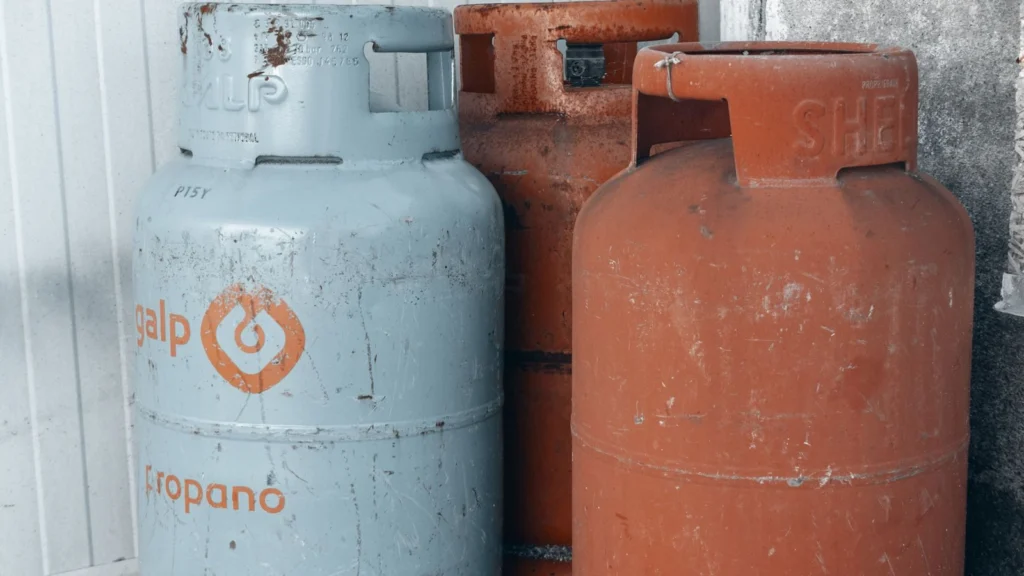
Propane is stored as a liquid under pressure. Inside the tank it boils off into a gas, and that gas is what the engine burns.
- Liquid propane sits in the tank. A full tank is only about 80% liquid, with space left for the vapor.
- Vapor leaves the top of the tank and passes through a regulator, which lowers the pressure.
- A gas line carries it to the generator.
- The engine mixes the gas with air and ignites it with a spark plug, much like a gasoline engine.
- The engine turns an alternator, which makes the electricity.
A propane engine is very close to a natural gas engine. That is why standby generators can run on either. Kohler’s spec sheets call its fuel system “multi-fuel” and “field-convertible,” and Champion ships a propane metering jet with its standby units.
Because propane arrives as a clean gas, it leaves no gummy residue in the fuel system. That is the reason a propane generator tends to start after a long rest.
The Three Types of Propane Generator
| Type | Size range on propane | Fuel supply | Starts |
|---|---|---|---|
| Home standby generator | 8.5 to 28 kW air-cooled, larger liquid-cooled | A permanent tank, hard piped | Automatically |
| Dual fuel portable | About 2,600 to 8,500 running watts | A cylinder and hose | By hand, switch or remote |
| Tri fuel portable | About 5,900 to 10,500 running watts | A cylinder, or a natural gas line | By hand, switch or remote |
Portable generators that burn propane only are rare. Nearly every portable propane generator also runs on gasoline.
Key insight: with propane, the generator is only half the purchase. The tank decides how long the lights stay on.
If you are still deciding between an automatic system and a portable, read portable vs standby generators first.
Propane Standby Generators: Ratings and Fuel Use
Propane gives a standby generator its full nameplate rating. The cost is fuel. These are the makers’ own figures.
| Brand and model | Rating on propane | At half load | At full load |
|---|---|---|---|
| Champion 8.5 kW | 8.5 kW | 1 gal/h | 1.5 gal/h |
| Generac 10 kW | 10 kW | 0.94 gal/h | 1.6 gal/h |
| Champion 14 kW | 14 kW | 1.6 gal/h | 2.6 gal/h |
| Generac 14 kW | 14 kW | 1.76 gal/h | 2.92 gal/h |
| Kohler 20RCA | 20 kW | 2.25 gal/h | 3.74 gal/h |
| Champion 22 kW aXis | 22 kW | 2 gal/h | 3.6 gal/h |
| Generac 24 kW | 24 kW | 2.45 gal/h | 3.71 gal/h |
| Kohler 26RCA | 26 kW | 2.34 gal/h | 3.54 gal/h |
| Champion 26 kW | 26 kW | 2.39 gal/h | 3.95 gal/h |
Each maker tests in its own way, so do not rank the brands on small differences. The pattern is what matters.
- Small units of 8.5 to 10 kW burn about 1 gallon an hour at half load.
- Mid-size units of 14 to 20 kW burn about 1.6 to 2.3 gallons an hour.
- Large air-cooled units of 22 to 26 kW burn about 2 to 2.5 gallons an hour at half load, and close to 4 at full load.
A home does not sit at one load all day, so real use is usually nearer the half-load figure or below it.
How Big a Propane Tank Do You Need?
This is the question that matters most with propane. The answer comes from three numbers: the tank size, the 80% fill rule and the generator’s fuel use.
A propane tank is never filled to the brim. It is filled to about 80%, so the liquid has room to expand. A “500-gallon” tank therefore holds about 400 gallons.
| Tank size | Usable propane | 14 kW at 1.6 gal/h | 22 kW at 2.45 gal/h |
|---|---|---|---|
| 120 gallons | About 96 gallons | 2.5 days | 1.6 days |
| 250 gallons | About 200 gallons | 5.2 days | 3.4 days |
| 500 gallons | About 400 gallons | 10.4 days | 6.8 days |
| 1,000 gallons | About 800 gallons | 20.8 days | 13.6 days |
Three cautions bring those numbers down to earth.
- The tank is rarely full on the day the power fails. Plan on what is usually in it.
- Your furnace, water heater and stove may share the tank. In a winter outage, heating adds to the propane the generator burns.
- Deliveries may be delayed after a big storm. A few spare days in the tank are worth having.
So work backward from the outage you fear.
- Decide how many days you want to cover.
- Find your generator’s half-load fuel figure in gallons an hour.
- Multiply by 24, then by the number of days.
- Divide by 0.8 to get the tank size, because of the 80% fill.
- Add a margin for other propane appliances and a part-full tank.
For example, five days on a 14 kW unit at 1.6 gallons an hour is 192 gallons of fuel. Divide by 0.8 and you need 240 gallons of tank, before any margin. A 500-gallon tank gives comfortable room.
Tip: talk to the propane supplier early
Your propane supplier sizes tanks for a living. Tell them the generator’s fuel use at full load in gallons or Btu per hour, and ask what tank and regulator they recommend. In cold climates the tank also has to be large enough to turn liquid into gas quickly on a freezing day.
Propane Pressure and Piping for a Standby Generator
A standby generator needs propane at the right pressure, measured in inches of water column. The makers publish the range.
| Brand | Propane pressure required | Notes |
|---|---|---|
| Generac air-cooled standby | 10 to 12 inches of water column | From Generac’s product spec tables |
| Kohler 20RCA and 26RCA | 7 to 11 inches of water column | From Kohler spec sheets G4-272 and G4-315 |
Pipe size matters as well. Kohler’s sheet for the 20RCA gives these minimum sizes for propane.
| Length of pipe run | Minimum pipe size |
|---|---|
| 25 feet | 3/4 inch |
| 50 feet | 1 inch |
| 100 feet | 1 inch |
| 150 feet | 1 1/4 inch |
| 200 feet | 1 1/4 inch |
Your installer and propane supplier will choose the regulators and pipe for your site. The useful point for you is that the tank’s position affects the cost. A tank far from the generator needs a longer, larger line.
Portable Propane Generators in Brief
If a standby system is more than you need, a portable does the same job on a smaller scale. Nearly all are dual fuel or tri fuel models.
| Model | Type | Running watts on gasoline | Running watts on propane |
|---|---|---|---|
| WEN DF480iX | Dual fuel inverter | 4,000 | 4,000 |
| Westinghouse 4650 Dual Fuel | Dual fuel open frame | 3,600 | 3,240 |
| Westinghouse 6500 Dual Fuel | Dual fuel open frame | 5,300 | 4,800 |
| Pulsar G12KBN | Dual fuel open frame | 9,500 | 8,550 |
| Westinghouse 14500 Tri-Fuel | Tri fuel open frame | 11,500 | 10,500 |
A portable feeds from a cylinder through a hose and regulator. The common sizes are 20, 30, 40 and 100 pounds. A 20-pound cylinder holds about 4.7 gallons, which is why large portables empty one quickly. A big portable can also connect to a home propane tank if your supplier fits a suitable outlet.
Our guide to dual-fuel generators explains how one engine handles two fuels.
Propane vs Natural Gas, Gasoline and Diesel
| Point | Propane | Natural gas | Gasoline | Diesel |
|---|---|---|---|---|
| Stored at home | Yes, for years | No, piped in | Yes, for months | Yes, for a year or more with care |
| Supply in a long outage | Limited by tank size | Continuous if service holds | Limited by cans and open stations | Limited by tank size |
| Standby rating | Full rating | Usually a little lower | Not used for standby | Used on larger standby units |
| Works without a utility | Yes | No | Yes | Yes |
| Main thing to plan | Tank size and deliveries | Meter, pressure and pipe | Fresh fuel and safe storage | Fuel care and a larger machine |
Propane’s place in that table is clear. It is the fuel for homes that have no gas main, or that want backup power that does not depend on any utility at all.
Four Propane Generators to Look At
Each of these had an active Amazon listing when we checked in October 2026. One is a standby system and three are dual fuel portables.
Automatic standby on propane
Generac 22kW Whole Home Generator with Transfer Switch and Cellular Capability
An air-cooled home standby generator sold with a transfer switch. On propane it delivers its full 22 kW rating.
- Rating on propane22 kW
- Propane at half load2.45 gal/h
- Propane pressure needed10 to 12 in. water column
- Weight451 lb
- MonitoringBuilt-in cellular
- Warranty5-year limited
- Why it works: it starts automatically and runs from a permanent tank, so it protects the house when nobody is home.
- Who it is best for: homes without natural gas service that want whole-home backup.
- What it solves: long outages. With a 500-gallon tank it can run for about a week at half load.
- Handy extras: oil level sensors, improved cold starting and a sloped roof to keep snow and ice out.
- Keep in mind: it needs a propane tank, professional installation and permits. The listing says remote monitoring requires a Mobile Link subscription. Only two were in stock when we checked.
As an Amazon Associate we earn from qualifying purchases. Specs come from the Amazon listing and Generac’s product page, checked October 2026.
Big dual fuel portable
Pulsar G12KBN 12,000-Watt Dual Fuel Portable Generator
A large open-frame dual fuel generator with electric start. It keeps 8,550 rated watts on propane and has a 50-amp outlet for home backup.
- On propane8,550 rated, 10,800 peak
- On gasoline9,500 rated, 12,000 peak
- Engine457 cc OHV
- Fuel tank8 gallons
- 240-volt outlets30A twist-lock and 50A
- Warranty1-year limited
- Why it works: it has the propane output to carry a long list of household loads through a transfer switch.
- Who it is best for: homeowners with a large cylinder or a home tank who are happy to start the generator themselves.
- What it solves: stale gasoline. Run it on propane and it is ready after months in storage.
- Handy extras: a propane hose in the box, low-oil shut-off, a digital meter and 10-inch never-flat wheels.
- Keep in mind: the listing gives a 1-year limited warranty, shorter than several rivals. A generator this size drains a 20-pound cylinder quickly.
As an Amazon Associate we earn from qualifying purchases. Specs come from the Amazon listing, checked October 2026.
Quiet dual fuel inverter
WEN DF480iX 4800-Watt Dual Fuel RV-Ready Inverter Generator
An inverter on wheels that lists the same 4,000 rated watts on propane as on gasoline. It is aimed at RVs and home essentials.
- On propane4,000 rated, 4,320 surge
- On gasoline4,000 rated, 4,800 surge
- Engine224 cc
- StartElectric
- Weight78.5 lb
- Warranty3-year
- Why it works: it keeps its full rated output on propane, which is unusual.
- Who it is best for: RV owners and homeowners who want clean, quiet power from a cylinder.
- What it solves: fuel choice on the road. It connects to propane with a tool-free quick-connector.
- Handy extras: a carbon monoxide shutdown sensor, a fuel shut-off, a TT-30R RV outlet and two USB ports.
- Keep in mind: the surge rating is lower on propane, so large motors start more easily on gasoline.
As an Amazon Associate we earn from qualifying purchases. Specs come from the Amazon listing, checked October 2026.
Simple and affordable
Westinghouse 4650 Peak Watt Dual Fuel Portable Generator
A straightforward open-frame dual fuel generator for RVs and the essentials at home.
- On propane3,240 rated, 4,650 peak
- On gasoline3,600 rated, 4,650 peak
- Engine212 cc OHV
- Fuel tank4 gallons
- Weight108 lb
- Warranty3-year limited
- Why it works: it is a plain, proven layout with a 30-amp RV outlet and a 30-amp twist-lock outlet.
- Who it is best for: buyers who want propane capability without paying for an inverter.
- What it solves: the basics. It covers a refrigerator, lights and a few small loads on propane.
- Handy extras: low-oil shutdown, a carbon monoxide shutdown sensor and rubber outlet covers.
- Keep in mind: it is louder than an inverter, and its outlets are 120 volts only.
As an Amazon Associate we earn from qualifying purchases. Specs come from the Amazon listing, checked October 2026.
Propane Safety
Treat propane and exhaust with respect
Propane is heavier than air and settles in low places. Portable cylinders must be stored and used outdoors, upright, away from doors, windows and ignition sources. A home tank and its piping must be installed by your propane supplier and licensed trades. Every generator makes carbon monoxide, so run a portable outdoors at least 20 feet from the house, follow the installation manual for a standby unit, and fit carbon monoxide alarms indoors. If you smell gas, leave the area and call your propane supplier or the fire department.
Our generator safety tips cover placement and carbon monoxide in more detail.
Common Mistakes With Propane Generators (and the Fix)
Pro Tips for Propane Backup Power
- Ask about a tank monitor. Generac offers a fuel monitor that reports the tank level to its Mobile Link app, and many propane suppliers have their own.
- Fill up before storm season. A full tank is the cheapest insurance you can buy.
- Own the right size tank for winter. Cold slows the rate at which liquid propane turns to gas, so small tanks struggle on freezing days.
- Keep the area around the tank clear of snow, leaves and plants.
- Service the generator once a year. Propane burns cleanly, but oil, filters, spark plugs and the battery still wear.
- Keep your supplier’s emergency number with the generator paperwork.
Real-Life Scenarios: Which Propane Setup Fits?
These are typical situations that buyers describe in forums and reviews. They are examples to help you plan, not quotes from real people.
🌾 The rural home
There is no gas main on your road. You already heat with propane from a 500-gallon tank.
You want automatic backup that shares the fuel you already buy.
Best fit: a propane standby generator, with the tank size reviewed by your supplier
🏡 The storm-prone suburb
You have no propane today, outages last a day or two, and you are usually home.
You want fuel that stores well without the cost of a tank and a standby system.
Best fit: a dual fuel portable with two or three cylinders
🏔️ The mountain cabin
The cabin is empty for weeks, winters are harsh, and the road may close.
You need power that starts by itself and a tank that will last.
Best fit: a propane standby unit with a large tank and a level monitor
Propane Powered Generator: FAQ
How long will a propane generator run on a 500 gallon tank?
A 500-gallon tank holds about 400 gallons when full. At half load, a 14 kW standby generator using 1.6 gallons an hour would run for about 10 days, and a 22 kW unit using 2.45 gallons an hour for about 7 days. Other propane appliances shorten that.
How much propane does a whole-house generator use?
Manufacturer figures for 22 to 26 kW standby units are about 2 to 2.5 gallons an hour at half load and close to 4 gallons an hour at full load. Smaller 8.5 to 10 kW units use about 1 gallon an hour at half load.
Is a propane generator better than a gasoline one?
For storage, yes. Propane does not go stale and it keeps the fuel system clean. Gasoline gives a little more power from the same portable engine and is easier to find in small amounts.
Is propane or natural gas better for a standby generator?
Use natural gas if you have it, because the supply is continuous. Use propane if you do not. Propane gives the full rating and does not depend on a utility, but the tank limits the run time.
Can a propane generator run a whole house?
Yes. Propane standby generators come in sizes from 8.5 kW to 28 kW air-cooled, and larger liquid-cooled models are available. An installer sizes the generator from a load calculation.
Do propane generators need a lot of maintenance?
They need the same basic care as any engine: oil and filter changes, spark plugs and a healthy battery. Propane burns cleanly, which helps the fuel system, but it does not replace routine service.
Your Propane Generator Checklist
- Decide between an automatic standby system and a portable.
- Add up your loads and choose a size.
- Find the generator’s propane use at half and full load.
- Decide how many days of outage you want to cover.
- Work out the tank size, allowing for the 80% fill.
- Add your other propane appliances to the sums.
- Ask your propane supplier to confirm the tank, regulators and piping.
- Use licensed trades, with permits and an inspection.
- Set up deliveries or a tank monitor.
- Fit carbon monoxide alarms and schedule yearly service.
The bottom line
A propane powered generator is the answer when you have no gas main or want backup that depends on nobody else. Pick the generator for your loads, then pick the tank for the outage you expect. For a portable with serious propane output, the Pulsar G12KBN is worth a look.
As an Amazon Associate we earn from qualifying purchases.
Sources: Generac’s official website (generac.com): home standby product spec tables and the Mobile Link page; Champion Power Equipment’s home standby product pages; Kohler specification sheets G4-272 and G4-315; Amazon listings for the products named in this guide. All checked October 2026.