Construction equipment comes in two families: heavy machines you sit in, and compact engine-powered tools you carry or walk behind. Once you know which family a job needs, choosing the right machine gets much easier.
This guide is written for small contractors, landowners and serious do-it-yourselfers. It explains what each machine does, when gasoline beats diesel, when to rent and when to buy, and how much power common job-site tools really need.
It also covers the safety rules that matter most around engines, because the biggest dangers on a small site are often the quiet ones: exhaust fumes, noise and dust.
Construction equipment at a glance
Two families: heavy machines and compact engine-powered tools
Safety figures come from OSHA and NIOSH. Tool wattages come from a manufacturer wattage chart. Product specs come from current Amazon listings, checked October 2026.
Quick answer
Heavy construction equipment, such as excavators, skid steers, backhoes and dozers, moves earth and lifts loads, and it is almost always diesel. Compact equipment, such as plate compactors, generators, air compressors, pumps and concrete saws, usually runs on small gasoline engines. Most small contractors rent the heavy machines and own the compact ones. Whatever you run, never use a gasoline engine indoors, protect your hearing and keep trenches shored.
How we put this guide together
This is a general guide, not a hands-on test. Safety rules and figures come from OSHA standards and NIOSH publications. Typical tool wattages come from Champion Power Equipment’s generator wattage chart. Product details come from current Amazon listings, checked in October 2026. We do not show prices, because they change constantly. Always follow the operator’s manual for your own machine.
In this guide
- The Two Families of Construction Equipment
- Heavy Equipment: What Each Machine Does
- Compact Engine-Powered Equipment
- Gas or Diesel on the Job Site?
- Should You Rent or Buy?
- How Much Power Do Job-Site Tools Need?
- Four Compact Machines Worth Knowing
- Job-Site Safety Rules Worth Knowing
- Maintenance: Keep It Earning
- Common Construction Equipment Mistakes (and the Fix)
- Pro Tips From the Job Site
- Real-Life Scenarios: Rent, Buy or Both?
- Construction Equipment: FAQ
- Your Construction Equipment Checklist
The Two Families of Construction Equipment
Heavy equipment is what most people picture: big diesel machines with a seat and a cab. They dig, push, lift and grade. They cost a great deal, need a trailer to move and are usually rented by smaller firms.
Compact equipment is everything you can load into a pickup. A plate compactor, a generator, a pump, a compressor or a concrete saw. These machines mostly use small air-cooled gasoline engines, the same kind found on a pressure washer or a tiller.
This site is about engines, so we spend most of our time on the second family. But you need to know both to plan a job.
Heavy Equipment: What Each Machine Does
| Machine | Main job | Good to know |
|---|---|---|
| Excavator | Digging trenches, footings and ponds | The cab and arm spin on tracks. The smallest mini excavators fit through a garden gate. |
| Skid steer loader | Moving soil, gravel and pallets | Small and wheeled. Takes dozens of attachments, from forks to augers. |
| Compact track loader | The same work on soft ground | A skid steer on rubber tracks. Better in mud and on slopes. |
| Backhoe loader | Digging and loading with one machine | A loader bucket at the front and a digging arm at the back. |
| Bulldozer | Pushing soil and rough grading | A tracked machine with a wide front blade. |
| Wheel loader | Loading trucks and moving stockpiles | A large front bucket on four big tires. |
| Telehandler | Lifting pallets up to height | A forklift with a telescopic boom. |
| Roller | Compacting soil and asphalt | Smooth drums for asphalt, padded drums for clay. |
For most small projects, three machines do nearly everything: a mini excavator, a skid steer or compact track loader, and a compactor. That is why they fill the yard at every rental shop.
Compact Engine-Powered Equipment
These are the machines small crews actually own.
| Tool | What it does | Usual power |
|---|---|---|
| Plate compactor | Packs gravel, sand and paver base | Gasoline, 4-stroke |
| Rammer, or jumping jack | Packs clay and narrow trenches | Gasoline, 4-stroke |
| Concrete mixer | Mixes small batches on site | Electric or gasoline |
| Power trowel | Finishes a concrete slab | Gasoline, 4-stroke |
| Cut-off saw | Cuts concrete, block and steel | Gasoline, usually 2-stroke |
| Portable generator | Runs tools and lights | Gasoline, sometimes diesel or propane |
| Air compressor | Runs nailers and air tools | Gasoline or electric |
| Trash pump | Removes muddy water from holes | Gasoline or diesel |
| Pressure washer | Cleans equipment and surfaces | Gasoline or electric |
| Light tower | Lights a site at night | Usually diesel |
Notice the pattern. Small, portable tools run on gasoline. As machines get bigger and work longer hours, diesel takes over.
Gas or Diesel on the Job Site?
Both fuels have a place. The right one depends on the size of the machine and the hours it works.
| Point | Gasoline engines | Diesel engines |
|---|---|---|
| Typical use | Compact tools under about 25 horsepower | Heavy equipment and machines that run all day |
| Purchase cost | Lower | Higher |
| Pulling power at low speed | Less | More |
| Fuel use under heavy load | Higher | Lower |
| Cold starts | Easier | Can need glow plugs or a block heater |
| Fuel storage | Goes stale in months | Stores longer, but can gel in deep cold |
| Exhaust | High carbon monoxide | Lower carbon monoxide, but soot and other fumes |
One change is worth understanding. From 2008 to 2015 the US phased in Tier 4 emission rules for off-road diesel engines. They cut soot and nitrogen oxides by about 90% compared with the rules before them. To get there, many newer diesel machines use a particulate filter, and larger ones also use diesel exhaust fluid. These systems work well, but they need the right fuel, the right fluid and regular attention.
For the deeper story, read gas vs diesel engines. If you work through winter, our guide to cold-weather diesel starting will save you a few slow mornings.
Should You Rent or Buy?
There is no magic number. Walk through these five questions and the answer usually becomes clear.
- How often will you use it? A machine you need every week is a candidate to own. A machine you need twice a year is a rental.
- Can you move it? Heavy equipment needs a trailer, a suitable truck and sometimes a permit. Rental yards deliver.
- Can you store and secure it? Equipment left outdoors rusts and gets stolen.
- Who will maintain it? Owning means oil, filters, tracks, hoses and breakdowns are yours. Renting passes those to the yard.
- Does the job need a special machine? Rent anything unusual. Own what you reach for every day.
For most small firms the result looks the same. Rent the heavy iron. Own the compact tools. A compactor, a generator, a compressor and a pump earn their keep on almost every job, and they fit in the truck you already drive.
Key insight: the cheapest machine is the one that is working. Buy what you will use weekly and rent the rest.
How Much Power Do Job-Site Tools Need?
If you run electric tools from a generator, size it by the tools, not by guesswork. Motors need a short burst of extra power to start, so the starting watts matter as much as the running watts.
| Tool | Running watts | Starting watts |
|---|---|---|
| Circular saw, 7-1/4 inch | 1,200 to 1,800 | 2,400 to 3,600 |
| Miter saw, 10 inch | 1,200 to 1,800 | 2,400 to 3,600 |
| Table saw, 10 inch | 1,800 to 3,000 | 3,600 to 6,000 |
| Hammer drill | 900 to 1,200 | 1,800 to 2,400 |
| Angle grinder, 4-1/2 inch | 900 to 1,800 | 1,800 to 3,600 |
| Air compressor, 1 HP | 1,500 | 4,500 |
| Air compressor, 2 HP | 2,500 | 7,500 |
| Welder, 120 volt | 1,800 to 2,500 | 3,600 to 5,000 |
| Halogen work light, 500 watt | 500 | None |
Look at the compressors. A 2-horsepower electric compressor can need 7,500 watts for a moment when it starts. That is why crews so often choose a gas-powered compressor instead, and keep the generator for saws and lights.
To size a generator:
- Add the running watts of everything that will run at the same time.
- Add the largest single starting surge on top.
- Leave some headroom so the generator is not flat out all day.
Our free Generator Size Calculator does the sums, and What Size Generator Do I Need? explains the method. For air tools, the Compressor Output Calculator and our guide to CFM do the same job.
Four Compact Machines Worth Knowing
These four cover the jobs that come up again and again on small sites: power, air, compaction and water. Each one below is a current Amazon listing from a well-known brand. We have not tested them. The details come from the listings.
Job-site power
A construction generator has a harder life than a home backup unit. It needs protected outlets, a tough frame and steady voltage for tools.
Built for job sites
Honda EB10000 10,000 Watt Industrial Generator with Electric Start (EB10000AN)
A large gasoline generator made for construction work. The listing describes full GFCI protection and calls it OSHA-compliant for job-site use.
- Output10,000 W, 120/240 V
- Sound level73 dB(A) at 7 meters
- Fuel tank8.19 gallons
- Run time5.4 to 7.9 hours
- StartElectric
- Weight on listing403 lb
- Why it works: GFCI protection is built in, which is what job-site rules call for on temporary 120-volt outlets.
- Who it is best for: contractors who run several saws, a compressor and lights from one machine.
- What it solves: unstable power. Honda says its voltage regulator holds output within plus or minus 1%.
- Safety extra: CO-MINDER shuts the generator down if carbon monoxide builds up around it.
- Keep in mind: it weighs about 400 pounds, so it needs its wheel kit and a ramp or lift gate. The listing says this version is not available in California.
As an Amazon Associate we earn from qualifying purchases. Specs come from the Amazon listing, checked October 2026.
Compressed air
Framing and roofing crews live on compressed air. A gas wheelbarrow compressor goes where there is no power at all.
Air without electricity
Metabo HPT 9-Gallon Gas Wheelbarrow Compressor with Honda GX200 Engine (EC2610EA)
A contractor compressor on a wheelbarrow frame. It needs no outlet, so it can work at the far end of a site from day one.
- Air delivery9.5 CFM at 90 PSI
- Tank9 gallons
- EngineHonda GX200
- PumpOil lubricated, with after cooler
- Assembled inUSA
- Warranty on listing1 year
- Why it works: the listing says it can run five framing, roofing or siding nailers at the same time.
- Who it is best for: framing, roofing and siding crews working before the power is connected.
- What it solves: the huge starting surge an electric compressor puts on a generator.
- Keep in mind: it is a gasoline engine, so it must stay outdoors with the hose run inside. It also needs oil checks on both the engine and the pump.
As an Amazon Associate we earn from qualifying purchases. Specs come from the Amazon listing, checked October 2026.
Compaction
Every patio, path, slab and trench needs a firm base. Skipping compaction is the classic cause of sunken pavers and cracked concrete.
For bases and paving
Tomahawk 5.5 HP Honda Vibratory Plate Compactor (TPC80H)
A walk-behind plate compactor with a Honda GX160 engine. It is a common size for landscapers and paving crews working on gravel, sand and paver base.
- EngineHonda GX160, 5.5 HP
- Plate size17 x 21 inches
- Compaction force3,000 lb, per the listing
- Exciter housingReinforced steel
- Engine warranty3 years
- Product warranty1 year
- Why it works: a plate this size is narrow enough for paths and tight corners but still covers ground quickly.
- Who it is best for: landscapers, paver installers and owners with a long driveway or several projects ahead.
- What it solves: settling. A properly compacted base stops pavers sinking and slabs cracking.
- Keep in mind: the listing gives the weight as 240 pounds, so plan how you will load it. Plate compactors suit gravel and sand. Sticky clay needs a rammer.
As an Amazon Associate we earn from qualifying purchases. Specs come from the Amazon listing, checked October 2026.
Water
Rain fills every hole you dig. A gas pump clears a footing or trench in minutes and needs no power on site.
Moves water fast
Honda WB20 2-Inch General Purpose Water Pump (WB20XT4A)
A 2-inch gas-powered centrifugal pump with a Honda commercial engine. It suits clear and slightly dirty water on construction sites, farms and landscaping jobs.
- Flow164 gallons per minute
- Port size2 inches
- Total head105 feet
- SolidsUp to 5/16 inch
- Weight51 lb
- Warranty on listing2 years residential, 1 year commercial
- Why it works: a cast iron volute and silicon carbide seals are made to resist the grit that wears pumps out.
- Who it is best for: crews who need to drain footings, trenches, ponds or flooded basements.
- What it solves: standing water that stops work. At 51 pounds, one person can carry it to the hole.
- Keep in mind: hoses are not included. For water full of mud, leaves and stones, a true trash pump is the better tool.
As an Amazon Associate we earn from qualifying purchases. Specs come from the Amazon listing, checked October 2026.
Not sure which pump type you need? Read trash pump vs transfer pump and how to choose a water pump.
Job-Site Safety Rules Worth Knowing
Big machines look dangerous, and they are. But on small sites, people are more often hurt by things they cannot see or hear coming. These five rules cover the main ones.
1. Never run a gasoline engine indoors
This is the rule that saves the most lives. NIOSH, the US workplace safety research agency, warns that small gasoline engines can cause carbon monoxide poisoning indoors even in spaces that seem well ventilated. Its list of tools includes pressure washers, concrete saws, power trowels, pumps, compressors and generators.
One NIOSH test makes the point. A 5.5 horsepower pressure washer was run in a double garage with both doors and a window open. Carbon monoxide reached NIOSH’s ceiling limit within three minutes.
Open doors are not enough
NIOSH states that opening doors and windows or running fans does not guarantee safety. If the work is indoors or in a partly enclosed space, use an electric tool, or keep the engine outside and run the hose or cord in. Carbon monoxide has no smell, and the first symptoms, headache and dizziness, are easy to ignore.
2. Protect your hearing
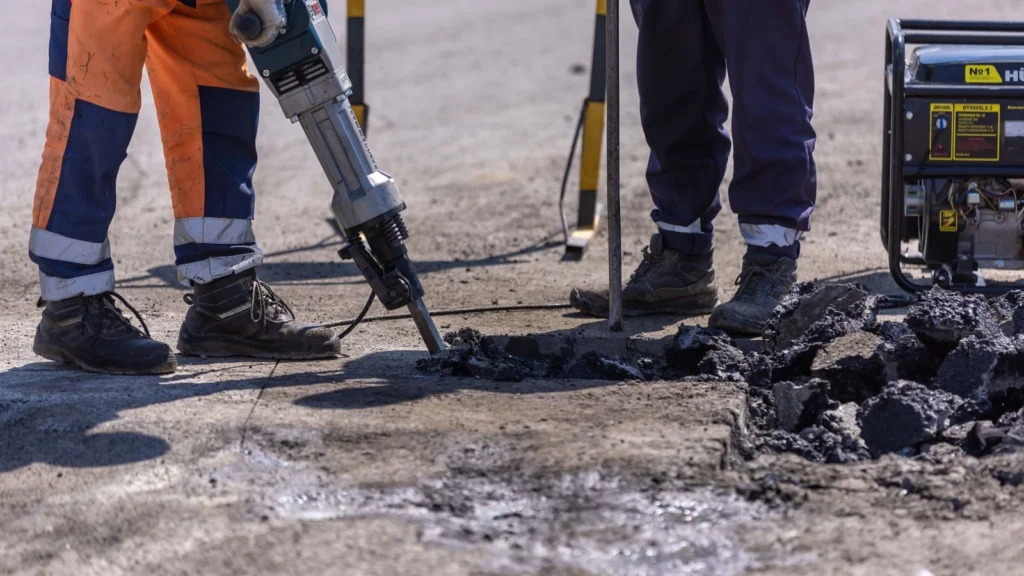
OSHA’s limit for construction work is an average of 90 dBA over an 8-hour day. NIOSH recommends a stricter 85 dBA, and says the safe time halves with every 3 dB above that. A jackhammer runs at roughly 102 to 111 dBA, so the safe time without protection is counted in minutes.
A simple rule: if you have to raise your voice to talk to someone at arm’s length, wear protection. Good ear muffs such as the 3M PELTOR X5A cost very little compared with a hearing aid.
3. Keep the dust down when cutting concrete
Cutting concrete, block or stone releases fine silica dust, which damages the lungs. OSHA’s silica rule for construction sets out how to control it. For handheld power saws, it calls for a saw with a built-in water feed that wets the blade continuously. A respirator is also required when you cut for more than four hours in a shift, or cut indoors.
In short: cut wet, stand upwind and wear a respirator for long or enclosed jobs.
4. Respect trenches
A trench can collapse without warning. OSHA’s excavation rules are short enough to remember.
- 5 feet or deeper: the trench needs a protective system, such as sloping, shoring or a trench shield.
- 4 feet or deeper: there must be a ladder or other safe way out within 25 feet of every worker.
- Keep spoil back: soil and equipment stay at least 2 feet from the edge.
- Inspect daily: a competent person checks the trench before each shift and after rain.
5. Use protected power
On construction sites, OSHA requires ground-fault protection for temporary 120-volt, 15 and 20 amp outlets. In practice that means GFCI outlets on the generator or GFCI cords. Use heavy outdoor-rated extension cords, and keep connections out of puddles.
Our equipment safety page has more day-to-day advice.
Maintenance: Keep It Earning
Construction is hard on engines. Dust, heat, long hours and rough handling all shorten their lives. A few habits make a big difference.
- Walk around it first. Check the oil, fuel, air filter, belts and guards before every shift.
- Go by the hour meter. Service by hours, not by the calendar. If a machine has no meter, add one.
- Clean the air filter often. Dust is the number one engine killer on a job site. Check filters daily in dry conditions.
- Change oil on time. Small air-cooled engines hold very little oil, so it wears out fast.
- Keep fuel clean. Use sealed cans, keep water and dirt out, and do not store gasoline for months.
- Let it cool before you shut it off. A minute or two at idle is kind to hot engines.
- Grease what moves. Heavy equipment has grease points that need attention every day.
Build a schedule with our Maintenance Interval Generator. For small gasoline engines see the small engine maintenance schedule, and for diesel machines the diesel engine maintenance schedule.
Common Construction Equipment Mistakes (and the Fix)
Pro Tips From the Job Site
- Label every machine with its oil type and service hours. Whoever picks it up next will know what it needs.
- Carry spares for the small stuff. A spark plug, a pull cord, a drive belt and an air filter end most breakdowns in ten minutes.
- Use fresh fuel. Buy gasoline for the week, not the season, and mark 2-stroke mix clearly.
- Match the hose to the pump. A hose that is too narrow or too long can halve the flow.
- Put the generator downwind and run cords to the work, not the other way round.
- Take photos when you rent. Record dents, hours and fuel level before the machine leaves the yard.
- Ask the rental yard to show you the controls. Ten minutes of instruction prevents most accidents.
Real-Life Scenarios: Rent, Buy or Both?
These are typical situations that owners and small contractors describe in forums. They are examples to help you decide, not quotes from real people.
🏡 The weekend patio builder
You are laying one paver patio and will not need a compactor again for years.
Buying makes no sense for a single job.
Best move: rent the compactor
🔨 The framing crew
You nail every day, often before the power is connected.
You need air on site from the first morning, with no outlet to rely on.
Best move: own a gas compressor
🚜 The small landscaper
You dig a few trenches a month and lay bases every week.
The excavator sits idle most days, but the compactor never stops.
Best move: rent the excavator, own the compactor
Construction Equipment: FAQ
What are the main types of construction equipment?
There are two families. Heavy equipment includes excavators, skid steer loaders, backhoes, bulldozers, wheel loaders and telehandlers. Compact equipment includes plate compactors, rammers, generators, air compressors, pumps, concrete saws and pressure washers.
Is construction equipment gas or diesel?
Heavy machines are almost always diesel, because diesel engines pull harder at low speed and use less fuel under heavy load. Compact tools usually run on small gasoline engines, which are lighter and cost less.
Is it better to rent or buy construction equipment?
Rent machines you use only now and then, especially heavy equipment that needs a trailer and regular servicing. Buy the compact tools you use every week, such as a compactor, generator, compressor or pump.
What size generator do I need for a job site?
Add the running watts of the tools that will run together, then add the largest starting surge. A circular saw needs about 2,400 to 3,600 watts to start, and a 2-horsepower compressor about 7,500. Job-site generators should also have GFCI protection.
Can I use a gas-powered tool indoors if the doors are open?
No. NIOSH warns that small gasoline engines can cause carbon monoxide poisoning even in spaces that seem well ventilated. In one test, carbon monoxide reached NIOSH's ceiling limit within three minutes in a garage with the doors open.
How deep can a trench be before it needs protection?
OSHA requires a protective system, such as sloping, shoring or a trench shield, for trenches 5 feet or deeper. Trenches 4 feet or deeper also need a ladder or other safe exit within 25 feet of workers.
Your Construction Equipment Checklist
- List the tasks: digging, moving, compacting, cutting, pumping, powering.
- Decide which machines you will use weekly and which only now and then.
- Rent heavy equipment and anything specialised.
- Size the generator for running watts plus the largest starting surge.
- Choose GFCI-protected power and outdoor-rated cords.
- Keep every gasoline engine outdoors.
- Buy hearing protection, eye protection and a respirator before the first cut.
- Plan trench protection before anyone gets in.
- Set a service schedule based on hours, and check air filters daily.
The bottom line
Rent the big machines and own the compact ones you use every week. Size your power properly, keep gasoline engines outside and look after the air filters. Do those things and your equipment will keep earning for years.
As an Amazon Associate we earn from qualifying purchases.
Sources: OSHA construction standards for noise, excavations, silica and electrical safety (29 CFR 1926); the NIOSH alert on carbon monoxide from small gasoline-powered engines; NIOSH guidance on noise exposure; Champion Power Equipment’s generator wattage chart; Amazon listings for the products named in this guide. All checked October 2026.