For a workshop that runs a generator a few hours a month, a gasoline or dual-fuel model is the right buy. For a shop that runs one for hours every working day, a diesel pays for itself in fuel and lasts longer. The line between them is not horsepower or brand. It is how many hours a year the machine will work.
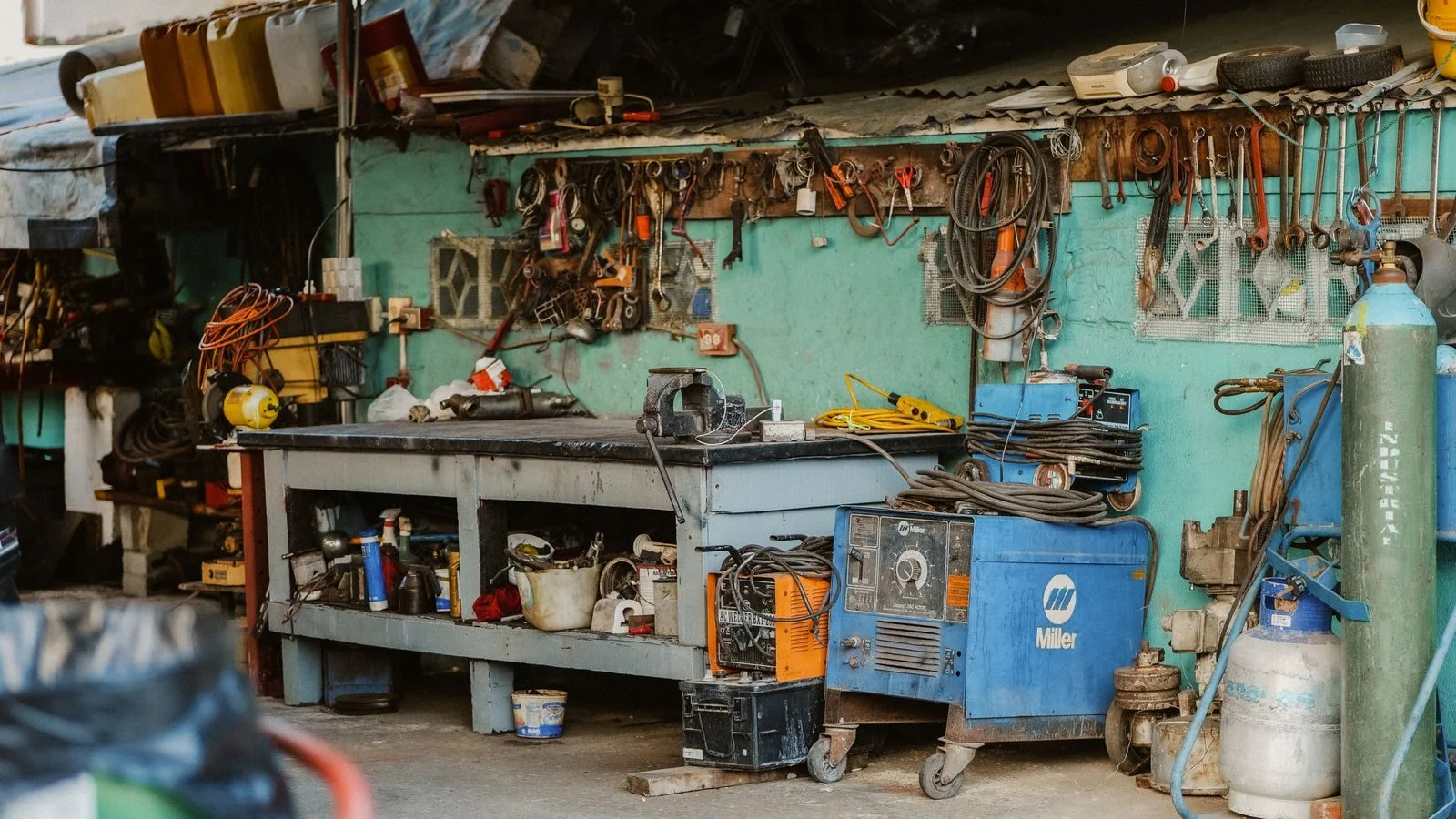
A workshop is not a house. At home, a generator waits for a storm. In a shop, it may be the main power on a remote site, the backup for a paid job, or the only way to run a welder and a compressor at the end of a long driveway.
This guide helps you choose for the way a shop really uses power. You will compare fuel use with real numbers, size for motors that start hard, see what the rules say about keeping fuel in a workplace, and look at four generators that suit shop work. Figures come from current product listings, the U.S. Energy Information Administration and OSHA standards. We have not tested these generators.
Diesel vs gas for the workshop
Count the hours before you count the watts
Fuel energy figures are from the U.S. Energy Information Administration. Generator specs come from current Amazon listings, checked in October 2026.
Quick answer
Choose gasoline or dual fuel if the generator will run less than about 100 hours a year, must be moved often or has to start easily in the cold. Choose diesel if it will run several hundred hours a year, if you already keep diesel on site, or if you want one tank to last a full working day. Either way, size it for the starting watts of your biggest motor, give it a 240-volt outlet if your tools need one, and run it outdoors.
How we put this guide together
We have not tested these generators. Specifications come from each product’s current Amazon listing. Fuel energy content is from the U.S. Energy Information Administration. Tool wattages are typical figures from Champion Power Equipment’s chart. Fuel storage limits are quoted from OSHA standard 29 CFR 1910.106. The fuel-use arithmetic and the hours rule of thumb are our own, and we show the working. Local fire codes may be stricter than the federal rules.
In this guide
- Why a Workshop Is a Different Question
- Step 1: Count Your Run Hours
- Step 2: Compare the Fuel Use
- Step 3: Size It for Shop Tools
- Step 4: Think About the Fuel You Keep on Site
- Step 5: Noise, Exhaust and Where It Sits
- Step 6: Cold Starts and Upkeep
- Diesel vs Gas for a Workshop: The Full Comparison
- Four Generators for Shop Work
- Connecting a Generator to a Shop Panel
- Common Workshop Generator Mistakes (and the Fix)
- Pro Tips for Shop Owners
- Real-Life Scenarios: Which Shop Are You?
- Diesel vs Gas Generators for a Workshop: FAQ
- Your Workshop Generator Checklist
Why a Workshop Is a Different Question
Most generator advice is written for homeowners. Their generator sits for months, runs for a day or two, and powers a refrigerator and a furnace fan.
A shop asks for other things.
| Point | Home backup | Workshop |
|---|---|---|
| Hours of use | A few days a year | Can be hours every week, or every day |
| Type of load | Small motors, lights, electronics | Large motors, welders, compressors |
| Voltage | Mostly 120 volts | Often 240 volts as well |
| Fuel on hand | A few cans | May already have a diesel tank for trucks and equipment |
| Cost of failure | Discomfort | A stopped job and an idle crew |
| Rules | Local fire code | Local fire code, plus workplace safety rules if you have employees |
Those differences change the answer. Our general diesel vs gas generators comparison covers the basics. This guide is about the shop.
Key insight: a generator that runs 20 hours a year should be cheap to buy. A generator that runs 1,000 hours a year should be cheap to run. Know which one you are buying.
Step 1: Count Your Run Hours
Be honest about how often the generator will really run. A quick way is to think in hours per week and multiply by the weeks you work.
| Run hours per year | Typical shop | Usual best choice | Why |
|---|---|---|---|
| Under 100 | Grid-powered shop that needs outage backup | Gasoline or dual fuel | Low purchase cost matters most |
| 100 to 500 | Part-time mobile work, seasonal jobs | Either. Decide on fuel and loads | Fuel savings start to show |
| Over 500 | Off-grid shop, daily mobile welding or service work | Diesel | Fuel use and engine life matter most |
If you land in the middle band, the next three steps will settle it.
Step 2: Compare the Fuel Use
Diesel wins on fuel for two reasons. A gallon of diesel holds more energy, and a diesel engine turns more of that energy into work.
The energy. The U.S. Energy Information Administration lists diesel at 137,381 Btu per gallon and gasoline at 120,214. That is about 14% more in every gallon.
The real-world use. Here is a current diesel portable beside the typical figure for a gasoline unit of the same size.
| Fuel | Example | Fuel per hour at half load | Hours from 12 gallons |
|---|---|---|---|
| Diesel | Generac XD5000E | About 0.37 gallons | 32.4, as listed |
| Gasoline | Typical 5,000-watt open-frame unit | 0.6 to 0.75 gallons | About 16 to 20 |
The diesel figure is simple division: 12 gallons over 32.4 hours. On that basis the diesel uses roughly half the fuel.
What that means over a year
| Run hours per year | Diesel | Gasoline | Fuel saved with diesel |
|---|---|---|---|
| 50 | About 19 gallons | 30 to 38 gallons | 11 to 19 gallons |
| 250 | About 93 gallons | 150 to 188 gallons | 57 to 95 gallons |
| 1,000 | About 370 gallons | 600 to 750 gallons | 230 to 380 gallons |
At 50 hours a year the saving is small. At 1,000 hours a year it is a serious sum every single year.
A quick break-even check
You can do this for any two models you are comparing.
- Find the price difference between the diesel and the gasoline model.
- Find the fuel saved per hour from each model’s run-time figures at the same load.
- Multiply the fuel saved per hour by your fuel price to get the saving per hour.
- Divide the price difference by the saving per hour. The answer is the number of run hours it takes to break even.
- Compare that with your hours per year. If break-even is many years away, buy the gasoline model.
For more on fuel figures, see how much gas a generator uses.
Step 3: Size It for Shop Tools
Shop loads are hard on generators. An electric motor needs a short burst of extra power to get moving. That burst is called starting watts, and it can be two or three times the running figure.
| Tool | Running watts | Starting watts |
|---|---|---|
| Angle grinder, 4-1/2 inch | 900 to 1,800 | 1,800 to 3,600 |
| Circular saw, 7-1/4 inch | 1,200 to 1,800 | 2,400 to 3,600 |
| Table saw, 10 inch | 1,800 to 3,000 | 3,600 to 6,000 |
| Air compressor, 1 HP | 1,500 | 4,500 |
| Air compressor, 2 HP | 2,500 | 7,500 |
| Welder, 120 volt | 1,800 to 2,500 | 3,600 to 5,000 |
Look at the 2-horsepower compressor. It runs on 2,500 watts but can ask for 7,500 for a moment. A 5,000-watt generator will stall on it. This is the mistake that catches most shop owners.
How to size for a shop
- List the tools that run at the same time. Be realistic. One person uses one tool.
- Add up their running watts.
- Add the extra starting watts of the largest motor, which is usually the compressor.
- Add 20 percent so the generator is not at its limit all day.
- Check the voltage. Large compressors and welders often need 240 volts.
Our free Generator Size Calculator does the adding, and what size generator do I need explains the method.
Tip: stop the compressor from starting under load
Start the compressor first, before any other tool is running, and let it fill the tank. Then bring the other tools on. The generator only has to face that big starting surge when nothing else is drawing power.
A word on three-phase machines
Portable generators in this class make single-phase power. If your shop has three-phase machine tools, a standard portable will not run them directly. Ask an electrician about a three-phase generator or a converter before you buy anything.
Step 4: Think About the Fuel You Keep on Site
Fuel is where diesel has its biggest safety advantage, and where a shop has duties that a home does not.
Why diesel is easier to live with
Gasoline gives off vapor that can ignite at temperatures far below freezing. Diesel has to be warmed to roughly 125 °F before its vapor will ignite. That difference is why farms, fleets and job sites prefer to store diesel in quantity.
Diesel also keeps longer. Untreated gasoline can go stale within months. Diesel usually keeps for six to twelve months, and longer with treatment in a clean, cool tank. Our guide on how long gasoline lasts has the detail.
What the workplace rules say
If you have employees, OSHA’s flammable liquids standard applies to your shop. It sorts liquids into four categories by flash point, which is the temperature at which the vapor can ignite.
| Category | Flash point | Boiling point |
|---|---|---|
| 1 | Below 73.4 °F | At or below 95 °F |
| 2 | Below 73.4 °F | Above 95 °F |
| 3 | 73.4 °F to 140 °F | Not used |
| 4 | Above 140 °F, up to 199.4 °F | Not used |
Gasoline’s very low flash point places it in Category 1 or 2. Diesel, with a flash point around 125 °F or higher, normally falls in Category 3. The safety data sheet from your fuel supplier states the category for the exact product you buy.
The standard then limits how much may be kept in a work area outside a storage room or a storage cabinet.
| Where | Limit |
|---|---|
| In containers, outside a storage room or cabinet | 25 gallons of Category 1 liquids |
| In containers, outside a storage room or cabinet | 120 gallons of Category 2, 3 or 4 liquids |
| In one storage cabinet | 60 gallons of Category 1, 2 or 3 liquids, or 120 gallons of Category 4 |
The practical message is simple. Keep only the fuel you need, in approved containers, away from heat and sparks. If you need more than a few cans, buy a listed storage cabinet or talk to your fire marshal. Local fire codes apply to every shop, with or without employees, and they can be stricter.
Step 5: Noise, Exhaust and Where It Sits
A generator is loud, and it makes carbon monoxide. A shop adds two more worries: other people working nearby, and doors that are often open.
- Run it outdoors, always. Keep it at least 20 feet from doors, windows and vents, with the exhaust pointing away. A roll-up door that is open is still a door.
- Never run it inside the shop, even “just to finish this job.” Carbon monoxide cannot be seen or smelled.
- Expect diesel to be louder at this size. Small open-frame diesels have a hard, clattering sound.
- Look for a decibel figure. The Honda in our picks lists 73 dB(A) at 7 meters, which is about 23 feet.
- Protect hearing. Anyone working near a running generator all day should wear hearing protection.
Our generator safety tips cover placement and cords in detail.
Step 6: Cold Starts and Upkeep
In the cold, gasoline is easier. A gasoline generator needs the right oil and fresh fuel. A diesel may need winter-blend fuel, an anti-gel additive and a strong battery, because diesel fuel can gel and block the filter. If your shop is in a cold region, read cold-weather diesel starting before you choose diesel.
In upkeep, the two differ more than they cost.
| Item | Gasoline | Diesel |
|---|---|---|
| Spark plug | Check and replace | None |
| Carburetor | Gums up with old fuel | None on a direct-injection diesel |
| Fuel filter and water separator | Simple | Critical. Clean fuel is everything |
| Air filter | Important | Very important |
| Oil changes | By running hours | By running hours |
| Fuel in storage | Stabilize or drain | Keep clean and dry. Treat for long storage |
A shop that already services diesel trucks or tractors will find a diesel generator familiar. A shop that does not may prefer the simpler gasoline routine. The intervals are in our generator maintenance checklist and diesel engine maintenance schedule.
Diesel vs Gas for a Workshop: The Full Comparison
| Point | Diesel | Gasoline or dual fuel |
|---|---|---|
| Fuel per hour | About half, in our 5,000-watt example | Higher |
| Run time per tank | Very long | Shorter |
| Purchase price | Higher | Lower |
| Choice of models | Few portable models | Many, in every size |
| Weight | Heavy | Lighter |
| Fuel storage | Safer to keep in quantity | More restricted |
| Cold starting | Needs care | Easier |
| Noise at small sizes | Louder | Quieter, most of all with inverters |
| Second fuel option | No | Propane on dual-fuel models |
| Best for | Daily, long-hour work | Backup and occasional use |
Four Generators for Shop Work
These four cover the main choices. Each had an active Amazon listing with an Add to Cart button when we checked in October 2026.
The diesel choice
Generac XD5000E 5,000 Running Watt Diesel Portable Generator
A diesel portable built around an industrial Yanmar engine. Its 12-gallon tank is sized to run through a long working day and beyond.
- Running watts5,000 W
- Starting watts5,500 W
- EngineYanmar LW 435cc, air-cooled diesel
- Fuel tank12 gallons
- Run time32.4 hours at 50% load
- Power quality6% total harmonic distortion
- Why it works: it uses about 0.37 gallons an hour at half load, roughly half of what a typical gasoline unit of this size burns.
- Who it is best for: shops that run a generator for hours every working day, and shops that already keep diesel on site.
- What it solves: refueling stops. One tank can last several working days at a moderate load.
- Handy extras: a steel frame with a lifting eye, so it can be moved with a hoist or loader.
- Keep in mind: 5,500 starting watts will not start a 2 HP compressor. It is heavy, diesel needs care in the cold, and only seven were in stock when we checked.
As an Amazon Associate we earn from qualifying purchases. Specs come from the Amazon listing, checked October 2026.
Gasoline, built for job sites
Honda EB10000 10,000 Watt Industrial Portable Generator (EB10000AN)
A large gasoline generator aimed at contractors. It has full ground-fault protection and tight voltage control for tools.
- Output10,000 W
- Voltage120 and 240 V
- Noise73 dB(A) at 7 meters
- Fuel tank8.19 gallons
- Run time5.4 to 7.9 hours
- Voltage controlWithin 1%
- Why it works: Honda’s voltage regulator holds the output within 1%, which suits power tools and electronics.
- Who it is best for: contractors and mobile shops that need big, clean power and move the generator between sites.
- What it solves: job-site rules. The listing says its full GFCI protection makes it OSHA-compliant for job sites.
- Handy extras: electric start, a wheel kit and a carbon monoxide shutoff that Honda calls CO-MINDER.
- Keep in mind: it burns gasoline, and a tank lasts 5.4 to 7.9 hours, so a long day means refueling. Only eight were in stock when we checked.
As an Amazon Associate we earn from qualifying purchases. Specs come from the Amazon listing, checked October 2026.
Dual fuel for backup duty
Westinghouse WGen9500DFc Dual Fuel Portable Generator (12,500 Peak Watts)
A dual-fuel generator that runs on gasoline or propane. It suits a grid-powered shop that needs dependable backup.
- Gasoline9,500 running / 12,500 peak W
- Propane8,500 running / 11,200 peak W
- Engine457 cc
- Fuel tank6.6 gallons
- Run timeUp to 12 hours
- OutletsL14-30R and 14-50R, plus two GFCI
- Why it works: 12,500 peak watts on gasoline gives room for a compressor’s starting surge.
- Who it is best for: shops with utility power that want to keep working through an outage.
- What it solves: stale fuel. Propane does not go off in storage, so a backup machine is ready after months of waiting.
- Handy extras: remote start, low-oil and carbon monoxide shutdown, and a 3-year limited warranty.
- Keep in mind: output is lower on propane, and it is an open-frame generator, so it is not quiet.
As an Amazon Associate we earn from qualifying purchases. Specs come from the Amazon listing, checked October 2026.
Most power here
DuroMax XP13000HX 13,000-Watt Dual Fuel Portable Generator
A large dual-fuel generator with a 500 cc engine and a 50-amp outlet for feeding a shop panel through a proper hookup.
- Output13,000 W peak, 10,500 W running
- FuelsGasoline or propane
- Engine500 cc OHV
- StartPush button
- Outlets50 A, two 30 A, four 120 V GFCI
- Weight245 lb
- Why it works: the highest output of the four gives the most headroom for motors that start hard.
- Who it is best for: shops with a large compressor or several people working at once.
- What it solves: tripping and stalling when two big tools overlap.
- Handy extras: a carbon monoxide shutoff that DuroMax calls CO Alert, and windings the maker lists as all copper.
- Keep in mind: it weighs 245 pounds. More output also means more fuel burned, so it is a poor match for small loads.
As an Amazon Associate we earn from qualifying purchases. Specs come from the Amazon listing, checked October 2026.
For more models, see our portable generator reviews.
Connecting a Generator to a Shop Panel
Cords are fine for a few tools. To power the shop’s own circuits, you need a transfer switch or a listed interlock, installed by a licensed electrician.
Never plug a generator into a wall outlet. It can send power back into the utility lines and injure the people repairing them. Our guide on how to connect a generator to a building explains the safe methods, and the same rules apply to a shop.
Common Workshop Generator Mistakes (and the Fix)
Pro Tips for Shop Owners
- Use one fuel if you can. If the trucks run on diesel, a diesel generator means one tank and one delivery.
- Fit an hour meter if the generator does not have one. Service is due by hours, not by the calendar.
- Keep a spare set of filters on the shelf.
- Load it properly. A generator that idles all day at a tiny load wastes fuel.
- Give it a level pad and shelter from rain, open on all sides and away from the building.
- Log the fuel you add. It is the easiest way to learn your real cost per hour.
- Test backup units under load every month or two.
Setting up the rest of the shop? See our 60-gallon compressor guide for pro shops and the $5,000 home workshop plan.
Real-Life Scenarios: Which Shop Are You?
These are typical situations that shop owners describe in forums and reviews. They are examples to help you choose, not quotes from real people.
🔧 The grid-powered repair shop
The shop has utility power. Outages happen a few times a year and stop paid work.
You need backup that starts after months of waiting and can start a compressor.
Best fit: a large dual-fuel generator
🚚 The mobile service truck
You weld and run tools at customers’ sites four days a week.
You need long run times, low fuel use and an engine built for hours.
Best fit: a diesel generator
🌾 The off-grid farm shop
There is no utility line. Diesel is already delivered for the tractors.
You need one fuel, a long-running engine and safe bulk storage.
Best fit: a diesel generator sized for the biggest motor
Diesel vs Gas Generators for a Workshop: FAQ
Is a diesel or gas generator better for a workshop?
It depends on run hours. For under about 100 hours a year, a gasoline or dual-fuel generator is usually the better buy. For several hundred hours a year or more, a diesel uses far less fuel and is built for long running.
How much less fuel does a diesel generator use?
In our 5,000-watt example, the diesel uses about 0.37 gallons an hour at half load, while a typical gasoline unit uses 0.6 to 0.75. That is roughly half.
What size generator do I need to run an air compressor?
Size it for the starting watts. A typical 2 HP electric compressor runs on about 2,500 watts but can need about 7,500 watts for a moment when it starts.
Is it safer to store diesel than gasoline in a shop?
Yes. Diesel vapor needs to be warmed to roughly 125 °F to ignite, while gasoline vapor can ignite far below freezing. Workplace rules also set their tightest storage limits on the most volatile liquids.
Can I run a generator inside my workshop with the doors open?
No. Generators make carbon monoxide. Run them outdoors, at least 20 feet from doors, windows and vents.
Are there dual-fuel generators that run on diesel?
Portable dual-fuel generators normally run on gasoline and propane, not diesel. A diesel generator is a separate type with a different engine.
Your Workshop Generator Checklist
- Estimate your run hours per year.
- List the tools that run at the same time.
- Add the starting watts of the largest motor, then 20 percent.
- Check whether you need 240 volts.
- Compare fuel use at the same load.
- Work out the break-even hours for diesel.
- Decide where the fuel will be stored and check the rules.
- Pick an outdoor spot 20 feet from doors and windows.
- Plan for cold starts if you choose diesel.
- Use an electrician for any connection to the panel.
- Stock oil and filters for the first services.
- Test the generator under load before you depend on it.
The bottom line
Count the hours first. A shop that needs occasional backup should buy a gasoline or dual-fuel generator sized for its biggest motor. A shop that runs a generator every working day should buy a diesel and enjoy half the fuel bill. In both cases, keep the fuel stored safely and the generator outdoors.
As an Amazon Associate we earn from qualifying purchases.
Sources: U.S. Energy Information Administration, energy conversion factors; OSHA standard 29 CFR 1910.106, flammable liquids; Champion Power Equipment’s published wattage chart; current Amazon listings for the Generac, Honda, Westinghouse and DuroMax generators named in this guide. Fuel arithmetic is our own. All checked October 2026.