Portable gas generators are the most common backup power source in America, because gasoline is sold on almost every corner and gives an engine its full rated power. They are also the generators most likely to let their owners down. The reason is rarely the machine. It is the fuel.
Gasoline is a wonderful engine fuel and a poor storage fuel. It starts to break down within weeks. It leaves varnish in a carburetor. And after a hurricane or an ice storm, it can be the hardest thing in town to find.
This guide is about living with gasoline. You will learn how much a portable gas generator really burns, how to store fuel safely and keep it fresh, why fuel injection changes the picture, how to maintain and store the generator, and which models are worth a look. In this guide, “gas” means gasoline, not natural gas or propane. Facts come from the makers’ own manuals and pages and from US government sources. We have not tested these generators.
Portable gas generators at a glance
Full power from gasoline, as long as the gasoline is fresh
Figures come from maker manuals, Generac’s FAQ and the US Energy Information Administration.
Quick answer
A portable gas generator runs on regular unleaded gasoline of at least 87 octane with no more than 10% ethanol. A mid-size model uses roughly 0.4 to 0.8 gallons an hour at half load, so a three-day outage can take 30 to 55 gallons. Gasoline starts to deteriorate in about a month, so use a stabilizer, rotate your cans and run the carburetor dry before storage. Choose fuel injection if you want easier starts after long storage. Always run it outdoors, at least 20 feet from the house.
How we put this guide together
We have not tested these generators. Fuel and oil requirements come from Champion’s owner’s manual for its 3500-watt generator and from Generac’s portable generator FAQ. Fuel use figures are our arithmetic from makers’ published tank sizes and run times. Energy content is from the US Energy Information Administration. Safety guidance is from the US Consumer Product Safety Commission and Ready.gov. Product details come from makers’ pages and Amazon listings. All were checked in October 2026.
In this guide
- What Is a Portable Gas Generator?
- Why Choose Gasoline?
- How Much Gasoline Does a Portable Generator Use?
- The Right Gasoline
- Storing Gasoline Safely
- Carburetor or Fuel Injection?
- Starting and Running a Gas Generator
- Maintenance for a Gas Generator
- Storing the Generator
- Safety: Carbon Monoxide and Electricity
- Gasoline Only or Dual Fuel?
- Five Portable Gas Generators Worth a Look
- Common Mistakes With Portable Gas Generators (and the Fix)
- Pro Tips for Gasoline Owners
- Real-Life Scenarios: Is Gasoline Right for You?
- Portable Gas Generators: FAQ
- Your Portable Gas Generator Checklist
What Is a Portable Gas Generator?
A portable gas generator is a gasoline engine coupled to an alternator, mounted in a frame you can move. The engine burns gasoline and turns the alternator, and the alternator makes electricity.
They come in two main styles.
- Open-frame generators. The engine and alternator sit in a steel tube frame. They are loud and strong, and they give the most watts for the money. Sizes run from about 1,200 to 18,000 running watts.
- Inverter generators. The engine sits in a closed case, and the electricity is processed electronically. They are quiet, light and efficient at light loads. Most are between 1,000 and 4,000 running watts, with a few larger ones.
Both are sold in gasoline-only versions. Many are also sold as dual fuel models that can burn propane. This guide concentrates on running them on gasoline.
Why Choose Gasoline?
The case for gasoline
- It is everywhere. You can buy it at any filling station and carry it home in a can.
- It gives full power. A dual fuel generator makes about 10% less on propane. On gasoline you get the whole rating.
- It is energy dense. The US Energy Information Administration lists gasoline at about 120,200 Btu per gallon, against about 91,450 for propane. A gallon of gasoline holds roughly a third more energy.
- The generators cost less. Gasoline-only models are the cheapest way to buy a given wattage.
The case against
- It does not keep. Generac’s guidance says fuel begins to deteriorate within about one month.
- It gums up carburetors. Old fuel leaves deposits in tiny passages. This is the most common reason a generator will not start.
- It is hard to store in quantity. Gasoline is highly flammable, and fire codes limit how much you may keep.
- It can vanish in a disaster. Filling stations need electricity to pump, and those that have power sell out fast.
Key insight: a gasoline generator does not fail in the storm. It fails in the eleven months before the storm, sitting in a garage with old fuel in its carburetor. Fuel care is the whole job.
How Much Gasoline Does a Portable Generator Use?
Makers publish a tank size and a run time. Divide one by the other and you get gallons per hour. Here are worked figures for several real models.
| Generator | Running watts | Tank | Published run time | Gallons per hour |
|---|---|---|---|---|
| Generac GP2500i inverter | 2,200 | About 1 gal | 5.5 hours at 50% load | About 0.17 |
| Champion 3500W open frame | 3,500 | 4.7 gal | 12 hours at 50% load | About 0.39 |
| Generac GP5500E EFI | 5,500 | 5.4 gal | 10.5 hours at 50% load | About 0.51 |
| Generac GP8000E | 8,000 | 7.9 gal | 10 hours at 50% load | About 0.79 |
| Champion 9200W open frame | 9,200 | 7.7 gal | 10 hours at 50% load | About 0.77 |
The pattern is simple. At half load, a small inverter uses under a quarter of a gallon an hour. A mid-size generator uses around half a gallon. A large one uses about three quarters of a gallon.
What that means for an outage
| Generator class | Per hour | 24 hours | 3 days | 7 days |
|---|---|---|---|---|
| Small inverter, about 2,200 watts | 0.17 gal | About 4 gal | About 12 gal | About 29 gal |
| Mid-size, about 3,500 watts | 0.39 gal | About 9 gal | About 28 gal | About 66 gal |
| Mid-size, about 5,500 watts | 0.51 gal | About 12 gal | About 37 gal | About 86 gal |
| Large, 8,000 to 9,200 watts | 0.78 gal | About 19 gal | About 56 gal | About 131 gal |
Those are large numbers. Fifty-six gallons for three days is eleven 5-gallon cans. Very few households store that much, and in most places they should not.
How to use less
You do not have to run a generator around the clock. A refrigerator and a freezer hold their temperature for hours with the doors shut. Ready.gov says a refrigerator keeps food cold for about 4 hours and a full freezer for about 48 hours if you keep the doors closed.
- Run it in blocks. A few hours in the morning and a few in the evening keeps food cold and devices charged, and can cut fuel use by more than half.
- Run only what you need. Fuel use follows the load.
- Choose the right size. A big generator running a small load wastes fuel.
- Consider an inverter. It slows its engine when the load is light.
Our guide to how much gas a generator uses has more examples.
The Right Gasoline
Makers are specific about fuel, and their warranties depend on it. Champion’s manual for its 3500-watt generator sets out the rules clearly, and Generac’s guidance matches.
- Regular unleaded gasoline, clean and fresh.
- A minimum of 87 octane.
- No more than 10% ethanol. Champion’s manual says not to use E15 or E85.
- No oil mixed in. These are four-stroke engines.
Why ethanol matters
Almost all gasoline at the pump contains up to 10% ethanol, sold as E10. Champion’s manual explains the problem. Ethanol blends absorb more water than plain gasoline. Over time, the blend can separate and leave water, or a watery sludge, in the tank, the fuel valve and the carburetor.
Champion states that damage caused by fuel with more than 10% ethanol, by improperly stored gasoline or by the wrong stabilizer is not covered by its warranty.
Some stations sell ethanol-free gasoline, often marked for boats and small engines. It costs more and keeps better. It is a good choice for the fuel you store, if you can find it.
Storing Gasoline Safely
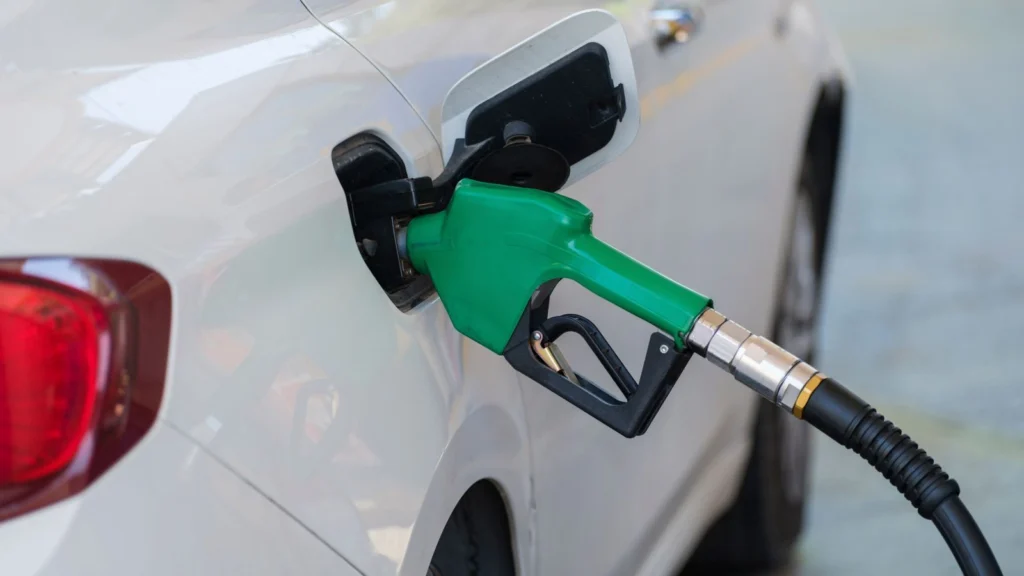
Gasoline vapor is heavier than air and catches fire very easily. Storage deserves care.
Gasoline storage rules
Store gasoline only in approved containers made for fuel. Keep them in a detached shed or a well-ventilated garage, never inside the home or in a basement, and away from water heaters, furnaces and anything else with a flame or a spark. Keep them out of reach of children and out of direct sun. Local fire codes limit how much gasoline you may keep at home, so ask your fire department. Refuel the generator outdoors with the engine off and cool. Ready.gov advises letting a generator cool before you refuel it.
Keeping it fresh
- Buy fuel from a busy station, so it is fresh when you get it.
- Add stabilizer on the day you buy it. Stabilizer protects fresh fuel. It cannot repair old fuel.
- Write the date on the can.
- Fill cans nearly full. Less air in the can means less moisture.
- Rotate every few months. Pour the stored gasoline into your car and refill the cans.
- Keep only what you will rotate. Fuel you forget about becomes a problem.
Generac says fuel begins to deteriorate within about one month. Champion’s manual says gasoline in the tank has a maximum shelf life of up to one year with a properly formulated stabilizer, stored in a cool, dry place. The maker of one popular stabilizer claims up to 24 months. Treat a year as the safe limit, and rotate sooner.
Our guide to how long gasoline lasts covers this in depth.
Carburetor or Fuel Injection?
Most portable gas generators have a carburetor. A growing number have electronic fuel injection, or EFI.
| Point | Carburetor | Electronic fuel injection |
|---|---|---|
| How it mixes fuel | Mechanically, through small jets | Electronically, with an injector and sensors |
| Starting | A choke, set by hand or automatically | No choke |
| After long storage | Jets can gum up | Much less prone to gumming |
| Altitude | May need a different jet | Adjusts itself |
| Fuel economy | Good | Better |
| Cost | Lower | Higher |
| Repair | Simple and cheap | Needs diagnostic steps |
Champion’s own figures give a neat example of the economy difference. Its 9,200-watt electric start generator is listed at 10 hours of run time at half load. The fuel-injected version of the same size, with the same 7.7-gallon tank, is listed at 11.5 hours. That is 15% longer on the same fuel.
For a generator that sits for months and then has to start first time, fuel injection is worth paying for. It does not make stale fuel good, so fuel care still applies.
Starting and Running a Gas Generator
Before you start
- Move it outdoors, at least 20 feet from the house, exhaust pointing away.
- Put it on level ground.
- Check the oil level.
- Check the fuel level and that the fuel is fresh.
- Unplug everything from the outlets.
- Have your cords ready and undamaged.
Starting
For a carbureted pull-start generator, the usual order is: fuel valve on, choke on, engine switch on, pull the cord, then ease the choke off as the engine warms. Let it run for a few minutes before you connect anything. Your manual has the exact steps.
Adding loads
Plug in the largest motor first and let it settle. Then add the next. Keep the total under the running watts. Champion’s manual says never to start or stop the generator with devices plugged in.
Refueling
Stop the engine and let it cool before you refuel. Gasoline spilled on a hot muffler can ignite. Do not overfill. Champion’s manual says to leave at least a quarter of an inch for expansion.
Stopping
Unplug the loads, let the engine run with no load for a few minutes, then switch it off. Champion recommends shutting off the fuel valve and letting the engine run until it stops after each use. That empties the carburetor.
Maintenance for a Gas Generator
Small gasoline engines need more frequent care than a car engine, because they hold very little oil and work hard.
| Task | Champion 3500W manual | Generac portable FAQ |
|---|---|---|
| First oil change | After 5 hours | After 20 to 30 hours |
| Later oil changes | Every 100 hours or yearly | Every 100 hours |
| Check oil level | Every 8 hours or each use | See the manual |
| Air filter | Clean every 50 hours or yearly | See the manual |
| Spark plug | Clean and adjust every 100 hours or yearly | See the manual |
| Spark arrestor | Clean every 100 hours or yearly | See the manual |
Oil by temperature
Generac’s FAQ gives a simple guide. Above 32°F, use SAE 30. Below 40°F and down to minus 10°F, use 10W-30. Synthetic 5W-30 is listed for all temperatures. Champion recommends 10W-30 as its general grade. Use what your manual says.
Breaking in a new engine
Champion’s manual says to keep the load at or below half the running watts for the first 5 hours, to vary the load, and then to change the oil. That first oil change removes the fine metal particles a new engine sheds.
Our generator maintenance checklist covers the full routine.
Storing the Generator
This is where most gasoline generators are damaged. Champion’s manual gives three cases.
| Storage time | What to do |
|---|---|
| Up to 30 days | Close the fuel valve and run the engine until it stops |
| 30 days to 1 year | Add stabilizer, run for 10 minutes, then drain the carburetor or run it dry. Add a tablespoon of oil to the cylinder and pull the cord slowly |
| More than 1 year | Drain the tank and the carburetor completely |
Generac’s advice is similar: for storage of more than 30 days, drain the fuel and run the carburetor dry, or add stabilizer from the start.
Store the generator clean and dry, in a place that does not share air with your living space, and with the fuel valve off. Our guide to how to store a generator has the full steps.
Safety: Carbon Monoxide and Electricity
The two dangers that kill
Carbon monoxide. The US Consumer Product Safety Commission reports that about 100 people die each year in the United States from carbon monoxide from portable generators. Run a generator outdoors only, at least 20 feet from the house, never in a garage, porch or carport. Fit battery-powered carbon monoxide alarms on every level of your home. Backfeed. Never plug a generator into a wall outlet. It sends power into the utility lines and can kill a line worker. To power house circuits, have a licensed electrician fit a transfer switch or an interlock.
Modern generators have a carbon monoxide sensor that shuts the engine off if the gas builds up. It is a backup. It does not make it safe to run a generator in an enclosed or partly enclosed space.
Keep the generator dry. If you must run it in rain or snow, use a cover made for running generators, in the open air. Our generator safety tips cover the rest.
Gasoline Only or Dual Fuel?
Many buyers now face this choice, because dual fuel models cost only a little more.
| Point | Gasoline only | Dual fuel |
|---|---|---|
| Price | Lower | A little higher |
| Power | Full rating | Full on gasoline, about 10% less on propane |
| Fuel storage | Gasoline goes stale | Propane keeps for years |
| After a disaster | Depends on filling stations | A second fuel to fall back on |
| Carburetor trouble | Likely if fuel care is neglected | Avoided when you run on propane |
| Simplicity | One fuel system | A selector and a regulator hose |
Choose gasoline only if you use the generator often, such as on job sites, so the fuel never sits. Choose dual fuel if the generator mostly waits for emergencies. Our guide to dual fuel generators explains the trade-offs.
Five Portable Gas Generators Worth a Look
We have not tested these generators. Details come from the makers’ pages and the Amazon listings, and stock changes quickly.
Light and simple
WEN 56235i Super Quiet 2,350-Watt Portable Inverter Generator
A 39-pound gasoline inverter. The listing gives 1,900 rated watts and a fuel shutoff that lets the engine use up the fuel in the carburetor before it stops.
- Rated watts1,900 W
- Surge watts2,350 W
- Weight39 lb
- OutletsTwo 120 V, one 12 V DC, two USB
- Fuel shut-offYes
- Warranty2-year
- Why it works: the fuel shutoff empties the carburetor for you, which is the single best habit for a gasoline generator.
- Who it is best for: campers and homes that only need a refrigerator, lights and chargers.
- What it solves: weight, noise and gummed carburetors in one small package.
- Keep in mind: it is a 120-volt generator of modest size. It will not run a well pump, a large microwave with other loads, or an air conditioner.
As an Amazon Associate we earn from qualifying purchases. Details come from the Amazon listing, checked October 2026.
Fuel injected
Generac GP5500E Portable Generator with EFI and Electric Start (6,875 Starting Watts)
A mid-size open-frame generator with electronic fuel injection. There is no carburetor to gum up and no choke to set.
- Running / starting watts5,500 / 6,875
- Engine298 cc OHV with EFI
- StartElectric, battery included
- Run timeUp to 11 hours at 50% load
- SafetyCOsense shutdown, low-oil shutdown
- Weight163 lb on the listing
- Why it works: fuel injection deals with the main weakness of a gasoline generator, which is starting after months in storage.
- Who it is best for: homeowners who use a generator a few times a year and want it to start first time.
- What it solves: a refrigerator, a furnace, lights and a 1/2 hp well pump, with easier ownership.
- Keep in mind: keep the battery charged, because the electric start depends on it. It is an open-frame unit, so it is loud. Shipping took a few days when we checked.
As an Amazon Associate we earn from qualifying purchases. Specs come from Generac’s product page and the Amazon listing, checked October 2026.
Work and home
Generac GP8000E Portable Generator with Electric Start (10,000 Starting Watts)
A large carbureted gasoline generator with a 7.9-gallon tank. The listing gives 8,000 running watts and up to 10 hours at half load.
- Running / starting watts8,000 / 10,000
- Engine420 cc OHV
- Fuel tank7.9 gallons
- Run timeUp to 10 hours at 50% load
- OutletsTwo 20 A GFCI duplex, one 30 A L14-30R
- Warranty on listing3-year residential
- Why it works: a big tank and a 240-volt outlet suit both a transfer switch at home and tools on site.
- Who it is best for: owners who use a generator regularly, so the fuel stays fresh.
- What it solves: essentials plus a well pump and kitchen loads.
- Keep in mind: at half load it uses about 0.8 gallon an hour, or around 19 gallons a day if run nonstop. Plan your fuel. It weighs about 198 pounds.
As an Amazon Associate we earn from qualifying purchases. Specs come from Generac’s product page and the Amazon listing, checked October 2026.
Large home backup
Champion 11,500-Watt Electric Start Portable Generator
A large gasoline-only Champion. By Champion’s naming, it makes 9,200 running watts and 11,500 starting watts.
- Starting watts11,500 W
- Running watts9,200 W
- Engine459 cc
- Run timeUp to 10 hours
- Noise level74 dBA from 23 ft
- Weight203 lb
- Why it works: it is the simplest way to get more than 9,000 running watts, with one fuel system and electric start.
- Who it is best for: larger homes with a 50-amp transfer switch, where gasoline supply is dependable.
- What it solves: most household essentials at once.
- Keep in mind: it is loud and heavy, and it uses about 0.77 gallon an hour at half load. The dual fuel version adds propane for a small extra cost. Shipping took a few days when we checked.
As an Amazon Associate we earn from qualifying purchases. Details come from the Amazon listing, checked October 2026.
The essential extra
STA-BIL Storage Fuel Stabilizer, 32 oz
A stabilizer for stored gasoline. The maker says it keeps fuel fresh for up to 24 months, at one ounce to 2.5 gallons.
- Size32 fluid ounces
- Dose1 oz per 2.5 gallons
- Maker’s claimFresh for up to 24 months
- TreatsUp to 80 gallons
- FuelsEthanol blends and non-ethanol gasoline
- After addingRun the engine for 5 minutes
- Why it works: it slows the breakdown that begins within about a month.
- Who it is best for: every owner of a gasoline generator.
- What it solves: stale fuel, the cause of most no-start complaints and of damage that warranties exclude.
- Keep in mind: add it to fresh fuel on the day you buy it. It cannot restore old gasoline. The 24-month figure is the maker’s claim, and makers of generators advise a shorter limit.
As an Amazon Associate we earn from qualifying purchases. Details come from the Amazon listing, checked October 2026.
For more models, see our portable generator reviews and our guide to the best portable generators. For Champion’s gasoline range, see portable gas Champion generators.
Common Mistakes With Portable Gas Generators (and the Fix)
Pro Tips for Gasoline Owners
- Test it every month or two. Twenty minutes with a real load keeps the carburetor clear.
- Fill up before the storm. Buy fuel when a storm is forecast, not after it lands.
- Keep your car’s tank full in storm season. It is your reserve.
- Buy the same fuel for all your small engines, so the cans get used.
- Keep a spare spark plug, oil and a funnel with the generator.
- Use the hour meter to time oil changes.
- Think about ethanol-free fuel for the gasoline you store.
Real-Life Scenarios: Is Gasoline Right for You?
These are typical situations. They are examples, not reports from real customers.
🔨 The contractor
The generator runs most weekdays on site.
Fuel never has time to go stale. A gasoline-only open-frame model is the simplest and cheapest choice.
Verdict: gasoline only
🏡 The storm-season homeowner
The generator runs twice a year, in outages.
Fuel care is the risk. Choose fuel injection or dual fuel, and stabilize and rotate what you store.
Verdict: EFI or dual fuel
🏕️ The weekend camper
You need quiet power for a few hours at a time.
A small gasoline inverter sips fuel. Empty the carburetor after each trip.
Verdict: gasoline inverter
Portable Gas Generators: FAQ
What kind of gas does a portable generator use?
Regular unleaded gasoline with a minimum of 87 octane and no more than 10% ethanol, according to Champion's and Generac's guidance. Do not use E15 or E85, and do not mix oil into the fuel on a four-stroke generator.
How much gas does a portable generator use per hour?
At half load, a small inverter uses about 0.17 gallon an hour, a 3,500-watt generator about 0.4, a 5,500-watt generator about 0.5 and an 8,000 to 9,200-watt generator about 0.8. These are worked out from makers' tank sizes and run times.
How long can gasoline sit in a generator?
Generac says fuel begins to deteriorate within about one month. Champion's manual says gasoline can gum up the carburetor if it sits for more than about four weeks. With a proper stabilizer, Champion gives a maximum shelf life of up to one year.
Is a fuel-injected generator worth it?
For a generator that sits for months, yes. Fuel injection has no carburetor jets to gum up and no choke, and it uses less fuel. Champion lists 11.5 hours for its fuel-injected 9,200-watt model against 10 hours for the carbureted one.
How much gasoline can I store at home?
Local fire codes set the limit, and it varies. Ask your fire department. Whatever the limit, use approved containers, and keep them in a detached shed or ventilated garage, away from flames and sparks.
Can I run a gas generator in the rain?
Not unprotected. Makers say to keep generators dry. Use a cover designed for running generators, in the open air. Never move a generator into a garage or under a carport to keep it dry.
Your Portable Gas Generator Checklist
- Use fresh 87 octane gasoline with 10% ethanol or less.
- Add stabilizer on the day you buy fuel.
- Date your cans and rotate them every few months.
- Store fuel in approved containers, away from the house and ignition sources.
- Work out your gallons per day before storm season.
- Check the oil before every use.
- Start with nothing plugged in.
- Refuel only when the engine is off and cool.
- Close the fuel valve and run the carburetor dry after use.
- Change the oil on schedule.
- Run it outdoors only, 20 feet from the house.
- Fit carbon monoxide alarms indoors.
The bottom line
A portable gas generator gives the most power for the least money, and gasoline is easy to buy. The cost is fuel care. Keep the gasoline fresh, keep the carburetor empty between uses, and it will start when you need it.
As an Amazon Associate we earn from qualifying purchases.
Sources: Champion Power Equipment owner’s manual and product pages for model 201286 and its 9,200-watt models; Generac’s portable generator FAQ and product pages; US Energy Information Administration for fuel energy content; US Consumer Product Safety Commission and Ready.gov for safety guidance; Amazon listings for the WEN 56235i, Generac GP5500E, Generac GP8000E, Champion 11,500-Watt generator and STA-BIL Storage. All checked October 2026.