A healthy modern diesel should produce almost no visible smoke once it is warm. When smoke appears, its color is a reliable first clue to what is going on inside the engine. Black, white and blue each point to a different group of causes, and a few quick checks usually narrow them down before any parts are bought.
Quick answer
Black smoke means too much fuel or too little air: think air filter, turbo or boost leak, injectors or EGR. White smoke means fuel that is not burning (cold start, faulty injectors, low compression, timing) or coolant entering the cylinders if it smells sweet and persists. Blue or gray smoke means engine oil is burning: worn valve seals or rings, a leaking turbo seal, an overfilled crankcase or a blocked crankcase breather.
| Smoke | Likely cause | First things to check |
|---|---|---|
| Black | Rich mixture: excess fuel or restricted air | Air filter, intake and boost hoses, turbo, injectors, EGR valve, engine load |
| White, thin, disappears when warm | Normal cold-start vapor | Nothing if it clears within minutes |
| White, persistent, raw fuel smell | Unburned fuel: injectors, timing, low compression, glow plugs | Glow plugs, injectors, fuel quality, compression test |
| White, sweet smell, coolant loss | Coolant in the cylinders: head gasket, cracked head or liner | Coolant level, overheating, oil condition, pressure test |
| Blue or gray | Burning engine oil | Oil level, crankcase breather, turbo seals, valve seals, rings |
In this guide
Black smoke
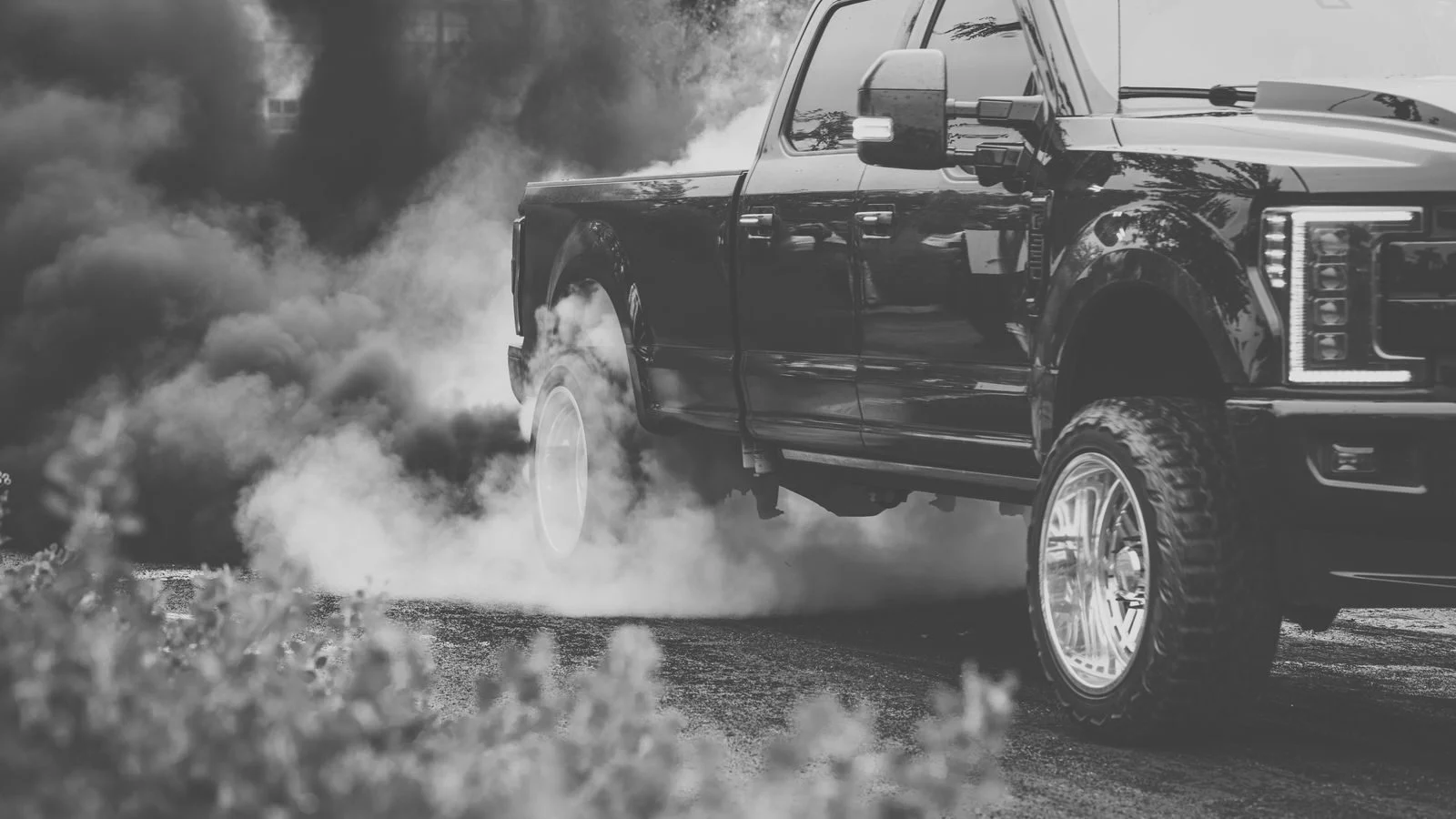
Black smoke is unburned carbon from fuel that did not get enough air, or had too much fuel to burn completely. A small puff from an older, non-emission diesel under hard acceleration is normal. Black smoke at steady speed, or thick clouds under load, is not.
Common causes
- Restricted air intake. A clogged air filter is the cheapest fix and the first check.
- Turbocharger or boost leak. A split intercooler hose, loose clamp or a worn turbo lets the engine run with less air than the fuel map expects. Listen for a whistle or hiss under load.
- Faulty injectors. Worn or stuck injectors deliver too much fuel or spray it badly.
- EGR valve stuck open. Exhaust gas displaces fresh air in the cylinder.
- Aggressive tuning or a lifted fuel setting on an older mechanical pump.
- Overloading. Towing or working beyond the engine’s rating on a machine without modern controls.
Black smoke wastes fuel and, on modern engines, quickly loads the particulate filter. On a vehicle with a check-engine light, read the codes first; boost pressure and EGR faults are usually logged.
White smoke
White smoke is either fuel vapor that never ignited, or water vapor from coolant. The smell tells them apart. Raw diesel smells of fuel and stings the eyes; coolant smells sweet.
Unburned fuel
- Cold starts. Thin white vapor for the first minute or two in cold weather is normal, especially on older engines.
- Glow plugs or intake heater not working. The engine starts hard, runs rough and smokes white until it warms up. See cold-weather diesel starting.
- Injectors or injection timing. Fuel delivered at the wrong moment or in the wrong pattern does not burn fully.
- Low compression. Worn rings, valves or a leaking head gasket mean the air never gets hot enough. The engine is usually hard to start and down on power.
- Water or gasoline in the diesel. Contaminated fuel burns poorly and can damage injectors.
Coolant
Persistent white smoke with a sweet smell, falling coolant level, bubbles in the coolant reservoir, overheating or milky oil points to coolant getting into the cylinders through a failed head gasket, a cracked head or, on some engines, a failed cylinder liner seal. This is serious. Stop running the engine and have it pressure-tested before the damage spreads.
Blue or gray smoke
Blue smoke is burning engine oil. It is often worst on startup after the engine has sat, or under deceleration, when vacuum in the intake pulls oil past worn seals.
- Overfilled crankcase. Check the dipstick first; too much oil gets thrown into the cylinders and the crankcase breather.
- Blocked crankcase ventilation. Pressure pushes oil past seals and into the intake.
- Turbocharger seals. Oil from a leaking turbo enters the intake or the exhaust. Oil pooled in the intercooler hoses is a giveaway.
- Valve stem seals or guides. Smoke on startup that clears quickly.
- Piston rings or cylinder wear. Continuous smoke, rising oil consumption and loss of compression.
Modern engines with a particulate filter
Engines fitted with a diesel particulate filter (DPF) should show no visible smoke at all. A faint puff during a regeneration cycle can be normal. Any sustained smoke on a DPF-equipped engine suggests either a problem upstream (such as an injector) or a damaged or removed filter, and it usually comes with warning lights. Do not ignore them; repeated regenerations and a filter that cannot clean itself lead to expensive repairs.
What to check first
- Note the color, when it happens (cold, warm, under load, idling) and the smell.
- Check the oil level and the coolant level.
- Inspect the air filter and all intake and boost hoses for damage and oil residue.
- Read any fault codes.
- Check for water in the fuel at the separator.
- If the engine is also hard to start, overheating or losing coolant, stop and get it looked at.
Keeping up with filters, oil and clean fuel prevents most of these problems. The diesel maintenance schedule covers the routine.
Frequently asked questions
Is a little black smoke from a diesel normal?
On older engines without modern emissions controls, a brief puff under hard acceleration or when a turbo is spooling is normal. Continuous black smoke, or any black smoke on a modern engine with a particulate filter, is not.
Why does my diesel smoke white on startup?
Cold cylinders do not get the air hot enough to burn all the fuel, so some leaves as vapor. If the smoke clears within a couple of minutes it is normal. If it continues, the glow plugs, injectors or compression are suspect.
Can bad fuel cause a diesel to smoke?
Yes. Water, gasoline contamination, very old fuel or biodiesel blends that have gone off can all cause white or black smoke and rough running. Drain the water separator, and if in doubt drain the tank and replace the fuel filter.