The Champion 42431 is an older small portable generator from Champion Power Equipment, part of the company’s 80 cc family that makes about 1,200 running watts. It is the kind of generator people buy for a campsite, a tailgate or a few lights in a power cut, and then keep for fifteen years.
If you are searching for this model number, you probably own one. Maybe it will not start. Maybe you lost the manual. Maybe you want to know whether it is worth fixing, or what you would buy today instead.
We have to be honest about the paperwork. We could not find a Champion manual or spec sheet for the 42431 itself. What we did find is this: parts sellers list the 42431 alongside the Champion 42436 as an 80 cc Champion generator, and Champion still publishes the 42436 owner’s manual. This guide uses that manual as the closest reference, and says so every time. Check the data label on your own generator before you rely on any figure here. We have not tested this generator.
Champion 42431 at a glance
A small 80 cc generator for lights, chargers and one small appliance
Figures are from Champion’s owner’s manual for the closely related model 42436. Check your own data label.
Quick answer
The Champion 42431 belongs to Champion’s 80 cc family of small portable generators. Its close relative, the 42436, is rated at 1,200 running watts and 1,500 starting watts, at 120 volts. That is enough for lights, phone and laptop chargers, a TV, a fan and one small appliance at a time. It is not enough for a well pump, an air conditioner or a whole house. Champion’s current model in this class is its 1200-watt generator, and small inverter generators are quieter, lighter alternatives.
How we put this guide together
We have not tested this generator, and we could not find official Champion documentation for model 42431. A parts listing names the C42431 with the 42436 as an 80 cc Champion generator, so we used Champion’s official owner’s manual for the 42436 for specifications, maintenance and troubleshooting. Figures for current Champion models come from Champion’s website, and product details come from Amazon listings. All were checked in October 2026. If your generator’s label or manual differs from this guide, follow the label and the manual.
In this guide
- What Is the Champion 42431?
- Specs of the 80 cc Champion Family
- What Can a 1,200-Watt Generator Run?
- Fuel and Oil
- Maintenance Schedule
- Troubleshooting an Older Champion Generator
- Parts and Support
- Repair It or Replace It?
- Modern Replacements for the Champion 42431
- Storing a Small Generator
- Common Mistakes With a Small Older Generator (and the Fix)
- Pro Tips for Owners
- Real-Life Scenarios: Keep It or Replace It?
- Champion 42431 FAQ
- Your Champion 42431 Checklist
What Is the Champion 42431?
Champion Power Equipment has made portable generators since 2003. In its early years its model numbers began with 4, such as 41533, 46561 and 42436. Later the company moved to six-digit numbers that begin with 1 or 2.
The 42431 comes from that earlier period. Sellers of replacement parts group it with the 42436 as an 80 cc Champion generator. The 42436 is a small, open-frame gasoline generator with a pull start and a single 120-volt outlet panel.
That is as much as we can say with confidence about the 42431 alone. For the rest of this guide, the numbers are those of the 42436, the sister model that Champion still documents.
How to identify your generator
Look for the data label on the frame or on the engine housing. It shows the model number, the serial number and the rated watts. Write them down, or take a photo. If the label says 42431, call Champion’s technical service line with the serial number. The line is listed in Champion’s manuals as 1-877-338-0999. They can tell you which manual and parts list apply.
Specs of the 80 cc Champion Family
| Spec | Champion 42436 | What it means for you |
|---|---|---|
| Running watts | 1,200 | The power it can supply all day |
| Starting watts | 1,500 | A short burst for starting a motor |
| Voltage | 120 volts, single phase, 60 Hz | Household outlets only. No 240-volt power |
| Engine | 80 cc, four-stroke, overhead valve | Runs on plain gasoline. No oil mixing |
| Start | Recoil | A pull cord |
| Fuel capacity | 1.2 gallons | A small tank for a small engine |
| Oil capacity | 0.4 quart | Very little, so check it often |
| Oil type | 10W-30 | The grade Champion recommends |
| Net weight | 52.9 lb | One person can lift it |
| Size | 17.8 x 14 x 14.8 inches | Length, width and height |
| Outlet | One 120-volt, 20-amp duplex | Shown in the manual’s parts list |
| Extras | Voltmeter, low-oil shutoff | A needle gauge on the panel |
A retailer’s page for the 42436 gives a run time of up to 10 hours at half load. We could not confirm that figure in the manual, so treat it as a guide.
Four-stroke, not two-stroke
This matters for fuel. Many small generators of this size from other brands are two-stroke machines that need oil mixed into the gasoline. The Champion 80 cc engine is a four-stroke. It has its own oil in the crankcase, and it runs on straight gasoline. Never add oil to the fuel.
What Can a 1,200-Watt Generator Run?
Twelve hundred running watts is about 10 amps at 120 volts. That is less than one household circuit. The generator can run several small things, or one medium-size thing, but not both together.
| Load | Typical watts | On a 1,200-watt generator? |
|---|---|---|
| LED light bulb | About 10 each | Yes, many |
| Phone charger | About 10 to 20 | Yes |
| Laptop | About 50 to 100 | Yes |
| Television | About 100 to 200 | Yes |
| Box fan | About 50 to 100 | Yes |
| Internet modem and router | About 20 to 50 | Yes |
| Refrigerator | 150 to 400 running, 800 to 1,200 to start | Often, if it runs alone when it starts |
| Coffee maker | About 1,000 | Yes, with almost nothing else on |
| Microwave | 600 to 1,200 | Only a small one, by itself |
| Sump pump, 1/2 hp | 800 to 1,050 running, 1,300 to 2,150 to start | Unlikely. The start is too much |
| Window air conditioner, 10,000 BTU | 900 to 1,200 running, 1,800 to 2,400 to start | No |
| Well pump | Needs 240 volts | No |
The starting surge is the catch
Anything with a motor needs extra power for a second or two as it starts. The generator has 1,500 starting watts in total. A refrigerator that needs 1,000 watts to start will usually get going if nothing else is drawing power at that moment. Add a television and a lamp, and it may not.
A simple routine helps. Plug in the refrigerator first and let it start. Then add the small loads. If the refrigerator’s compressor cycles on while a coffee maker is running, the generator will bog down or trip its breaker.
Key insight: a 1,200-watt generator is a one-big-thing generator. It runs the refrigerator, or the coffee maker, or the microwave. It does not run them together.
Our Generator Size Calculator adds up your own loads, and our guide to what size generator you need explains running and starting watts.
Fuel and Oil
Champion’s manual for the 42436 is specific.
- Gasoline. Regular unleaded with a minimum octane rating of 85, and an ethanol content of less than 10% by volume.
- Oil. 10W-30 automotive oil. The capacity is 0.4 quart, and the manual says in capital letters not to overfill.
- Checking the oil. Every 8 hours of running, or daily.
Four-tenths of a quart is not much. A small leak or a few long runs can take the level low enough to trip the low-oil shutoff. If your generator stops for no clear reason, or will not start, check the oil first. Make sure the generator is sitting level, because the sensor can also trip on a slope.
Ethanol and old fuel
Small carburetors have tiny passages. Gasoline left in the tank for months breaks down and leaves a sticky deposit that blocks them. This is the most common reason an older generator will not start. Our guide to how long gasoline lasts explains how to avoid it.
Maintenance Schedule
This schedule is from Champion’s manual for the 42436.
| When | What to do |
|---|---|
| Every 8 hours or daily | Check the oil level. Clean around the air intake and the muffler |
| After the first 5 hours | Change the oil |
| Every 50 hours or every season | Clean the air filter. Change the oil if working under heavy load or in heat |
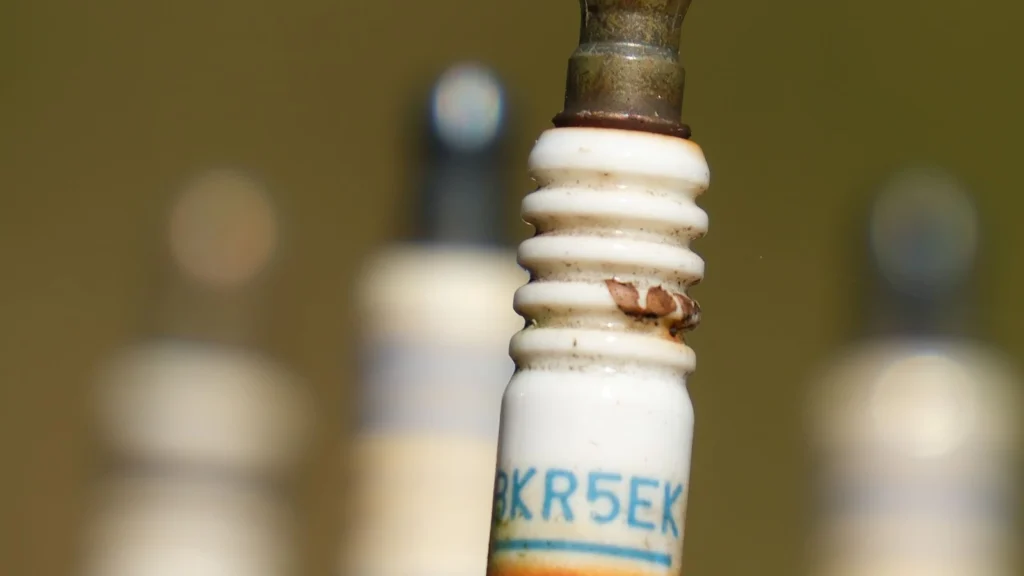
| Every 100 hours or every season | Change the oil. Clean and adjust the spark plug. Clean the spark arrester |
| Every 100 hours or every season, by an experienced owner or dealer | Check and adjust valve clearance. Clean the fuel tank and filter |
| Every 3 years | Replace the fuel line |
For a generator that is used a few weekends a year, “every season” is the interval that applies. Change the oil once a year even if it has only run for ten hours.
Cleaning
The manual says to wipe the outside with a damp cloth, brush away dirt and oil with a soft brush, and use low-pressure air to clear debris. It warns against spraying the engine with water, because water can get into the fuel system.
The spark arrester
The muffler has a small screen called a spark arrester, which stops hot particles from leaving the exhaust. It clogs with carbon over time, and a clogged screen makes the engine lose power. The manual’s steps are simple: let the engine cool fully, remove the two screws on the cover plate, take out the screen, clean it with a wire brush and replace it if it is damaged.
Our small engine maintenance schedule gives the general routine for engines of this size.
Troubleshooting an Older Champion Generator
Champion’s manual has a troubleshooting table. Here it is in plain English.
| Problem | Likely cause | What to do |
|---|---|---|
| Will not start | No fuel | Add fresh fuel |
| Will not start | Faulty spark plug | Replace the plug |
| Will not start | A load is plugged in | Unplug everything, then start |
| Will not start, or runs roughly | Low oil level | Fill to the proper level, on a flat surface |
| Will not start, or runs roughly | Choke in the wrong position | Adjust the choke |
| Will not start, or runs roughly | Spark plug wire loose | Push it back on |
| Shuts down while running | Out of fuel, or low oil | Refill. Check the oil on level ground |
| Not enough power, or overheating | Overloaded | Reduce the load |
| Not enough power, or overheating | Poor ventilation | Move it to an open, airy spot |
| No power at the outlet | Circuit breaker open | Reset the breaker |
| No power at the outlet | Bad cord or device | Try another cord or device |
| Engine speed surges up and down | Governor fault | Call Champion’s help line |
Two points from that table are worth repeating. First, start the generator with nothing plugged in. Second, the manual says the air and fuel mixture is not adjustable and that tampering with the governor can damage the generator and whatever is plugged into it.
If it has sat for years
A generator that has been in the shed since the last big storm usually has three problems at once: stale fuel, a gummed carburetor and old oil.
- Drain the old gasoline from the tank into an approved container and dispose of it properly.
- Drain and replace the oil with fresh 10W-30, to the correct level.
- Fit a new spark plug of the type listed in your manual.
- Clean or replace the air filter.
- Add a small amount of fresh gasoline and try to start it, outdoors.
- If it still will not run, the carburetor needs cleaning. This is a job for someone with small-engine experience, or a service shop.
Our generator won’t start checklist and small engine won’t start guide walk through each step.
Parts and Support
Champion’s manuals list a technical service line at 1-877-338-0999, on weekdays. The 42436 manual describes a 3-year limited warranty when new, which will have ended long ago on a generator of this age.
For parts, your model and serial numbers are the starting point. Champion’s support staff can tell you whether a part is still supplied. Common service items, such as spark plugs, air filters, fuel line and recoil starters, are also sold by aftermarket suppliers for the 80 cc engine. Match any part to your own model number, and be cautious with listings that claim to fit a long list of models.
Repair It or Replace It?
Small generators are cheap to buy, which changes the sums.
Worth doing: fresh fuel, an oil change, a spark plug, an air filter, a fuel line, a carburetor clean. These are low-cost jobs, and they fix most faults.
Think twice: a new carburetor fitted by a shop, a failed alternator or a seized engine. A shop’s labor on any of these can approach what a new small generator costs.
Also consider what you would gain. A generator of this age has no carbon monoxide shutoff. Current portable generators from the major brands have a sensor that stops the engine if carbon monoxide builds up around it. New small inverter generators are also quieter and lighter, and they make cleaner power for electronics.
An older generator has no CO shutoff
The Champion 42431 and 42436 were built before carbon monoxide sensors became standard. They will keep running in a dangerous spot. Run any generator outdoors only, never in a garage, shed, porch or carport. Safety agencies advise at least 20 feet from the house, with the exhaust pointing away from doors and windows. Champion’s own manual says the product must always be operated outdoors, in a well-ventilated area and away from doors, windows and other vents. Fit battery-powered carbon monoxide alarms indoors.
Modern Replacements for the Champion 42431
Champion still makes a generator in this class. Its website lists a 1200-watt generator, model 201285, with 1,500 starting watts, a 79 cc engine, a 1.46-gallon tank, up to 10 hours of run time at half load and a noise level of 65 dB(A).
If you are replacing a 42431, you also have a choice the original buyer did not: a small inverter generator. Here are four options we found for sale. We have not tested them. Details are from the sellers’ listings.
Step-up from Champion
Champion 2500-Watt Ultralight Portable Inverter Generator
A small Champion inverter that weighs less than the 42436 and makes half as much power again. The listing gives 1,850 running watts, 53 dBA and CO Shield.
- Running / starting watts1,850 / 2,500
- Weight39.7 lb
- Noise53 dBA
- Run timeUp to 11.5 hours at 25% load
- Outlets120 V duplex, 12 V DC
- SafetyCO Shield shutoff
- Why it works: an inverter makes clean power for electronics and slows the engine at light load, so it is quiet and frugal.
- Who it is best for: owners who want the same grab-and-go size with more power and less noise.
- What it solves: the starting-surge problem. With 2,500 starting watts, a refrigerator starts far more easily.
- Keep in mind: it costs more than a basic open-frame generator. It is still a 120-volt machine and will not run a well pump or central air.
As an Amazon Associate we earn from qualifying purchases. Details come from the Amazon listing, checked October 2026.
Same power, half the weight
A-iPower 1500-Watt Portable Inverter Generator
An inverter with almost the same ratings as the 42436. The listing gives 1,200 running watts, 1,500 starting watts, 60 dB and a weight of 28.5 pounds.
- Running / starting watts1,200 / 1,500
- Engine60 cc OHV
- Weight28.5 lb
- Noise60 dB
- Run time8 hours at 25% load
- Outlets120 V duplex, USB-A, USB-C
- Why it works: it matches the old Champion’s output in a package about half the weight, with clean power and USB ports.
- Who it is best for: campers and tailgaters who were happy with 1,200 watts.
- What it solves: carrying a 53-pound generator when a 28-pound one does the same job.
- Keep in mind: the tank holds about 0.7 gallon, so run time under heavy load is short. Only a few were in stock when we checked.
As an Amazon Associate we earn from qualifying purchases. Details come from the Amazon listing, checked October 2026.
Quiet and frugal
Westinghouse iGen1500c Portable Inverter Generator (1,500 Peak Watts)
A very quiet small inverter. The listing gives 1,000 rated watts, 1,500 peak watts, a noise level as low as 52 dBA and up to 12 hours on a 0.79-gallon tank.
- Rated / peak watts1,000 / 1,500
- WeightAbout 32 lb
- NoiseAs low as 52 dBA
- Run timeUp to 12 hours
- Power qualityUnder 3% THD
- Warranty on listing3-year limited
- Why it works: it is quiet enough for a campground and sips fuel at light load.
- Who it is best for: people who run lights, chargers, a TV and a fan, not appliances.
- What it solves: noise. An open-frame generator of this size is far louder.
- Keep in mind: its rated output is 1,000 watts, a little less than the 42436. It will not run a coffee maker and anything else together.
As an Amazon Associate we earn from qualifying purchases. Details come from the Amazon listing, checked October 2026.
No engine at all
Jackery Explorer 1000 v2 Portable Power Station
A battery power station, not a generator. The listing gives 1,500 watts of AC output, 1,070 watt-hours of storage and a weight of 23.8 pounds.
- AC output1,500 W, 3,000 W surge
- Capacity1,070 Wh
- BatteryLithium iron phosphate
- Weight23.8 lb
- Ports3 AC, 2 USB-C, 1 USB-A, DC car port
- ChargingFrom a wall outlet, car or solar panel
- Why it works: it has no engine, so it makes no exhaust and almost no noise. It can be used indoors.
- Who it is best for: apartments, short outages and anyone who cannot run an engine safely outdoors.
- What it solves: fuel storage, pull starts, oil changes and carbon monoxide risk, all at once.
- Keep in mind: when the battery is empty, it has to be recharged. At a steady 500 watts it lasts about two hours. It costs more than a small gasoline generator.
As an Amazon Associate we earn from qualifying purchases. Details come from the Amazon listing, checked October 2026.
How the options compare
| Model | Running watts | Weight | Type | CO shutoff |
|---|---|---|---|---|
| Champion 42436, sister to the 42431 | 1,200 | 52.9 lb | Open frame, gasoline | No |
| Champion 2500-Watt Ultralight | 1,850 | 39.7 lb | Inverter, gasoline | Yes |
| A-iPower 1500W inverter | 1,200 | 28.5 lb | Inverter, gasoline | CO sensor on the listing |
| Westinghouse iGen1500c | 1,000 | About 32 lb | Inverter, gasoline | See the listing |
| Jackery Explorer 1000 v2 | 1,500 from a battery | 23.8 lb | Battery power station | Not needed. No exhaust |
Our guides to Champion generators and the 1,500-watt generator class cover the wider range, and inverter vs conventional generators explains the difference between the two types.
Storing a Small Generator
Storage is where small generators are ruined. The fix takes ten minutes.
- For a few weeks: shut off the fuel valve, if your model has one, and let the engine run until it stops. That empties the carburetor.
- For a season: add fuel stabilizer to fresh gasoline, run the engine for several minutes, then drain the carburetor or run it dry.
- For a year or more: drain the tank and the carburetor completely.
- Always: store it in a cool, dry place, with the oil changed and the outside clean.
Our guide to how to store a generator has the full routine.
Common Mistakes With a Small Older Generator (and the Fix)
Pro Tips for Owners
- Watch the voltmeter. If the needle drops well below 120 volts, the generator is overloaded. Unplug something.
- Use a heavy cord. A thin, long extension cord wastes power that a small generator cannot spare.
- Run it for 20 minutes every month or two with a load, so the carburetor stays clear.
- Keep a spare spark plug and a pint of oil with the generator.
- Clean the spark arrester each season. It restores lost power.
- Use a surge protector for electronics. A basic open-frame generator does not make power as clean as an inverter’s.
- Write the model and serial number inside the fuel cap cover or on a tag, so you have them when you call for parts.
Real-Life Scenarios: Keep It or Replace It?
These are typical situations. They are examples to help you decide, not reports from real customers.
🏕️ The camping generator that still starts
It runs lights and charges phones at the cabin and has never let you down.
Keep it. Change the oil, fit a new plug and store it dry. Add a CO alarm in the cabin.
Verdict: keep it
🛠️ The one that sat for six years
The fuel smells like varnish and the cord is stiff.
Try fresh fuel, fresh oil and a new plug. If the carburetor needs a shop, weigh the bill against a new inverter.
Verdict: try the cheap fixes first
🏠 The home backup plan
You hope it will keep the refrigerator and the sump pump going.
It may start the fridge. It will not reliably start a sump pump. You need a larger generator.
Verdict: replace with more power
Champion 42431 FAQ
How many watts is a Champion 42431?
We could not find official figures for the 42431 itself. Parts sellers group it with the Champion 42436 as an 80 cc generator, and Champion's manual rates the 42436 at 1,200 running watts and 1,500 starting watts. Check the data label on your own generator.
What kind of oil does a small Champion 80 cc generator take?
Champion's manual for the 42436 specifies 10W-30 automotive oil, with a capacity of 0.4 quart. It is a four-stroke engine, so the oil goes in the crankcase and is never mixed with the gasoline.
Can a 1,200-watt generator run a refrigerator?
Often, yes, if the refrigerator is the only large load. A typical refrigerator needs 150 to 400 watts to run and 800 to 1,200 watts for a moment as it starts. Start the refrigerator first, then add small loads.
Why will my old Champion generator not start?
The usual causes are stale fuel, a low oil level, a worn spark plug or a load plugged in at start-up. Drain old gasoline, check the oil on level ground, fit a new plug and unplug everything before you pull the cord.
Can I still get parts for a Champion 42431?
Call Champion's technical service line with your model and serial numbers to ask. Service items for the 80 cc engine, such as spark plugs, air filters and recoil starters, are also sold by aftermarket suppliers.
What is the modern equivalent of the Champion 42431?
Champion's current 1200-watt generator, model 201285, has the same 1,200 running and 1,500 starting watts. Small inverter generators of 1,000 to 1,850 running watts are quieter, lighter alternatives.
Your Champion 42431 Checklist
- Find the data label and note the model and serial numbers.
- Call Champion’s service line if you need the correct manual.
- Use straight gasoline with less than 10% ethanol. Never mix in oil.
- Check the oil every 8 hours of running. Do not overfill.
- Start it with nothing plugged in.
- Add loads one at a time, largest first.
- Keep the total under 1,200 watts.
- Change the oil and clean the plug and spark arrester every season.
- Run the carburetor dry before storage.
- Run it outdoors only, 20 feet from the house.
- Fit carbon monoxide alarms indoors.
- Compare any large repair bill with the price of a new inverter.
The bottom line
The Champion 42431 is a simple, small generator that can still earn its keep for lights and chargers. Look after the fuel and the oil, never run it near the house, and when it needs more than a tune-up, a modern inverter is the better buy.
As an Amazon Associate we earn from qualifying purchases.
Sources: Champion Power Equipment owner’s manual for model 42436 (championpowerequipment.com); a parts listing that names the C42431 with the 42436 as an 80 cc Champion generator; retailer pages for the 42436; Champion’s product page for its 1200-watt generator, model 201285, and its wattage chart; Amazon listings for the Champion 2500-Watt Ultralight, A-iPower 1500W inverter, Westinghouse iGen1500c and Jackery Explorer 1000 v2. All checked October 2026.